
After the Red Sox’s short postseason run, it’s clear the team needs a No. 2 pitcher for their rotation. Domestically, the 2025-26 free-agent starting pitcher class is headlined by quality yet red-flag-laden pitchers, such as Zac Gallen (30), Dylan Cease (29), Michael King (30), and Framber Valdez (31). Gallen regressed in 2025, posting a 4.83 ERA and 21.5% strikeout rate, the highest of his career. Cease (forearm cramp) and King (knee inflammation and pinched nerve in his right hand shoulder) dealt with injuries and were sidelined at various points during the season. Valdez pitched a complete season, recording a 3.66 ERA and 23.3% strikeout rate across 192.0 innings pitched, but certain character issues make me question the idea of signing him to a long-term deal. All four pitchers will be on the wrong side of 30 come the start of the 2026 season, and Red Sox owner John Henry is notoriously apprehensive about dishing out long-term contracts to aging pitchers.
While last year’s Japanese starting pitcher market centered around Roki Sasaki, a larger group of players is expected to be posted in the 2025-26 offseason. Back in May, I wrote about the Red Sox pursuing slugger Munetaka Murakami and utility infielder/outfielder Kazuma Okamoto. Yes, the Red Sox also need a power hitter—this was brought to light following Roman Anthony’s oblique injury. There are so many ifs, ands, and buts surrounding Alex Bregman’s and (potentially) Trevor Story’s opt-outs, and the discussion about adding any infielder free agents should be put on hold until their respective decisions are announced.
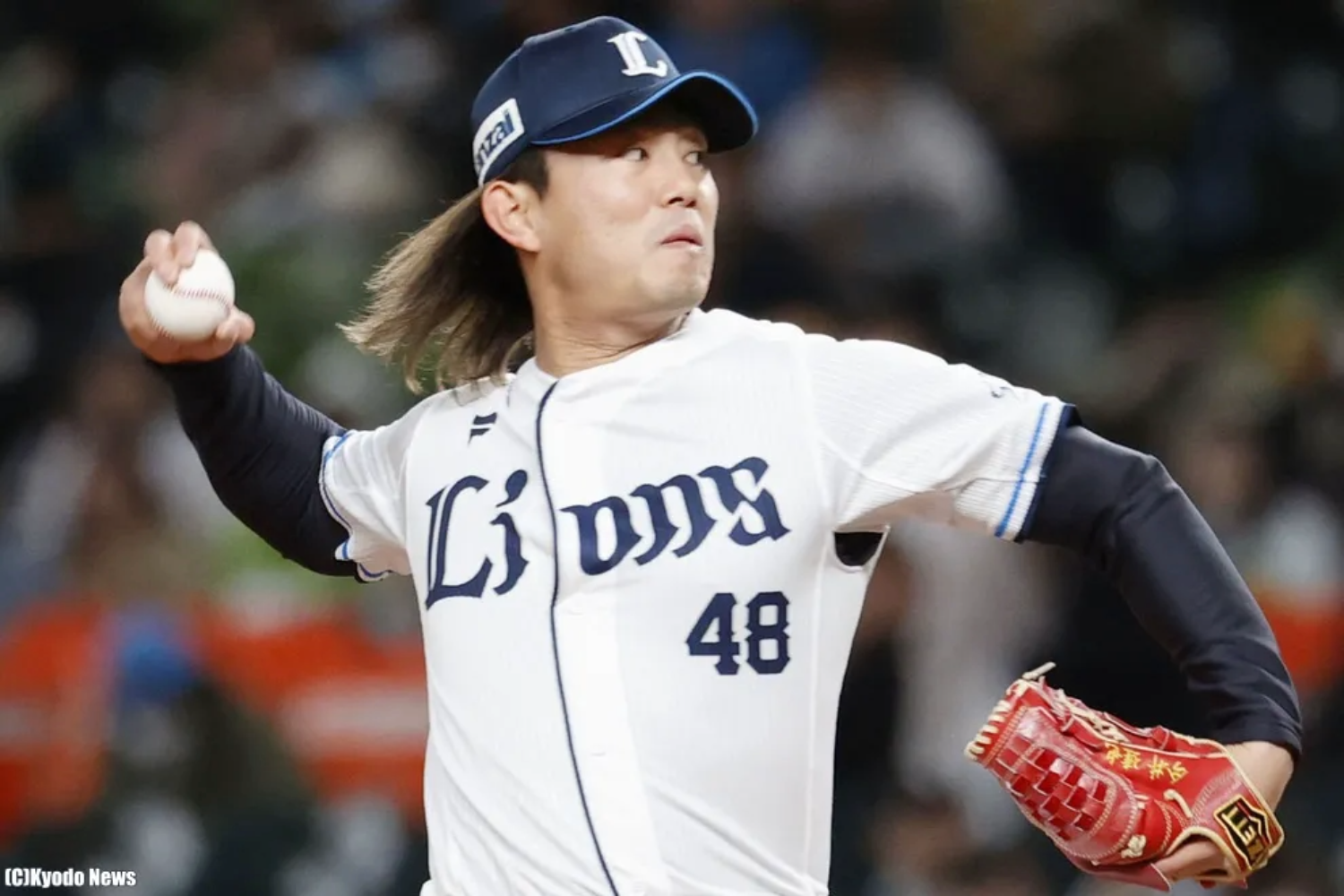
In the meantime, let’s turn our attention to potential additions to the Red Sox’s rotation. While Murakami and Okamoto are already garnering interest, there’s a third player who fans should start familiarizing themselves with ahead of the offseason: Tatsuya Imai, the best free-agent starting pitcher you might not know about.
Over the past seven years, more NPB pitchers (seven) have made the jump to MLB versus batters (three). Of the three batters, Shohei Ohtani and Seiya Suzuki posted respectable WARs in their rookie seasons. Ohtani is a unicorn, a first-ballot Hall of Famer, and the best baseball player that I’ll see in my lifetime. Suzuki is a criminally underrated player. His home run total jumped from 14 in his 2022 rookie season to 20 in 2023, then 21 in 2024, before breaking out in 2025 with 32 home runs and 103 RBIs.
This brings me to the third NPB batter who made the jump to MLB: Masataka Yoshida. Just mentioning Masataka Yoshida’s name prompts robust debate among Red Sox fans. Compared to Seiya Suzuki’s performance and similar contract, Yoshida is being overpaid, and his performance has not met the expectations of his five-year, $90 million contract. Yoshida is a one-dimensional player who’s limited defensively to left field and has primarily been used as a designated platoon hitter against right-handed pitchers. Yet, among batters with a minimum of 1,000 PAs since 2023, he’s recorded a 13.0% strikeout rate, ranked 12th, and a 16.5% whiff rate, ranked 21st. Moreover, Yoshida posted the Red Sox’s highest wRC+ (228) and WPA (0.28) in the 2025 postseason. Understandably, Red Sox ownership might be a little apprehensive about shelling out a projected $200+ million, long-term contract to another Japanese batter when they’re already tied to an underperforming, costly one. On the other hand, Tatsuya Imai could slot in as the team’s number two or three starter.
Japanese Batter Stats
NPB Team
Player
Age at MLB Debut
Initial MLB Contract Length & Value
Rookie Year fWAR
NPB wRC+
MLB wRC+
Total fWAR
Nippon-Ham Fighters
Shohei Ohtani
23
1-yr, $545k (2018)
2.7
N/A
156
36.0
Hiroshima Toyo Carp
Seiya Suzuki
27
5-yr, $85m (2022-26)
2.0
178
127
11.1
Orix Buffaloes
Masataka Yoshida
29
5-yr, $90m (2023-27)
0.7
181
109
1.5
Former NPB pitchers are gaining ground in MLB. Kodai Senga’s impressive 2.98 ERA in his 2022 debut season earned him a spot on the National League’s All-Star Game roster, a seventh-place finish in Cy Young Award voting, and second in Rookie of the Year voting. Despite his injury history in recent years, it’s a shame that the Mets, with their bloated payroll, were able to sign him to a five-year, $75 million steal of a contract. Two years later, Shota Imanaga, who signed a four-year, $53.25 million contract with the Cubs, followed suit and was named to the National League’s All-Star Game roster, finished fifth in Cy Young Award voting, and fourth in Rookie of the Year voting. That same offseason, Yoshinobu Yamamoto, who had never pitched in MLB beforehand, inked a 12-year, $325 million deal with the Dodgers, the largest contract ever for a pitcher.
Japanese Pitcher Stats
NPB Team
Player
Age at MLB Debut
Initial MLB Contract Length & Value
Rookie Year fWAR
NPB K-BB%
MLB K-BB%
Total fWAR
Hiroshima Toyo Carp
28
8-yr, $25m (2016-23)
2.9
15.0%
18.8%
15.0
Nippon-Ham Fighters
Shohei Ohtani
23
1-yr, $545k (2018)
1.1
19.4%
22.8%
13.7
Saitama Seibu Lions
28
3-yr, $43m, 2019-21, 2022 player option
0.2
17.3%
15.4%
10.2
Fukuoka SoftBank Hawks
Kodai Senga
30
5-year, $75 million (2023-27)
3.4
18.8%
15.6%
5.0
Yokohama DeNA BayStars
Shota Imanaga
30
4-yr, $53.25m (2024-25), 2026-27 player option, 2028 club option
3.1
18.5%
18.8%
4.0
Orix Buffaloes
Yoshinobu Yamamoto
25
12-yr, $325m, (2024-35)
2.9
20.0%
21.4%
7.9
Chibba Lotte Marines
*Roki Sasaki
23
1-yr, $760k (2025)
26.7%
3.7%
-0.1
Considering the immediate success of NPB pitchers in the majors, signing a pitcher like Tatsuya Imai represents a safer, more cost-effective solution compared to pursuing an NPB batter. Imai is a 27-year-old right-handed pitcher for the Seibu Lions. This offseason presents an opportune time for the Lions to post Imai, who just completed his eighth season in the Nippon League. NPB players waive international bonus pool money restrictions once they’re at least 25 years old and have played in a foreign league recognized by MLB for at least six seasons. Some reports have indicated that Imai’s contract could amount to $200 million. Unlike the Roki Sasaki sweepstakes, where he was limited to international bonus pool money restrictions, Imai’s market will be limited to teams with the resources and willingness to pay a sizable contract.
In the past, the Lions have been reluctant to post their pitchers, rejecting pitcher Kona Takashi’s request to be posted following the 2023 NPB season. The organization risks potentially letting Imai walk for free as a free agent after the 2026 season. When the Red Sox signed Masataka Yoshida, they paid a $15.375 million posting fee to the Buffaloes, calculated from his $90 million contract. Note: posting fees are not factored into CBT payroll. Likewise, it’s worth noting that Yoshida and Imai are represented by Scott Boras.
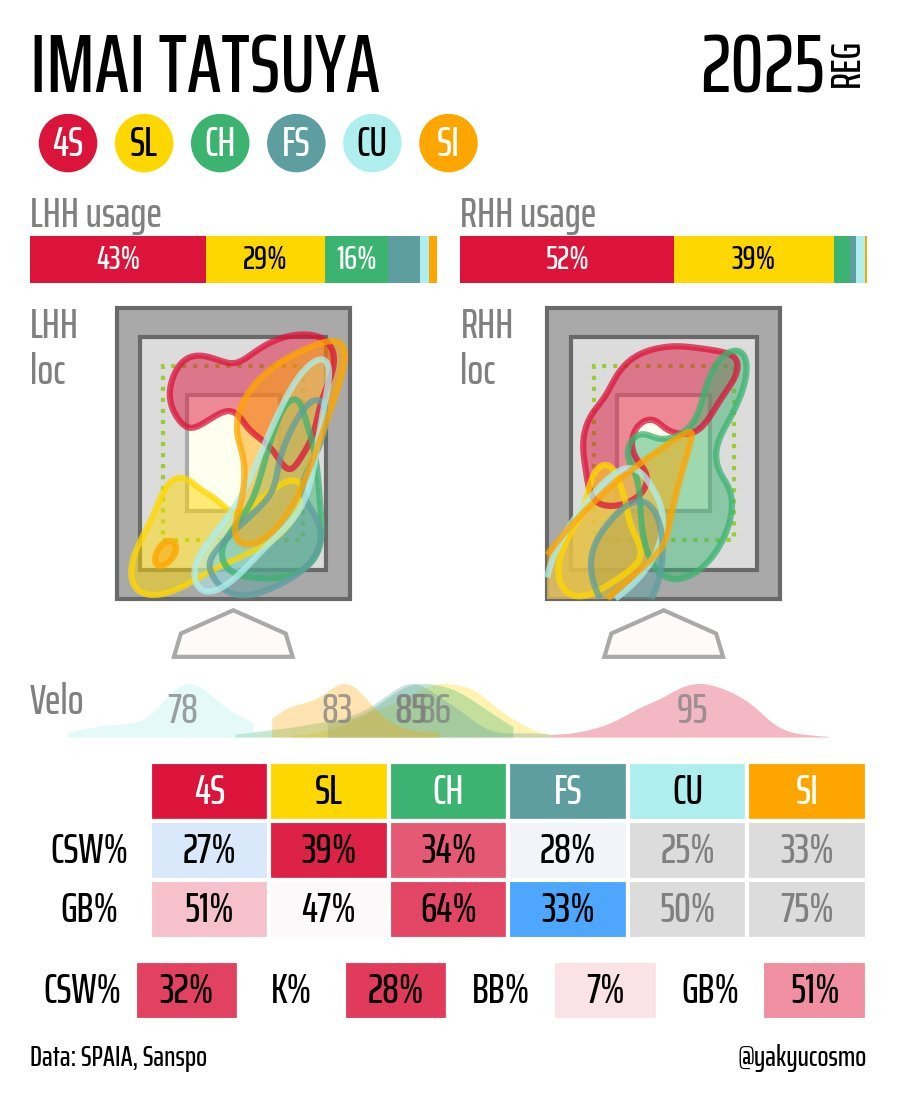
Imai had a breakout season in 2025, posting a career-high 27.8% strikeout rate (NPB average: 19.6% strikeout rate) across 163.7 IP. For reference, Yoshinobu Yamamoto recorded a 26.6% strikeout rate in his final NPB season (2023) with the Orix Buffaloes. Imai’s strikeout rate has trended positively through eight NPB seasons. He excels at limiting hard contact (16.5% hard hit rate) and preventing pitches from leaving the park (4.3% HR/FB). Imai’s 53.8% ground ball rate, combined with his overpowering arsenal, mirrors the formula of MLB’s elite starting pitchers, who blend high strikeouts with ground-ball tendencies.

Imai’s major-league-ready six-pitch mix consists of a four-seam fastball that averages 95 mph and occasionally hits 98-99 mph, a slider, a changeup, a splitter, a curveball, and a new sinker. Despite his four-seamer lacking carry and elite shape, he locates the pitch at the top of the zone to generate swings and misses. Imai pairs his fastball with his nasty slider that sits in the mid-80s. This combo works well against right-handed batters, but takes a hit against lefties. When facing lefties, he relies more on his off-speed pitches.
Around the horn, Japanese players have shone in the 2025 postseason. While Ohtani’s batting has been so-so, he racked up nine strikeouts with an absurd 34.8% K-BB% in his postseason pitching debut. Yoshinobu Yamamoto looked sharp against the Reds in Wild Card Round, and then authored a complete-game victory over the Brewers in the NLCS. In the other NLDS, Seiya Suzuki tied Jackson Chourio for the fastest pitch hit (101.4 mph) for a playoff HR in the pitch-tracking era. There’s no reason to believe Imai will falter in October.
The Red Sox’s 2026 starting pitching depth is deep. Fans witnessed some of the organization’s young arms receive a cup of coffee in the 2025 season. Pitching prospects are volatile, and I have no exception to trading unproven prospects for established major league talent. Signing Tatsuya Imai and then drawing from their surplus of young arms and trading for a major league starter like Joe Ryan, Sandy Alcantara, Hunter Greene, or even Tarik Skubal would allow the Red Sox to make a deeper run in the postseason. Imagine the following rotation:
SP1: Garrett Crochet
SP2: Sandy Alcantara/Joe Ryan/Tarik Skubal/Hunter Greene
SP3: Tatsuya Imai
SP4: Brayan Bello
SP5: Kutter Crawford/Connelly Early/Hunter Dobbins/Payton Tolle
The Red Sox reportedly offered Yoshinobu Yamamoto at least $300 million, and they made a strong push to sign Roki Sasaki, but ultimately fell short in both cases. With a free-agent market full of older, inconsistent starting pitchers, the Red Sox have another opportunity to finally secure a young Japanese ace in Tatsuya Imai.