
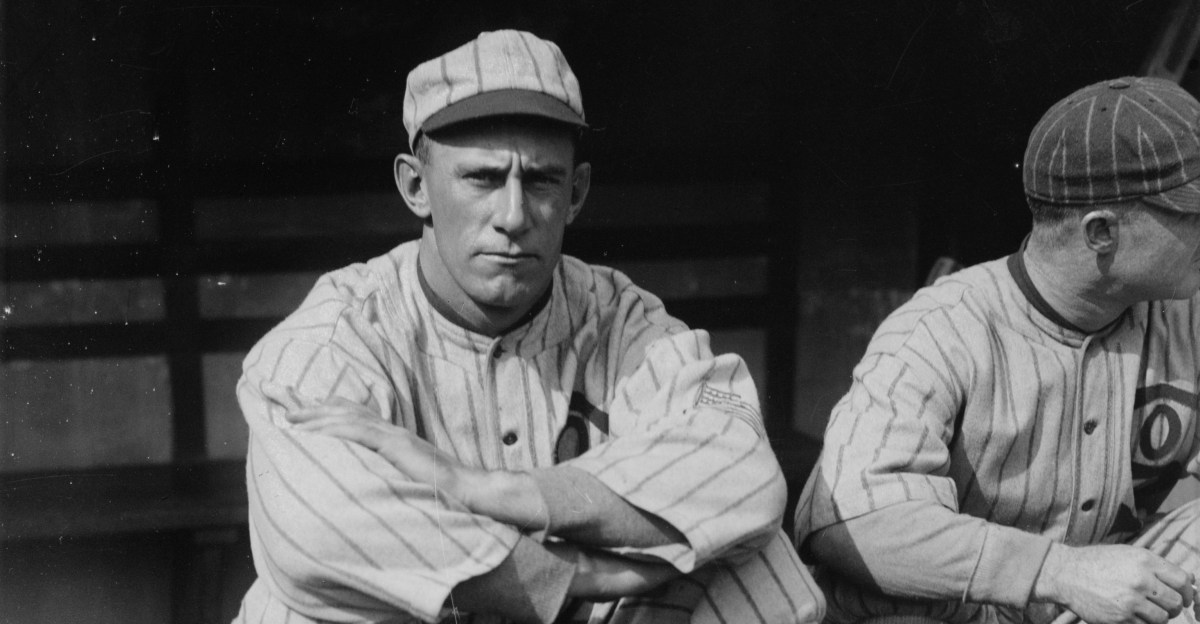
1912
The White Sox capped the most amazing City Series ever, having rallied from a 3-0 deficit to win the final four and take the crown. And on this day, in front of a Comiskey Park crowd of 14,985, the South Siders walloped the Cubs, 16-0. The rout would stand as the biggest win and most runs in City Series history, and at the time the South Siders’ 17 hits were the most in Series history.
Due to two ties (both called on account of darkness) that started the Series, this was officially Game 9. And the October 18 date made this the longest into October the City Series would ever stretch or ever go.
The two hurlers who had finished up the previous day’s White Sox win at Wrigley Field, Ed Walsh and Jimmy Lavender, took the pill to start the Game 9 decider, and only one survived past the second inning. Already up 3-0, the White Sox crushed Cubs pitching for eight runs in the third inning, turning the game into an 11-0 laffer.
Shano Collins had an incredible game, going 3-for-3 with three runs, three RBIs, a walk and two steals. He got on base a fifth time after being hit by a pitch, which may or may not have had to do with stealing home on the front end of a double-steal in a 10-0 game.
Walsh, after 393 innings pitched in the 1912 regular season, saw action in six of the nine City Series games, amassing a 2-1 record with a save and 41 more innings. Walsh completed this win, but the wear and tear of the season had an effect: He would throw just 14 more complete games in the rest of his career, and never again reached even 100 innings in a single year.
1950
Filling the largest imaginable managerial shoes, former White Sox skipper Jimmy Dykes replaced Connie Mack in the dugout for the Philadelphia Athletics. Mack managed the A’s for 50 years, all the way back to their inception in 1901. (Dykes, who broke into the big leagues with Philly and won World Series under Mack before being sold to the White Sox in 1933, was not even Connie’s first choice. He preferred son Earle taking over, but was overruled by the rest of the A’s governing board, including one of Mack’s other sons.)
Dykes took over a floundering Athletics club but managed a winning season (79-75) in 1952, wrapped inside of two terrible ones. He was fired after the 1953 season but managed for four other teams in the years to come.
1955
The White Sox sent infielder Bobby Adams to Baltimore for outfielder Cal Abrams.
Abrams saw action in four games for the White Sox in 1956, singling in his first at-bat with the team. But he was released in May, caught on in the Phillies system, but never saw the majors again. Adams was a spot player in Baltimore and then with the Cubs, winding his career up in 1959.
1969
A little-known studio musical group had released an oddly-named song. On this date, it broke into the Billboard Top 100, and would eventually move all the way to No. 1.
The group was called Steam, and the song, “Na Na Hey Hey (Kiss Him Goodbye).” Thanks to the efforts of White Sox organist Nancy Faust, it would become the song Sox fans used to “serenade” pitchers being removed from games.
Faust had played the song many times at Comiskey Park before it caught on as a phenomenon, but it was during a battle for first place with the Kansas City Royals at the end of July 1977 that fans started singing along to Nancy’s playing — and never stopped. The song has crossed over to every sport, The Simpsons, Congress … in short, it made Faust a cultural icon.
The song became so enormously popular at Comiskey Park in 1977 that the Steam single was reissued, with the additional notation “(White Sox Theme Song)” — and Faust was awarded a commemorative gold record for reviving interest in the track.
In April 2021, ESPN had a special short documentary on the history of the song, and how through the efforts of Faust it became the fan base’s anthem before spreading to other teams, leagues and sports.
Although Faust only heard the Steam single and decided to move it into her rotation at the park years later, ironically the song was released just prior to her getting the White Sox organist job, taking over for Bob Creed in 1970.