
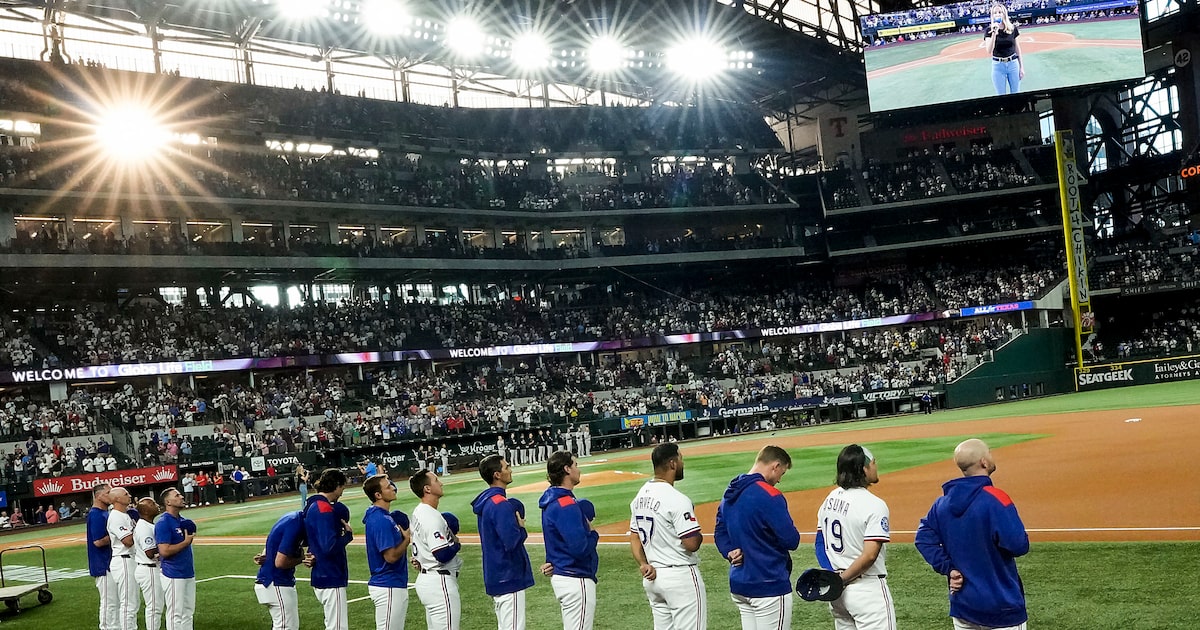
The biggest highlight of the Texas Rangers’ season was watching the starting rotation dazzle its way to the lowest ERA in the majors.
The second biggest highlight: People could actually watch them.
Numbers suggest that the first year of the Rangers’ grand experiment to create, operate and distribute their TV broadcasts was largely a success. Fans watched Rangers Sports Network (RSN) broadcasts on cable and, in a twist too long in coming, on direct-to-consumer streaming platforms. They could even get a bi-monthly taste via good, old-fashioned over-the-air channels.
Of course, this doesn’t mention the single-most important factor: Revenue generated. With good reason. It’s hard to get a complete picture on how much the Rangers made vs. what they made in 2024 and, more importantly, how it will impact the 2026 payroll and beyond.
Rangers
First things first: The hits. Might as well start here since hits were in such short supply for those who tuned into the games.
According to Nielsen ratings, RSN broadcasts produced a 37% increase in households delivered over the 2024 season average in the Dallas-Fort Worth market. On streaming broadcasts delivered through the Victory+ app and available through the club’s five-state territory, just over 100,000 viewers tuned in per game. The only way previously to access a stream of the game was to have what was previously branded Bally’s Sports Southwest as part of a pre-existing pay-TV package. There was no stand-alone streaming option.
“We wanted to make Rangers baseball available to the maximum number of viewers in our television territory and give them more ways to watch our games,” said Angie Swint, the Rangers senior vice president for broadcasting. “We understood there would be challenges in communicating the ways to watch and were hopeful Rangers fans would tune in. Needless to say, we’re very happy with the overall viewership for RSN game broadcasts. The year-over-year increase was substantial.”
What the Rangers pulled off after the implosion of the cable rights fees market was no small feat. They created RSN from scratch over the course of an offseason. While most of the clubs in the Rangers’ position took either further discounted rights from the newly-branded FanDuel Sports Network or allowed MLB to produce its games, also for a steep discount, the Rangers opted to invest in their own product with the idea to eventually grow revenue, but immediately increase viewership.
They negotiated their own carriage deals with multiple providers across multiple platforms and sold their own advertising for broadcasts. They reimagined their own broadcast with their own imprint and their own technological upgrades that included occasional drone cams, a “dirt” cam and increased the number of broadcast cameras. They enlarged the pre- and post-game shows to better feature rising star Jared Sandler and to simulcast it on radio and TV. Both shows drew less than a one in terms of Nielsen ratings; the numbers were small, but in 2024 they had been microscopic.
Related
“The goal was to give fans more options,” Swint said. “Ownership could have made a number of decisions and we’re so thankful that they trusted us to build and manage this undertaking internally. We were able to execute the vision for RSN without any major disruptions for fans watching our games and that’s a good feeling. I’m incredibly proud of the work our team did to make it happen and their commitment to building a quality broadcast.”
It doesn’t, however, mean the Rangers are in the clear for the long-term. The club declined to answer whether the revenues from the RSN undertaking matched the $90-95 million it received in 2024 from the parent company of Bally (also the parent company of re-branded FanDuel). And that figure had already been discounted from the $112 million-115 million annual fee the Rangers had negotiated in the initial contract. In addition, MLB Commissioner Rob Manfred said during the season that he wants to centralize local TV rights under the league’s control by 2028. Such a plan would seem to face headwinds from teams with stable and lucrative TV deals, such as team-owned networks like YES (Yankees), NESN (Red Sox) and Marquee (Cubs). The Rangers would like RSN to be on that level in the not-to-distant future.
In the meantime, though, it’s unclear how the Rangers’ did on the financial side in 2025. Club officials seemed to acknowledge RSN wasn’t initially able to match the previous revenue figure. And the only thing coming out of the Rangers about 2026 is that payroll is going to come down. When asked if TV revenues had any impact on that decision, the club declined to comment.
“The first year of Rangers Sports Network exceeded our expectations as far as viewership and production quality, and we are grateful to everyone in our RSN team who helped make this possible,” Neil Leibman, Rangers minority owner and chairman of Rangers Sports Media and Entertainment Company, said in a statement. “The ratings and engagement data confirm that more people were watching Rangers games than we have experienced for years, which was one of the key goals for this effort.
“While local TV revenue may not have reached previous levels, we can say with confidence that building a quality broadcast internally was the best path for the Rangers. The local TV landscape for MLB clubs is constantly evolving, and we feel the Rangers and RSN are well-positioned for the immediate future.”
But, not matter how good the production or the delivery, ultimately, what will dictate if fans tune in, will be the product on the field.
Find more Rangers coverage from The Dallas Morning News here.
Click or tap here to sign up for our Rangers newsletter.