
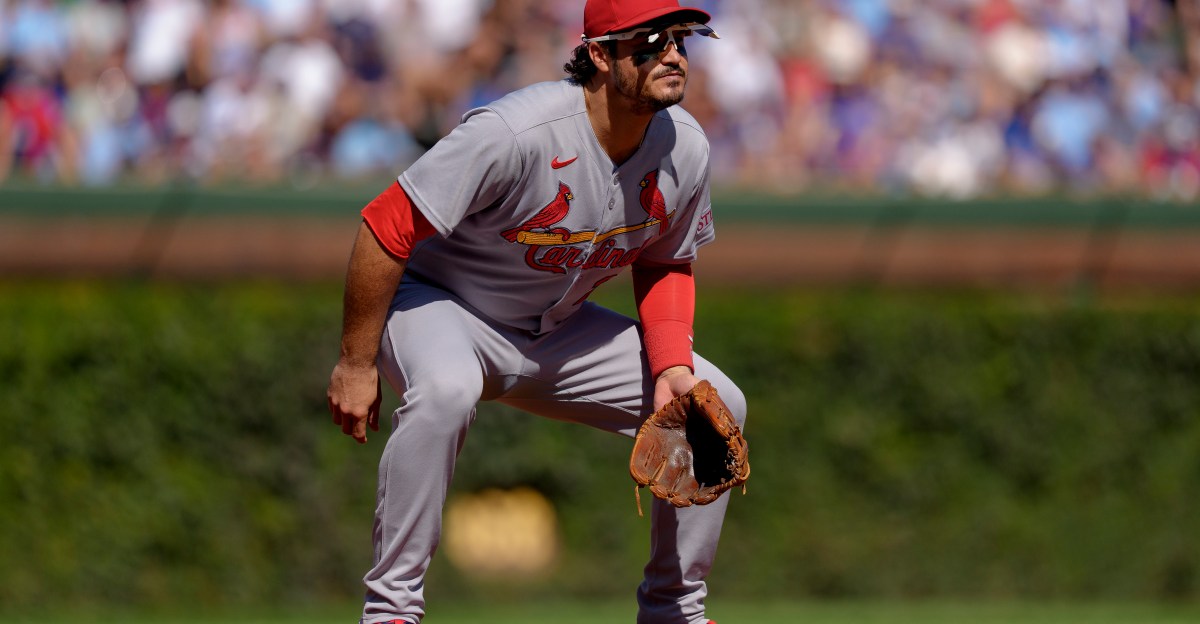
For the first time since at least when there was some buzz about the Cardinals maybe signing Bryce Harper (which if you remember correctly, peaked when Harper and Nelly appeared in a video together), this offseason brings about a lot of uncertainty. We’ve had quite a string of predictable offseasons. There were no real questions about what would happen. Part of that was the Cardinals more or less told us, but another part is just recognizing how John Mozeliak operated.
For this offseason, we have a perfect storm. There’s a brand new man in charge, Chaim Bloom. By itself, I don’t think a new name would mean anything, because the owner is the same. What makes it a perfect storm is moves need to be made to clear out redundant players, veterans are willing to be traded, and if they are traded, their salaries will be replaced by another free agent signing. There’s a lot of potential avenues to take and we don’t really know how Bloom operates the way we know John Mozeliak. We do have his three years in Boston, but that’s not the same as 18 years. And he may very well operate differently in St. Louis, either because he may have learned something from his experience in Boston or just because it’s not the same situation with the same resources.
One of the things we are sure about is that the Cardinals want to trade Nolan Arenado and Arenado seems to be want to be traded. I phrase it like that, because the intersection of teams willing to get Arenado and teams Arenado is willing to go to is not a large list. Hell, we hope it’s a list. Honestly a trade will get done even if it’s just one team.
So I was interested to see: what does a Nolan Arenado trade look like? What kind of money do the Cardinals need to throw-in? Is there an amount of money they can chip in to get an actual prospect? I want to know the answers to these questions, or my best attempt at an answer. The projection systems aren’t out and I don’t want to wait until they are to write this, so this is where I play my best guessing game.
I’m not sure this is as difficult as it sounds though. Coming into the 2025 season, Nolan Arenado was projected for 3.1 WAR in 581 PAs by ZiPS. He did not do that. He was worth just 0.9 fWAR in 436 PAs. That’s quite the underperformance. So it is, on the surface, not that useful to see what the 2026 projection for Arenado is, given that it is partially based on him having a 3.1 WAR season in 2025.
But it is actually very helpful because it helps define a very narrow range of what he might be in 2026 by a projection system. ZiPS saw a rather sharp decline from 2025 to 2026, projecting just 1.8 WAR in 527 PAs. So it’s safe to say that’s the absolute ceiling for 2026 as far as a projection system. Typically though, if you underperform to a significant degree in Year 1, you’re going to see a noticeable drop from where Year 2 was. So I feel extremely comfortable saying that Nolan Arenado’s projected WAR in 2026 will be somewhere between 1 WAR and 1.7 WAR.
That’s not a wide range and we can work with that. I can guarantee it will see a little bit of a bounceback from Arenado from 2025 because that’s just how projection systems work. Even at an older age, if someone drops from a 3.2 WAR season to 0.9 WAR, the projection will be better than 0.9. Easily. Also easily, if a player in Year 2 is supposed to have a 1.8 WAR season after a 3.1 WAR season, but underperforms by 2 wins, the projection will be worse than 1.8. Easily. So for the unknowability of a projection system, I would be surprised if just splitting this in half won’t be very close to the truth. Since it is a difference of 9, we’ll say his 52 fWAR career will tilt it towards being on the higher end. 1.4 WAR it is.
And for his last year of the deal, I’ll be lazier and just make it 0.5 worse which I default to whenever I consider aging. So, I have Nolan Arenado being worth 2.3 WAR over the next two years for $42 million. You can see why it might be difficult to trade Nolan Arenado. It’s not really even the salary that’s the problem, because the Cardinals can solve that issue, it’s more that his projection is a bench player. A bench player who can only play 3B (or at least should only play 3B), can’t really hit right-handed pitchers (most likely), and who carries the baggage of a presumed Hall of Fame career. In other words, those type of players aren’t benched typically.
Somewhat ironically, if used correctly, the Cardinals may very well be the best fit for Nolan Arenado at this stage of his career. Weirdly, Arenado against LHP and as a defensive sub is a pretty snug fit on this roster. And at least two members of the pitching staff are heavy groundball pitchers. You could really maximize his particular talents at this stage of his career and milk all the value you can out of him. I don’t know that any other roster fits that well for him.
Nonetheless, let’s move forward with the assumption that some team wants him and wants fair value for him. First off, the Rockies are responsible for $5 million of that $42 million – the gift that keeps on giving. Without having to take care of any money, both the Cardinals and the team that trades for him can rest easy knowing $5 million is taken care of by the Rockies. So that’s nice.
I’m going to use Fangraphs version of WAR to dollars, which does not subscribe to the $10 million per win. They had his 0.9 fWAR season being worth $6.8 million in free agent dollars. I don’t know how they arrived at this, but it does make sense. A team would not pay $9 million for a 0.9 fWAR player. So again, I’m going to be a little lazy, and just use that same rate for the next two seasons, which comes out to $7.56 million per win. That means his projection is worth $17.4 million.
Would a team sign the current version of Nolan Arenado to a 2 year, $17.4 million deal? I don’t know that he would get a two-year deal, but if he did that sounds about right to me. Paul Goldschmidt coming off a slightly better season got $12.5 million in one year. So Arenado could probably get $10 million from somebody I imagine.
Valued at $17.4 million, Arenado’s current contract excluding the Rockies commitments, is almost $20 million underwater. What this means is that the Cardinals probably have to throw in $20 million to get a fake return. In a literal sense, I’m sure they’ll get a player back, but the player in that return would be roughly a 95% chance to never make the majors. If they get real lucky, maybe someone throws in an 18-year-old in the DSL. Very, very long odds, but that’s how Yordan Alvarez got to the Astros.
And then it’s kind of hard to envision the Cardinals throwing even more money to get a better return. But hypothetically, maybe they get throw in a few more million and get a 40 future value player. Maybe a surefire reliever close to the majors, but with no expectation to be more than a middle reliever.
So the enticing part of a potential trade for the other team is that most of the 2027 salary is picked up by the Cardinals. Say they throw in $22 million. If you split that in half for each season, one way a new team could look at this is that they are paying Arenado $11 million as a bounceback candidate with a $4 million buyout. I don’t know if this is allowed by the CBA, but if it is this is absolutely what I would do: Throw in $21 million, split evenly, and if he fails to reach 500 PAs in 2026, the Cardinals are on the hook for all of his 2027 salary. If some version of that is allowed, that’d be an interesting way of really making the Arenado deal look like a one-year deal, which I just think is a lot, lot more tradable than two years.
So when the Cardinals announced that they would be willing to throw in money to complete trades, I shrugged my shoulders. Because there is no trading Arenado without throwing in a lot of money. There is no amount of throwing in money that will net them a “real” prospect. Teams would rather pay Arenado some money than throw in a real prospect to get Arenado.
Oh and there’s also the option of swapping bad contracts, which I’ll maybe address in a future post if I find names. If I ever write that post, Luis Castillo will not be mentioned because for that to work, the Cardinals would have to give them a prospect. (Only mentioning him because his name has been mentioned in the comments) Castillo is getting paid $48 million over the next two seasons and he’s probably not worth that, but he’s probably worth at least $40 million, so there’s a decent gap in value between him and Arenado that would need to be filled in by a fairly decent prospect.