
Tell me if you’ve ever experienced this before. You are looking forward to preparing one of your favorite meals, but when you open your refrigerator, you realize your key ingredient has gone bad. Perhaps you were going to make some beef and broccoli, but your skirt steak expired yesterday. So you dutifully make a grocery list, including a few other things you need along with the steak, and you head to the grocery store.
But when you get there, you discover they’re completely sold out of flank steak. You could grab a more expensive cut of beef, but it probably wouldn’t go right, and it’s outside your budget. Disappointed, you grab a TV dinner from the freezer section, but while you’re there, you spot the ice cream. Sure, you couldn’t get the skirt steak you wanted, but the TV dinner will be good enough, and what might elevate it like a Klondike bar? So you grab a package to go with your TV dinner and head home.
That’s a bit like the process that resulted in the Royals signing Carlos Estévez this past offseason.
And, much like a meal consisting of only a heavily processed TV dinner combined with an equally heavily processed frozen dairy treat, the season was ultimately a disappointment. But it wasn’t the ice cream’s fault!
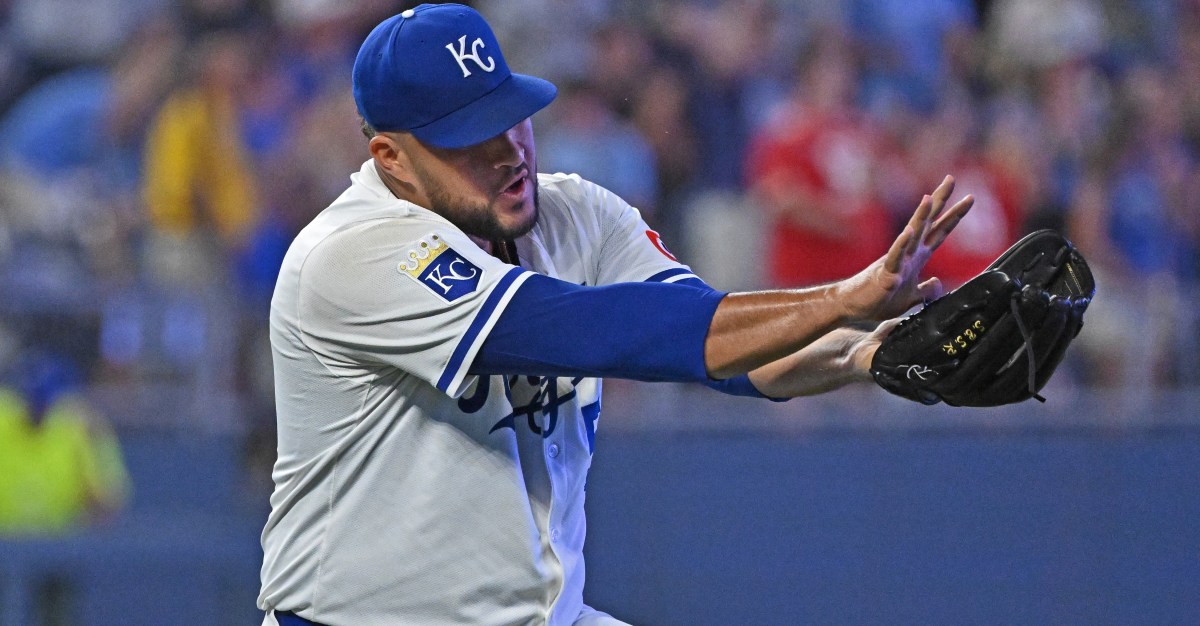
The Royals signed Carlos Estévez once it became clear that they weren’t going to be able to add their coveted free agent outfielder, hoping that he would be able to help elevate the bullpen to the point that it could cover for the lack of offense. Estévez took a lot of heat from Royals fans for not being good enough, but like the metaphorical ice cream above, it’s not his fault that even his terrific work couldn’t get the Royals where they were trying to go.
Estévez finished the season with the 28th-best ERA among all relievers, the most saves – only the second time a Royal has ever led MLB in saves. He was tied for eighth in MLB with 34 shutdown appearances – a statistic that measures when a reliever has an especially impactful performance, whether it’s a save or not. For comparison. Jhoan Duran, one of the most coveted relievers in the sport at the trade deadline, finished with the same number of shutdown appearances but had eleven meltdowns (fittingly, the opposite of a shutdown) compared to Estévez’s nine.
There are reasons to be concerned about his future performance, as he produced by far a career-low strikeout rate. There’s no denying he had something of a rough stretch in mid-late July, but before that, he was well-deserving of his second career All-Star appearance, and he finished the season with 17 straight saves. That was the second-longest such streak in the majors behind Atlanta’s Raisel Iglesias, per a season summary document sent out by the Royals.
He’s certainly no Greg Holland or Wade Davis in their primes. He’s probably not even Kelvin Herrera or Joakim Soria in theirs. But he was absolutely one of the better – and cheaper! – closers in baseball last year. He represents success not just for himself, but also a good mark each for the Royals’ front office and pitching coaching staff. He more than did his job, and maybe he’ll be able to find something he was missing during this offseason to get back to being a touch more dominant in 2026. If the Royals can go out this offseason and get that skirt steak to make an appetizing lineup, it’ll be nice to be able to rely on the dessert that is Carlos Estévez to close things out.