
Since the National League implemented the designated hitter in 2022, the position has not been kind to the New York Mets. They have consistently struggled to get solid production out of the spot, as they have put together a .229/.316/.398 triple slash from the position since 2022, good for a whopping 103 wRC+, 18th in the league.
2025 was not much different, as they hit .247/.314/.428, good for a 109 wRC+, 16th in the league. Only four Mets took 40 plate appearances or more at the position, and it was messy:

Starling Marte got the lion’s share of the work and was actually pretty good, although a 117 wRC+ from the DH spot would put the Mets 12th in Major League Baseball, tied with the Los Angeles Angels — so not bad, but also probably a little less than what you want there, considering there is little supplemental value from the position other than base running.
Jesse Winker was, frankly, a little better than I remember, but he also barely played due to a back injury. The rest of the options were, well, bad. Mark Vientos heavily regressed after his breakout 2024, with him posting a wRC+ over 100 in only the month of August (to his credit, it was an obscene 167 wRC+ that month, but he was below league average in every other month). Jared Young was an interesting signing after tearing up the KBO in 2024, but he did not get much of a shot, and did not do much of anything with the few shots he got.
The goal should be getting much better offense out of the spot, considering it is literally only offense. However, doing that is a little more complicated than one would like, due to the incumbent players on the roster.
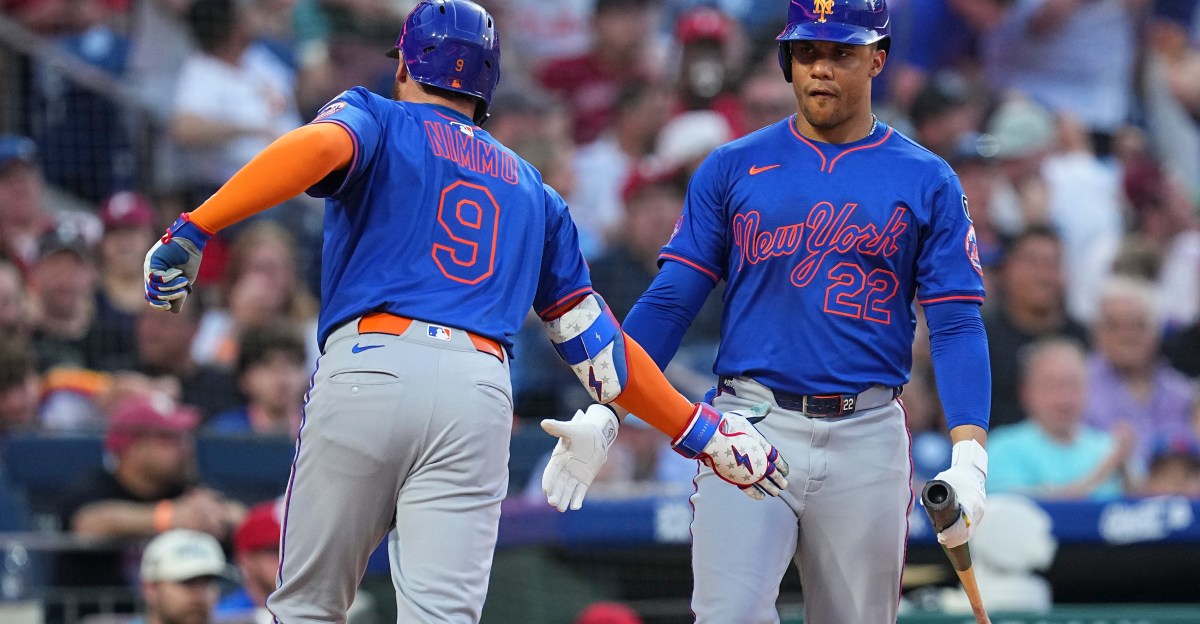
The Mets, as we sit here today prior to the start of the 2026 season, have two future designated hitters already on the roster in Brandon Nimmo and Juan Soto. Neither one of the corner outfielders are good defenders: Juan Soto posted a -12 Outs Above Average this past season, which, as you can imagine, is not good. Brandon Nimmo posted a much more palatable -1 OAA, but it has dropped from +6 in 2022, to +1 in 2023 and 2024, to the -1 he earned last year. His sprint speed has also dropped about one mile per hour from 2023 and 2024 (28 miles per hour), to 2025 (27.3 miles per hour). Both of these combined could suggest a physical decline, which would likely mean even worse defense out of Nimmo in 2026 and beyond.
While Soto is almost certainly not going to move off of right field before 2030 no matter what the metrics suggest (unless he goes Bryce Harper mode and has an injury that forces him to, which I advise everyone reading to knock on some wood to prevent that outcome), it will be hard to stomach negative defense in both corner outfield spots, and Nimmo is likely an easier candidate to move to DH. David Stearns has made it very clear that run prevention is hugely important this offseason, going as far to call it their “primary focus” in his end of season press conference. He also suggested some significant changes in that presser, as evidenced by this quote: ““We’re going to have to be open-minded on our position player grouping so that we can improve our run prevention. Does that mean there are robust changes? I don’t know. Does it mean people will be playing different positions? Maybe. Does it mean we ask people to play different roles? Maybe.”
The entire press conference was interesting, but that particular quote is going to be one to keep an eye on as we move into their 2026 plans. Mentioning robust changes (a trade, perhaps?), and moving positions and roles speaks to, in my opinion, Soto and Nimmo the most. Will Nimmo be here next year? Will he be asked to play more DH while they get better outfielders onto the field? Will Soto DH more, for the same reasons? Are one of these players the potential replacement for Pete Alonso at first base? It is impossible for us to know today, but I do not think that the corner outfield defense is tenable long term, and that muddies up the DH picture.
Pete Alonso is another interesting part of this equation. He is kind of a square peg in a round hole for the 2026 Mets — he is a poor first baseman (just ask Kodai Senga’s hamstring and his -9 OAA), and DH is already a complicated picture. He is almost certainly a DH now, let alone what it will look like in 2027 and beyond, assuming they do bring him back. If they do bring him back, you are effectively rostering three DHs long term, which is even harder to stomach than two DHs long term, since three is one more than two.
The poor defense across the board, and the fact that there is only one DH on the roster, probably makes it harder to envision Alonso returning this time around, not to mention the fact that the lack of a qualifying offer and better platform season will likely boost his market, even if he is being irrational about his asks. Any type of longer term Alonso contract will require him to move to DH, which is already occupied in the future by Nimmo and Soto.
Even if Alonso goes, it will still be hard to upgrade the position externally. Kyle Schwarber is the obvious choice to upgrade the position, but 1) it will be a surprise if he leaves Philadelphia and 2) it is basically the Pete Alonso question with a different player attached; can you give Schwarber a four year contract and tie up the DH spot while Nimmo and Soto patrol the corners? That flies directly in the face of Stearns’s plans to beef up the defense.
The most likely scenario, it seems to me, is to do a Frankenstein’s monster on the position — using it to take Soto out of right field and Nimmo out of left field more often, and replacing those players in the field with better defenders, and acquiring a hitter who can supplement the DH rotation and is not a zero in the field like all of the 2025 DH options were. While that is not necessarily ideal (the top of the DH wRC+ leaderboard largely have regular DHs), a DH only player simply does not fit the Mets in the short term future. And that makes their decision on what to do at that spot perhaps the most interesting question for the 2026 position players.