
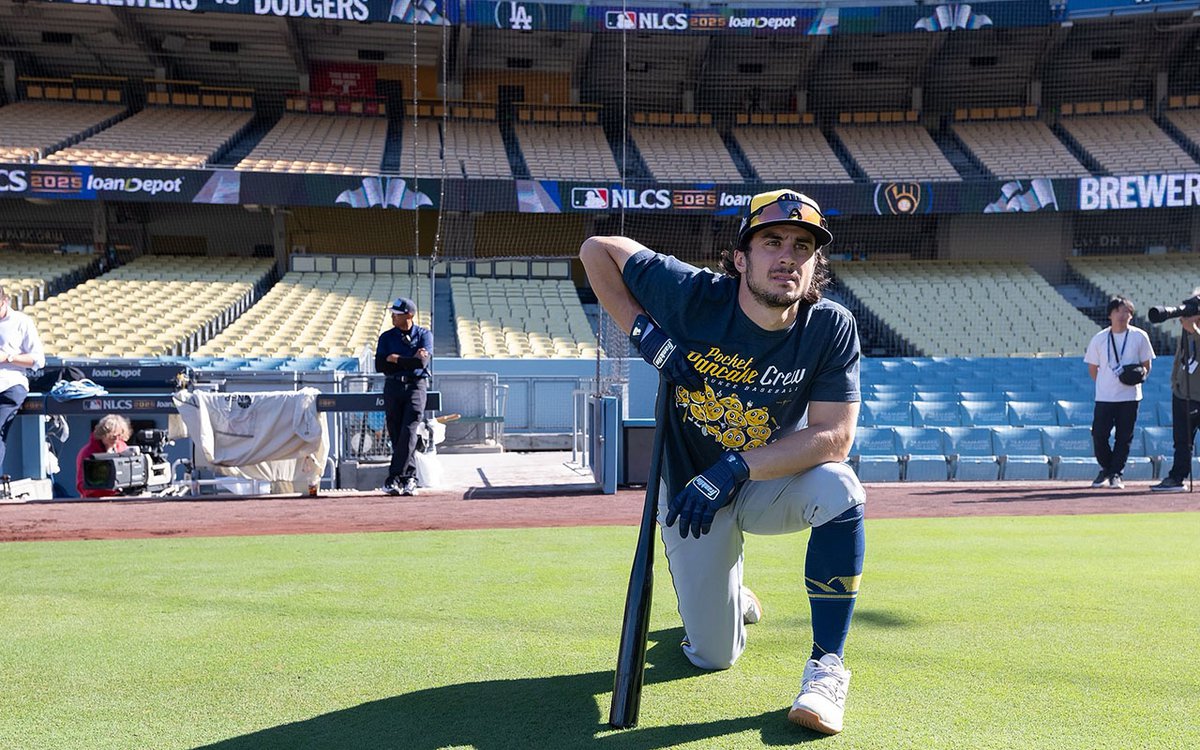
By virtually any measure the 2025 season was one of the most successful in Brewers franchise history. They set a franchise record with 97 regular season wins. They finished with the best record in baseball for just the second time in club history. They won a postseason series for the fourth time in franchise history. They won their eighth division title, their third in a row and their fourth in five years. And yet, somehow, their season still ended at least in part because of unanswered questions from several months prior.
The Brewers opened the season with question marks on the left side of their infield, where Caleb Durbin had not yet reached the majors and Joey Ortiz was moving from third to short after a successful rookie season. They got perhaps as much as they could have hoped for from Durbin, who Baseball Reference estimates was worth 2.9 Wins Above Replacement (ninth most among all MLB third basemen) in 136 games. Ortiz, however, took a major step back. He batted just .230 with a .276 on-base and .317 slugging, good for the lowest OPS of any qualified hitter in baseball.
The Brewers, of course, had no way of knowing Ortiz would struggle this greatly. They also, however, went into the season without a clear backup plan at one of the game’s most important positions. They also didn’t address it at the trade deadline, when Ortiz’s numbers were even worse (he was hitting .209/.263/.303 on July 30). As a result, in spite of being the lightest hitting everyday player in baseball Ortiz still played in 149 regular season games for the Brewers. He also started all nine postseason games, going just 2-for-19 for an offense that desperately needed a spark.
 Stay on top of the news of the day
Subscribe to our free, daily e-newsletter to get Milwaukee’s latest local news, restaurants, music, arts and entertainment and events delivered right to your inbox every weekday, plus a bonus Week in Review email on Saturdays.
Surprising Decisions
Looking further back, last fall the Brewers made surprising decisions not to retain two pitchers who had experienced significant success the season before in Bryse Wilson and Colin Rea. Wilson eventually signed with the White Sox and struggled this season, but Rea landed with the Cubs and pitched 165 solid innings across the regular season and NLDS.
Meanwhile, by the second week of the season the Brewers had been beset by injuries and poor performance on the pitching side. They struck gold with a pair of late transactions, getting Quinn Priester off the Red Sox’ AAA roster and signing Jose Quintana. By October, however, their rotation was back in tatters, and their bullpen was just getting healthy. Freddy Peralta started three of their nine postseason games but openers started four of the others.
Not pursuing a veteran infielder and not retaining a pair of pitchers who had experienced significant success in Milwaukee in prior years helped the Brewers trim their end-of-year payroll to $115 million (according to Cot’s Contracts), up from $98 million in 2024 but significantly down from $134 million in 2023 and $135 million in 2022. There are several ways to measure and rank payrolls, but by Opening Day salary ($108 million, 24th out of 30 teams), year-end salary ($115 million, 23rd) and Competitive Balance Tax Number ($143 million, 21st) the 2025 Brewers were ranked the lowest they’ve been since 2017.
Even a payroll that held steady, however, wouldn’t have been worth as much in 2025 as in prior years. Inflation exists in baseball just like everywhere else, and so the value of an MLB team’s dollar (or million dollars) isn’t what it used to be. In 2012, for example, the Brewers’ Opening Day payroll of $98 million was the 13th highest in baseball. This season it would have ranked 26th. When tracked against baseball inflation the Brewers’ 2025 payroll marks a low point in recent franchise history. This graphic uses Spotrac data to compare the Brewers’ annual salary to the MLB median since their data set begins in 2011:
Not all teams have the same resources, of course. There’s no amount of money the Brewers could reasonably spend that would have made them a candidate to sign Juan Soto last winter or run a $400 million payroll like the Dodgers. At least one metric, however, suggests that the Brewers’ payroll is low at least in part because they’re not investing their revenue at the same rate as their rivals. During the NLCS Razzball shared these estimates showing that the Brewers only invested less than 41% of their 2024 revenue in 2025 payroll, the 24th highest rate in baseball:
https://bsky.app/profile/razzball.bsky.social/post/3m3dnq3ci522t
The 2025 Brewers themselves are a perfect example that spending more money doesn’t always mean winning more games. Twelve of the teams with a higher end-of-year payroll than theirs missed the postseason this year. The Brewers front office has done an incredible job of doing more with less and finding creative ways to solve problems. It’s entirely possible Matt Arnold will become the first person ever to repeat as MLB Executive of the Year. Having money available to spend, however, would give him more options to try to fill in holes in the Brewers’ roster. Instead, the first rumor of the offseason was that the Brewers might trade Freddy Peralta, who is due to become a free agent next winter.
By all accounts the Brewers’ 2025 season was a remarkable accomplishment, doubly so given the relatively low expectations and limited resources they had entering the season. In the end, however, it’s hard to imagine them remaining at this level or going further without making a larger financial commitment to pursuing a championship.
Keep the Shepherd Free
Support Milwaukee’s locally owned free weekly magazine.