
The Freddy Peralta trade rumors came quickly, but not unexpectedly. Entering the final year of his contract with the Brewers, Peralta has a club option for $8 million. That will surely get picked up. A very team-friendly deal, this makes Peralta an attractive option to retain for the financially challenged Crew, but it also lures other teams towards him—especially those also operating in smaller markets and who have strong farm systems.
Peralta is just short of being a true ace, with a tendency to get bogged down in his efforts to put away hitters and (too often, sometimes) to walk them in the process. However, his raw stuff and his intelligent approach are good enough to keep him consistently better than average. Perhaps his most valuable trait is his ability to post day in and day out, making 30 starts or more in each of the last three seasons while continuing to round out his arsenal.
We know Peralta is also valuable to this Brewers team as a clubhouse leader, and has been a rock around which they built their rotation and their team culture over the last two seasons. That being said, purely because of the environment in which they operate, the Brewers organization cannot afford not to at least listen to offers.
The Valuations
The first consideration is what an organization is willing to give up for a starting pitcher with one year of control remaining. From the Brewers’ perspective, the bar to clear is the one-year on-field value of Peralta’s pitching, plus that of a pick just after the first round in 2027—because, should the team keep him. they’ll certainly extend him a qualifying offer and receive such a pick if and when he signs elsewhere after next year.
Secondly (if you’ll allow some math nerdiness), the $8-million contract value is a huge boon to whoever is receiving Peralta—whether it be a team lingering around the competitive-balance tax threshold, or those with tighter budgets. Peralta’s performance in 2025 would be closer to a value of $30 million, meaning there’s around $22 million of excess value the Brewers would be looking for in return, plus the compensation pick.
Looking at the Corbin Burnes trade (who commanded more, as a Cy Young winner, but who was also due considerably more money in his final year of arbitration eligibility than Peralta will make next year), we have some basis for comparison. In that deal, the Brewers received two fringe top-100 prospects in Joey Ortiz and DL Hall, plus a competitive-balance pick that allowed the Brewers to select Blake Burke in the 2024 MLB Draft.
One of the biggest considerations for pitchers is that they’re always at risk of a long-term, season-ending injury. Burnes’s elbow went out this year, as did Gerrit Cole‘s. Both pitchers had workloads in excess of 500 innings throughout the three prior seasons, as has Peralta from 2023-2025.
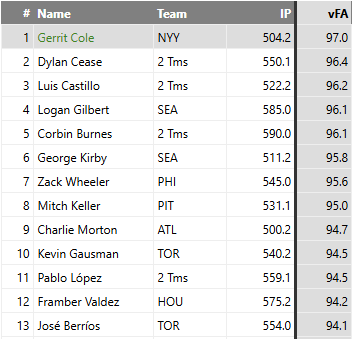
Here are the pitchers from 2022 through 2024 to breach that 500-inning mark, with a fastball velocity over 94 mph. Of them, only Kevin Gausman, Framber Valdez, Luis Castillo and Mitch Keller pitched over 170 innings in 2025. That’s not to say Peralta will get injured, but we saw Burnes get injured in Year One of his long-term deal with Arizona. In this day and age, nearly every pitcher has a long-term injury at some point, and it’s a ticking time bomb.
The value for one year of Peralta is likely somewhere in the range of two top-100-ranked prospects (per the Brewers model; they were higher on both Hall and Ortiz than the consensus public rankings) and no competitive-balance selection. Alternatively, they could look for three players, with one fringe top-100 player and two higher-upside, lower-ranked players. It certainly won’t be the type of package that’s franchise-altering, despite the likelihood that Peralta gets a meaningful number of Cy Young votes this year.
Are the Brewers Higher on Peralta Than Most Teams?
Peralta’s value in the Brewers clubhouse in mentoring young pitchers—and especially his impact on Latin American players—is no small thing, either. In that sense, perhaps the Brewers will see Peralta as more important than Burnes, who had public beef with the Brewers in the wake of his arbitration proceedings.
It’s an intangible benefit the Brewers hold dear as a reason for their success over the last eight years, and with a young core coming through and some questions around their depth entering 2026 (certainly the kind of depth that is ready and capable of making 30 starts in a season), Peralta holds a lot of additional value that the Brewers organization will prize more dearly than their counterparts, and that may require an offer far beyond somple, rational valuation.
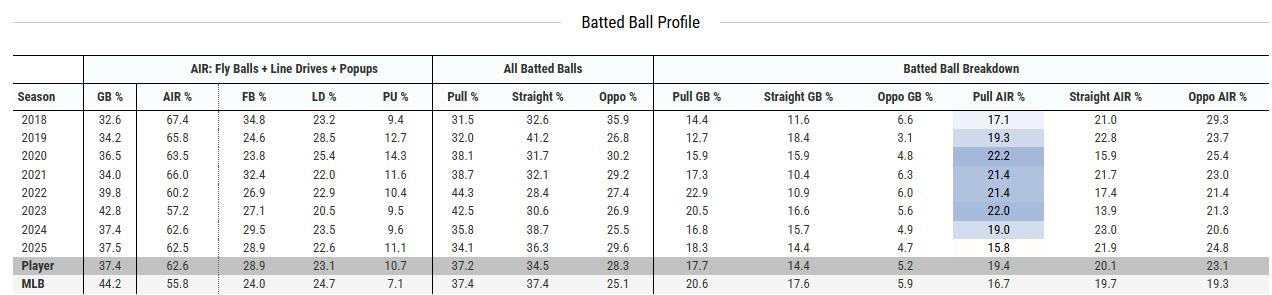
Peralta also showed tangible improvements on the field in 2025. Yes, he did outperform his peripheral numbers, which were more in line with the higher ERAs produced in 2023 and 2024, but he managed to lower his “air pull” rate, which is one of the biggest indicators in home runs conceded. In tandem with that, the increased usage of his changeup added significantly to his profile, both in neutralizing opposite-handed hitters and even allowing him to tunnel in under the hands of right-handers.
Peralta is the Brewers’ best starter, but he hasn’t yet demonstrated the combination of dominance and consistency to rate as one of the league’s elite starters. His 2025 was a step in the right direction, but whether teams think they can unlock that final step will play a big role in any negotiations.
If He’s So Valuable, Why Would The Brewers Trade Him?
The important note here is that the Brewers aren’t definitively trading him. All we have so far is a speculative report from an out-of-town national writer, saying they’re expected to listen to offers. Mark Attanasio has said previously that, due to the Brewers’ market potential, they can never afford to ignore a call. Hyperbole though this is, it makes sense. If the Tigers were willing to offer Tarik Skubal for Freddy Peralta, you would have to jump at the deal. That won’t happen, but it illustrates the broader point.
The Brewers may be seeing some prospects with that type of upside who can help not just in 2026, but in the long term. If a team is willing to overpay, the Brewers won’t push them away. (See the Athletics’ overpay in their determination to acquire *checks notes* Esteury Ruiz.)
With one year remaining on his deal, there is a possibility that Peralta gets moved. It’s the nature of the business, with no room for compassion—at least in Milwaukee. The Brewers won’t be actively shopping him. They’ll want a team to get desperate and overpay for the lone stalwart in their rotation, and if nothing comes through, they’ll be very happy proceeding into 2026 with Peralta on board.