
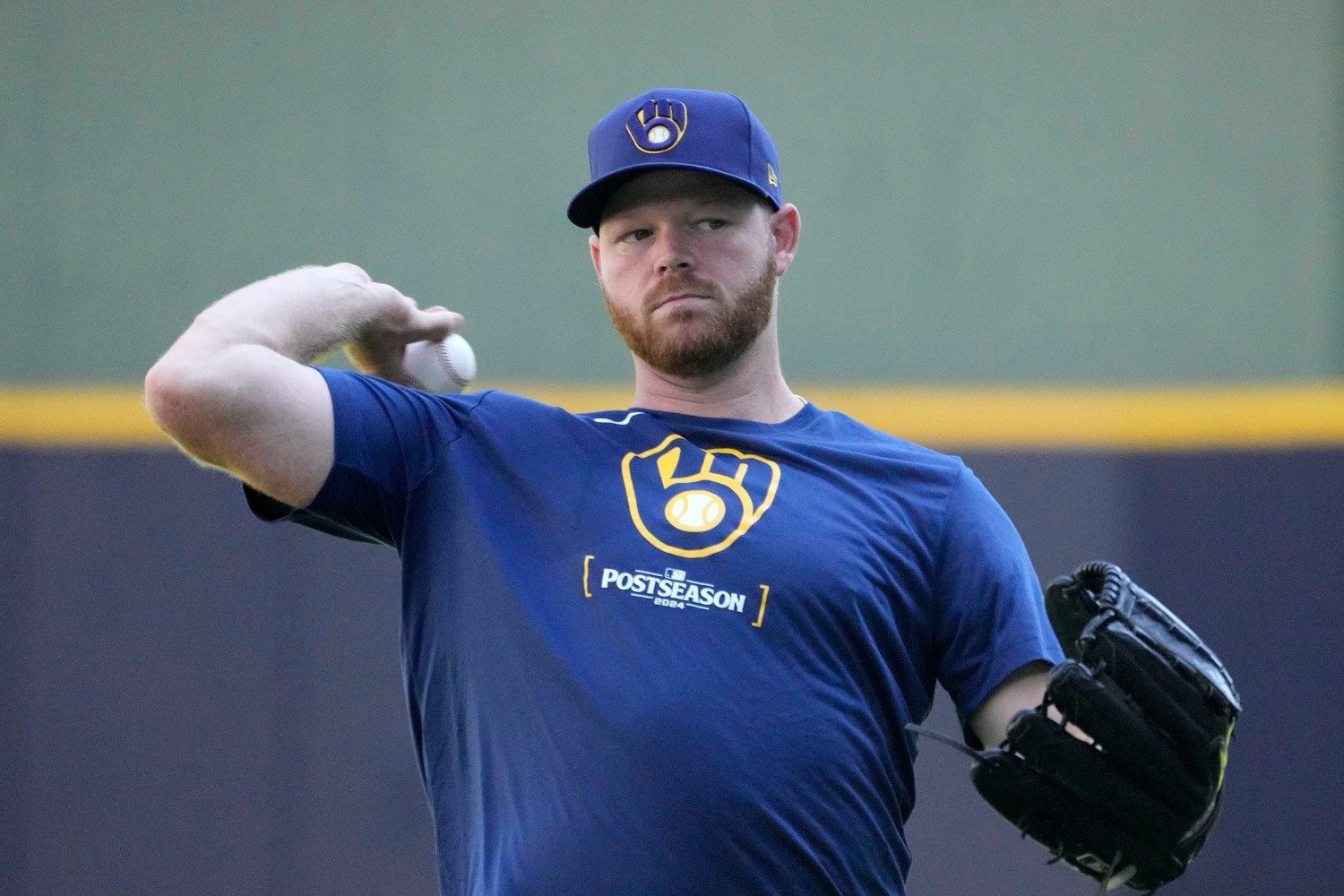
The Brewers had one of their lowest payrolls of the 2020s this season. Their year-end 40-man roster payroll was around $115 million, according to Cot’s Contracts. That was the lowest mark since 2021, when they spent $105 million, and their ranking (23rd in the league) was lower than it’s been since 2017. They had a high number of pre-arbitration salaries, combined with deferred salaries and likely-to-be-declined mutual options that have been pushed onto 2026, as the team always tries to maximize their liquidity and the utility of their money within the revenue cycle of the sport.
Here’s an early roster projection, based on last year’s salaries and MLB Trade Rumors arbitration estimates:
The team is always spinning plates and kicking cans down the road, but there are a few more plates in motion and a bit more litter on the path than usual this offseason. The deferred salary still being paid to long-retired stars Ryan Braun and Lorenzo Cain is no big deal. Most teams have such line items; the payments are just bills coming due for things that saved the club money in the past; and Christian Yelich’s $4-million deferral (which will be paid out in 2037 and 2038) offsets that money anyway. (That deferral is why, though his official salary is $26 million, Yelich is only listed at $22 million above.) The buyouts the team owes to Brandon Woodruff, Rhys Hoskins and Jose Quintana, however, add up to real money. They won’t really think of those as part of next year’s budget, and the money they made in reaching the NLCS this fall will cushion the pain of paying those buyouts this winter, but they’re still there.
How Much Revenue Do the Brewers Have to Spend?
In the wake of the postseason exit, a lot of graphics went around about the percentage of total revenue teams spend on payroll, but this isn’t exactly a fair fight. For one thing, player payroll is only the most visible (and, admittedly, the most expensive) of several ways to invest in the team. It doesn’t include money spent on coaching staffs, analytics departments, facilities, the farm system, or other ancillary supports. For another, some teams’ costs are more elastic than others’. Ditto for revenue. The Brewers’ revenue depends much more heavily on their on-field success, for instance, than does the Dodgers’. Still, there’s a trend to observe. Generally, teams spend something like $160 million less on their roster than they took in the previous year.
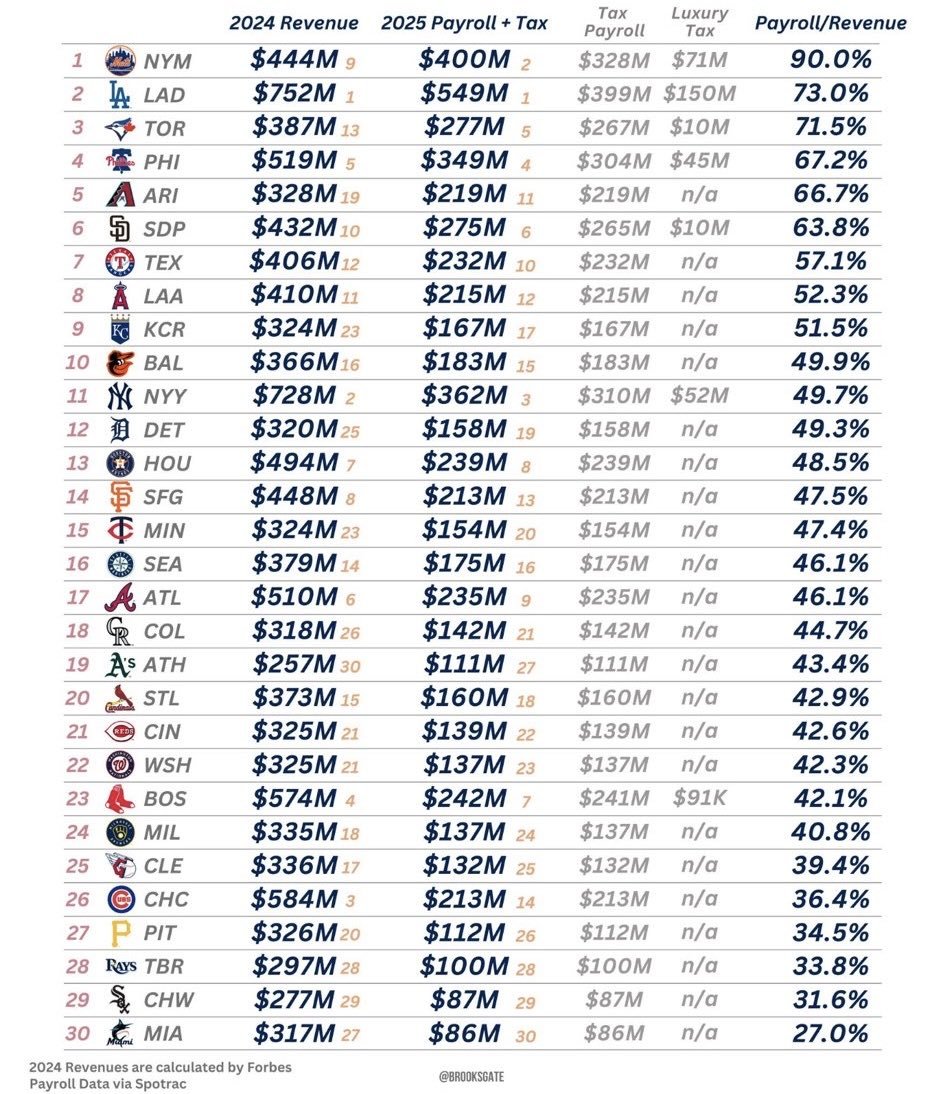
(Note: Forbes’s revenue estimates, while better than nothing, are likely far from perfect. Spotrac, used by the creator of this content to estimate payroll, is not especially good at capturing the dynamics of payroll in baseball, so consider that estimate of spending even rougher than Forbes’s shot at revenues. Again, though, it’s better than nothing.)
There are some exceptions, but for instance, the Dodgers had $203 million left after their on-field payroll, compared to the Brewers’ $198 million. It could be worse, if you’re someone who worries that Mark Attanasio isn’t spending freely enough; the Chicago Cubs have $371 million remaining. In short, what I’m saying here is that if we can estimate the Brewers’ total revenue for 2025 and deduct around $200 million, we could have an upper limit for their 2026 payroll.
How Much Revenue Did the Brewers Make In 2025?
First of all, the Brewers’ total attendance in 2025 was higher than they managed in 2024. With 2.65 million fans crossing the turnstiles (up around 112,000, or something like 1,400 per game), they’ll have created additional revenue from ticket sales, concessions and merchandise. The merchandise is more variable, but if we prudently estimate the gross revenue as somewhere around $12 per person for concessions and the average cost of a ticket in 2024 being $57 (per Gametime; another imperfect source that beats wild shooting in the dark), the Brewers have added an additional $7-8 million in revenue.
On top of that is the playoff success @Matthew Trueblood covered on Sunday. Reaching the NLCS has serious financial implications for the Brewers, adding around $15 million by Matt’s estimate. All things considered, a conservative estimate might be that the team made $22 million more this season than last. They may want to retain some of this as insurance against a potential lockout in 2027, when the CBA is re-negotiated, but they do have more to spend than they’ve had even very recently.
The Brewers have also been one of the heaviest spenders in revamping their minor-league structure, an effort that has been undertaken heavily in recent years—and will continue in 2026 with the relocation of the Carolina Mudcats to form the Wilson Warbirds with brand-new, state-of-the-art facilities. The Brewers partially own that affiliate, so they do factor some of the costs associated with their move into their own finances.
Prior success is no guarantee of future profits. The Brewers cannot afford to say that, because they made an additional $20-25 million in 2025 and have lots of money to spend relative to what they invested this season, they can splurge on a 10-year, $300-million contract. Nor would they be likely to do so, anyway. This is a team with major reinforcements on the way in positions of need throughout their minor-league system, from Cooper Pratt and Jesus Made at shortstop to Blake Burke, Brock Wilken and Luke Adams as infielders with some thump. It does, however, give the front office some breathing room, should they choose a two- or three-year deal with a manageable average annual value, similar to the Hoskins and Woodruff ones.
They may have even more than that to spend. There should be some room for a steady veteran upgrade this offseason, perhaps someone like Ha-Seong Kim. Perhaps they’ll decide to go large, if they can get a short-term, high-AAV deal for someone like Trevor Story or Alex Bregman. Will the Brewers make those moves? Or will they, as in 2021, be cautious with their spending, as TV uncertainty and the CBA negotiations loom large? They certainly have additional funds and some budget space, if they choose to be aggressive.