
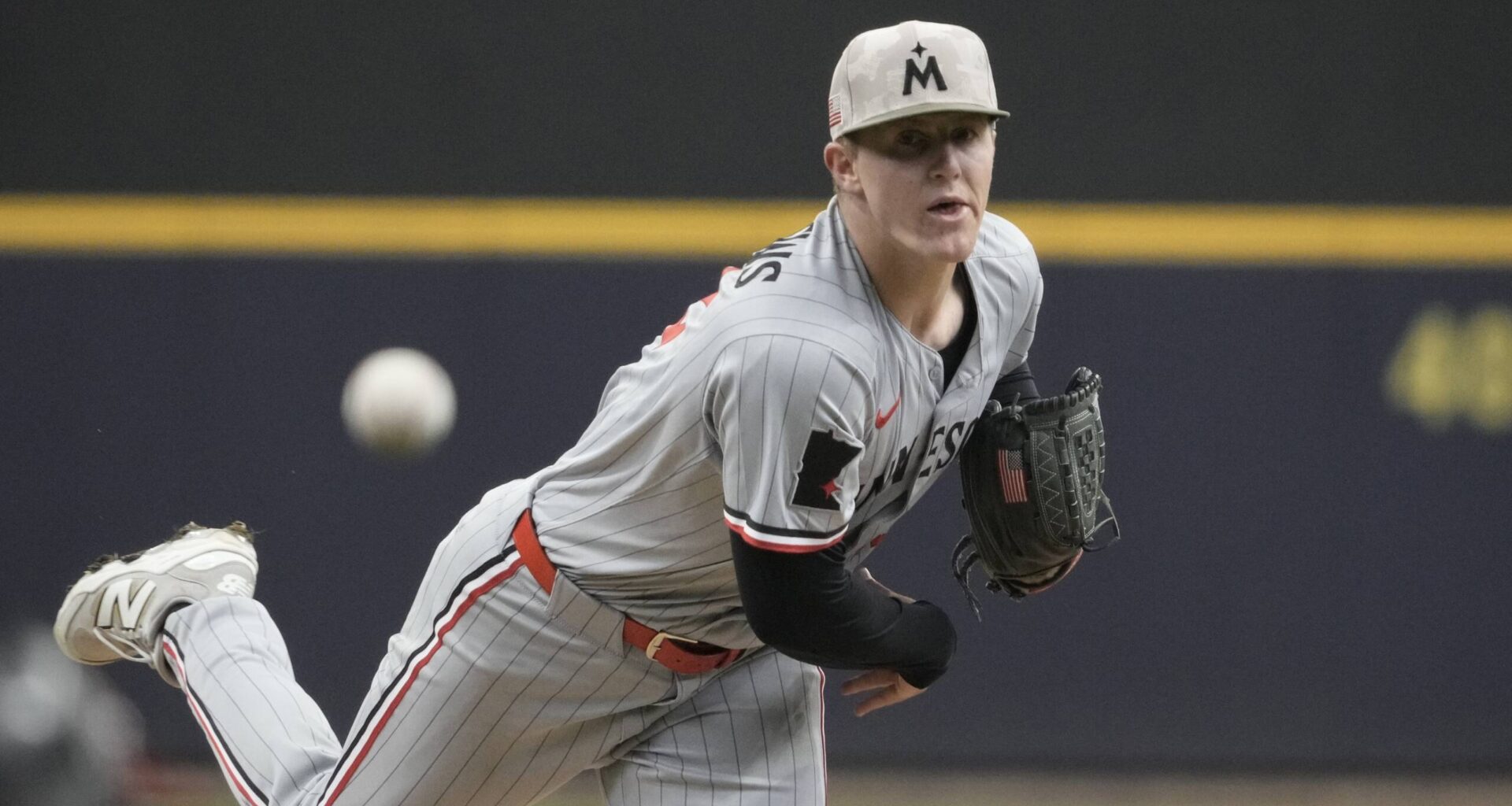
Zebby Matthews made his long-awaited return to the Minnesota Twins’ starting rotation on Sunday, and Twins fans couldn’t have been happier to see him try to extend their 13-game winning streak to 14.
However, not everyone got their desired results. After a perfect bottom of the first where Matthews struck out the side on only 11 pitches, Milwaukee’s lineup began to attack Matthews early in the count, ending Minnesota’s pitching staff’s scoreless inning streak at 34 in the second.
Things quickly fell apart for Matthews in the third. He needed 44 pitches to get all three outs, but not before Milwaukee’s hitters drew three consecutive two-out walks and added three more runs to a 4-0 lead off back-to-back singles from Minnesota native Isaac Collins and Sal Frelick.
His final line tallied out to five hits, three walks, four runs allowed (all earned), and five strikeouts in only three innings of work. Even with five of his nine outs recorded coming via strikeout, the high number of hits and walks allowed may have some concerned about what’s to come for Matthews as he starts his second stint in the majors.
The three walks allowed in a row in the third inning didn’t help his case that his first start this year was only a temporary setback. Matthews allowed only three walks once during his first nine starts in the majors, which came in his final start last season against the Baltimore Orioles on Sept. 28.
Matthews had more than three walks in a game only once with the Saints this season in a start against Indianapolis. Two of them were turned into walks by successful ABS challenges.
Fortunately, MLB Gameday provides its own ABS, even if it won’t be implemented into games until next season. If ABS were used in games today, Matthews would have overturned at least one of his walks if he or Christian Vázquez had chosen to challenge it – the one he allowed to Christian Yelich.
However, the other two walks highlighted some issues with pitch location and where they landed outside the strike zone to try and get hitters to chase. Still, Matthews got six swings and misses between his fastball, cutter, and slider, with the slider getting the most swings and misses.
Most importantly, his fastball velocity averaged 95 MPH and topped out at 98.5 MPH, demonstrating his velocity build-up from this off-season into spring training and the regular season has not been a fluke.
The average velo on the fastball only increased 0.1 MPH from Matthews’ average 94.9 MPH in his first seven MLB starts. One start can only provide so much of a comparison, so the more starts he has, the more everyone will see how the uptick in velocity averages out on his fastball.
If the stuff looked strong aside from a few bad pitch locations and the velocity is holding up as advertised this year, were there any other indicators of concern from the five hits Matthews allowed? Not really.
Matthews only had one pitch that was hit for an exit velocity over 100 MPH: Yelich’s single in the bottom of the second, which he tagged for 108.3 MPH. The next closest exit velocity that any Brewers hitter had off of Matthews was Collins’ RBI single in the third hit 91.5 MPH off his bat.
For a pitcher with 84 pitches that batters tagged for an exit velocity of 95 MPH or higher in nine starts last year, this was the most promising sign of improvement for Matthews in his start Sunday.
The Brewers didn’t hit any fly balls for outs, and only the one hit over 100 MPH shows the home run issue Matthews had in the majors last season may be behind him, especially when he’s only allowed one in 32 ⅔ innings with the Saints this season.
Therefore, there isn’t much concern for Matthews in his future starts.
The underlying numbers show that Matthews experienced only a minor setback in his return to the Twins rotation. Despite the high pitch count, which had him last only three innings, he could keep any of his pitches from being elevated as fly balls and keep hitters guessing on his slider.
There will be room for improvement after this outing. However, it’s a better baseline than what Matthews had from his first MLB start last August and provides hope for an improved sophomore season in the majors.