
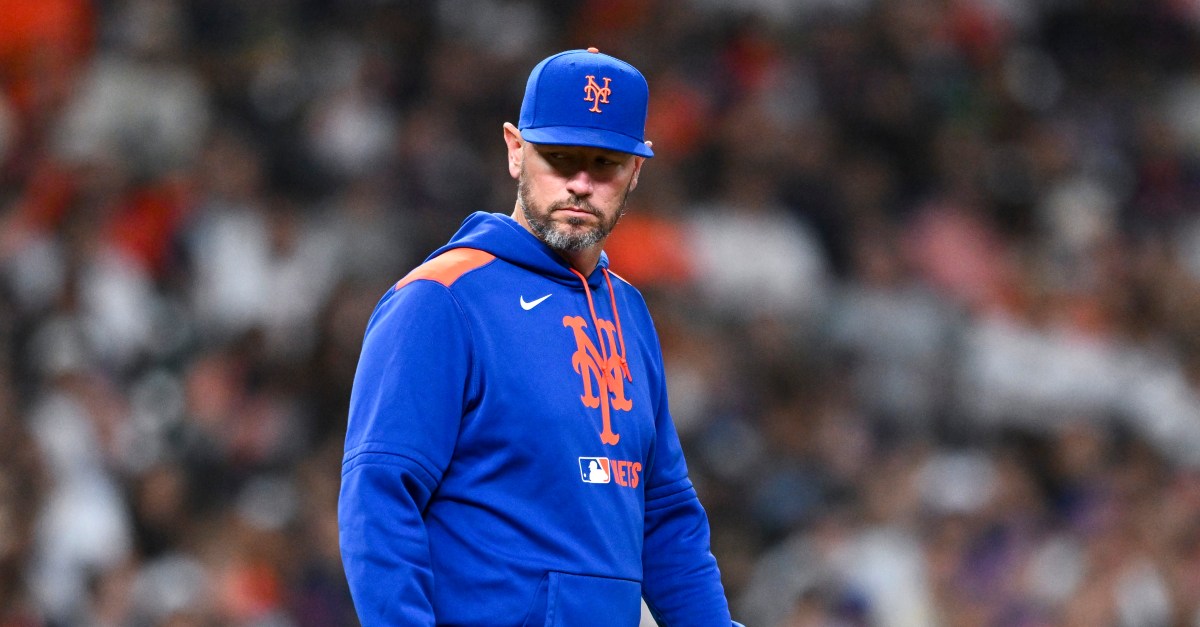
Jeremy Hefner was announced as the Mets’ new pitching coach on November 26, 2019 — back when the organization was owned by the Wilpons, the roster was constructed by Brodie Van Wagenen, and the coaching staff was set to be led by highly-anticipated rookie manager Carlos Beltrán. Since that date, the Mets have been sold to a new owner, switched general managers (or president of baseball operations) five times, and cycled through a trio of managers, bullpen coaches, and hitting coaches. Through all the chaos, Jeremy Hefner had remained; but on October 3, amid a sweeping wave of turnover after the Mets’ stunning late-season collapse, Hefner’s time with the Mets came to an unceremonious end.
Only four men have held the position of Mets pitching coach for at least six seasons: Rube Walker (1968-1981), Mel Stottlemyre (1984-1993), Dan Warthen (2008-2017), and Hefner (2020-2025). While Hefner is the only member of that group without a pennant, he oversaw the third-best regular season in franchise history in 2022, led the ragtag staff that came two games short of the World Series in 2024, and perhaps most notably seemed to earn the trust of players and executives around the Mets organization. While fans outside the clubhouse might never know the impact that a coach has on a specific team’s record or a specific player’s performance (there’s no WAR for pitching coaches, after all), it feels only fitting to honor Hefner by highlighting those who have found success during his tenure.
So let’s take a seam-shifted, tunneled, induced vertical drop down memory lane to revisit, in no particular order, some of the most memorable pitching success stories from the past six years of Mets baseball.
1 The Evolution of Taijuan Walker
Taijuan Walker was an All-Star in 2021, but his second half yielded a whopping 7.13 ERA, 0-8 record, and .540 opponent slugging percentage (for reference, Juan Soto’s career SLG is .531, meaning the average batter facing Walker was doing more damage than Soto). The next offseason, the 29-year-old right-hander aimed to tweak his repertoire by honing command over his split-finger fastball. Walker used the splitter just 14.3% of the time in 2021, but threw it at a 27.6% rate in 2022, generating a .267 opponent SLG and a run value of 13 — the second-highest run value for a splitter in the majors that season behind Tony Gonsolin.
Walker rode his new approach in 2022 to a 3.49 ERA, 2.7 bWAR, and 12 wins, all setting or matching a career-high at the time. The strong season helped land Walker a four-year, $72M deal with the Phillies, and helped the Mets reach 101 wins. Walker’s improvement followed a pattern observed throughout during Hefner’s time with the Mets, and throughout this list: an underutilized pitch is mastered, its usage is prioritized over a less-effective fastball, and results follow.
2 The Return of Luis Severino
When the Mets signed Luis Severino ahead of the 2024 season, he was six years removed from his last 20-start season and coming off a nightmarish 2023 in which he put up a 6.65 ERA. In 2024, Severino’s career was rejuvenated in two ways. First, he remained healthy, starting 31 games and tossing 182.0 IP. Second, he built a repertoire to match his more mature age, dropping his four-seam fastball usage to 35.7% while emphasizing a sinker and sweeper combination that made up just 5.3% of his pitches the previous season.
Severino’s sinker, previously an afterthought in his arsenal, became his most valuable pitch in 2024. The sinker generated the third-lowest Hard Hit % of any sinker in the National League that season (trailing only a pair of ex-Mets in Zack Wheeler and Steven Matz). In his first year with the Athletics in 2025, Severino continued to wean off his four-seamer, finding success with his cutter. If Severino continues to serve as a quality major league pitcher for years to come, his success would be traced back to his one-season revival with the Mets.
3 The Side-Arming of Sean Manaea
Sean Manaea was signed to be a reliable, middle-of-the-rotation arm for the Mets in 2024. For 20 starts, that’s exactly who the Mets got, as Manaea pitched to a 3.74 ERA and 8.6 K/9 rate — both just a tick better than his career norms up to that point. But after watching fellow lefty Chris Sale dominate the Mets in late July, Manaea decided to experiment with a mechanical adjustment, dropping his arm slot to emulate the 2025 Cy Young Award winner. Over his next 15 starts, Manaea became an ace, pitching to a 3.01 ERA and 9.7 K/9 rate while the Mets went 12-3.
For a 32-year-old veteran to suddenly make a dramatic shift in his delivery is relatively rare. Though the change wasn’t Hefner’s idea, it takes a special type of energy, support, and flexibility to facilitate an environment where such a change is possible — not to mention resoundingly successful. Manaea was unable to continue his success into a disappointing 2025 season, but the left-hander’s transformation nonetheless played a critical role in the Mets’ 2024 postseason run. Regardless of what awaits him in the remaining two seasons of his contract, Manaea will forever be a meaningful part of Mets history.
4 The Brief Unlocking of Griffin Canning
Before his tragically timed Achilles injury, Griffin Canning’s resurgence was one of the best stories of the Mets’ 2025 season. Across 31 starts in 2024, Griffin Canning had a 5.19 ERA, sporting a dismal Baseball Savant page that resembled a sea of solid blue. Over 16 starts in 2025, Canning’s ERA dropped to 3.77.
What did the Mets see in the 28-year-old right-hander? Canning had one of the worst fastballs in baseball, but an under-utilized arsenal of breaking and off-speed pitches. In New York, his slider gained over three inches of vertical break and its usage jumped from 24.1% to 31.5%. His changeup, already his best pitch, gained over two inches of vertical break and yielded a .196 batting average. While Canning’s whiff and hard hit rates remained relatively unchanged from his career norms, his ground ball rate jumped from a modest 41.3% in 2024 to an elite 51.6% as a result of the improved slider and changeup. In just sixteen starts, Canning also racked up seven wins — matching a career-high before his season came to a sudden end in June.
5 The Rise (and Horizontal Break) of Reed Garrett
When Reed Garrett arrived in Flushing at 30 years old, he bore a career ERA of 7.97 across 27.1 innings pitched with three different teams. Throughout his first three seasons in the majors, Garrett threw his four-seam fastball at a 48.3% rate, with hitters slugging .494 against the primary pitch. During his first full season with the Mets in 2024, Garrett’s approach completely flipped, using the four-seamer just 16.8% of the time and using his splitter — previously his third or fourth pitch — at a 27.1% clip. The splitter generated a 51.1 Whiff%, the fourth-highest of any splitter in baseball. The next season, Garrett leaned even less on his four-seamer, relying almost entirely on his cutter, sinker, splitter and sweeper — four pitches which possess above-average horizontal break.
Since the start of the 2024 season, Garrett has become a reliable force in the Mets’ bullpen, pitching to a solid 3.83 ERA while totaling 111.2 innings of relief, the 28th-most in baseball. In a story by Mark W. Sanchez of The New York Post that September, Garrett sang Hefner’s praises, saying of his pitching coach: “I don’t think he gets all the credit he deserves,” “I don’t think we could do what we do on the field without him,” “I trust him more than any coach I’ve ever trusted,” and, “He is a genuine human being who cares about you as a person, not just a player. … He’s just a good individual who cares about us and wants us to be the best we can be.”
6 The Final Form of Jacob deGrom
Every year, it seemed the ageless wonder Jacob deGrom gained an extra gear of velocity. In reality, deGrom only had one season where his fastball velocity gained more than one mile per hour: in 2020, Hefner’s first season, when his average fastball jumped from 96.9 to 98.6 mph.
If not for the covid-shortened schedule restricting teams to play within their geographic divisions, deGrom would have been in position to win a third consecutive Cy Young Award that season (Trevor Bauer, who won the N.L. award, pitched ten of his eleven starts to a bottom-ten offense in baseball). The following year, deGrom reached peak dominance, recording an absurd 1.08 ERA and 45.1 K% before injuries diverted his career. Whether or not those injuries were ultimately a product of his velocity jump, it’s undeniable that the Mets phenom had his best stuff — although not his best full seasons — under Hefner’s watch.
7 The Reformation of Edwin Diaz — again, and again, and again
Edwin Díaz’s first season in orange and blue might feel like a distant memory, but before he was the beloved bullpen staple entering to blaring trumpets, sealing no-hitters and playoff series, and earning multiple All-Star selections, Díaz seemed doomed to be a trademark Mets disaster. In his first year with the Mets after being traded from Seattle, Díaz pitched to a 5.59 ERA, recorded -0.6 WAR, and set a franchise record by allowing 15 home runs as a reliever in a single season. Díaz’s 2.3 HR/9 rate was also the highest of any Met in a single season with at least 50.0 IP. The next summer, Díaz was a different pitcher, posting a 1.75 ERA in the shortened 2020 campaign with Hefner now at the helm.
The remarkable bounceback was a microcosm of Díaz’s Mets tenure while working with Hefner. It hasn’t always come easily — whether because of a WBC injury, mechanical funks, or legs of different lengths — but every time Díaz has struggled to find his footing (figuratively or literally), he’s returned stronger than before. If Díaz enters a slump, fans now seem to instinctually believe that he’ll return to form in a matter of outings. It’s a trust that speaks to the remarkable mental resilience of Díaz and the efforts of the entire Mets training staff, but also to the pitching coach who has helped ensure that the calamitous season-long slump of 2019 stays a thing of the past.