
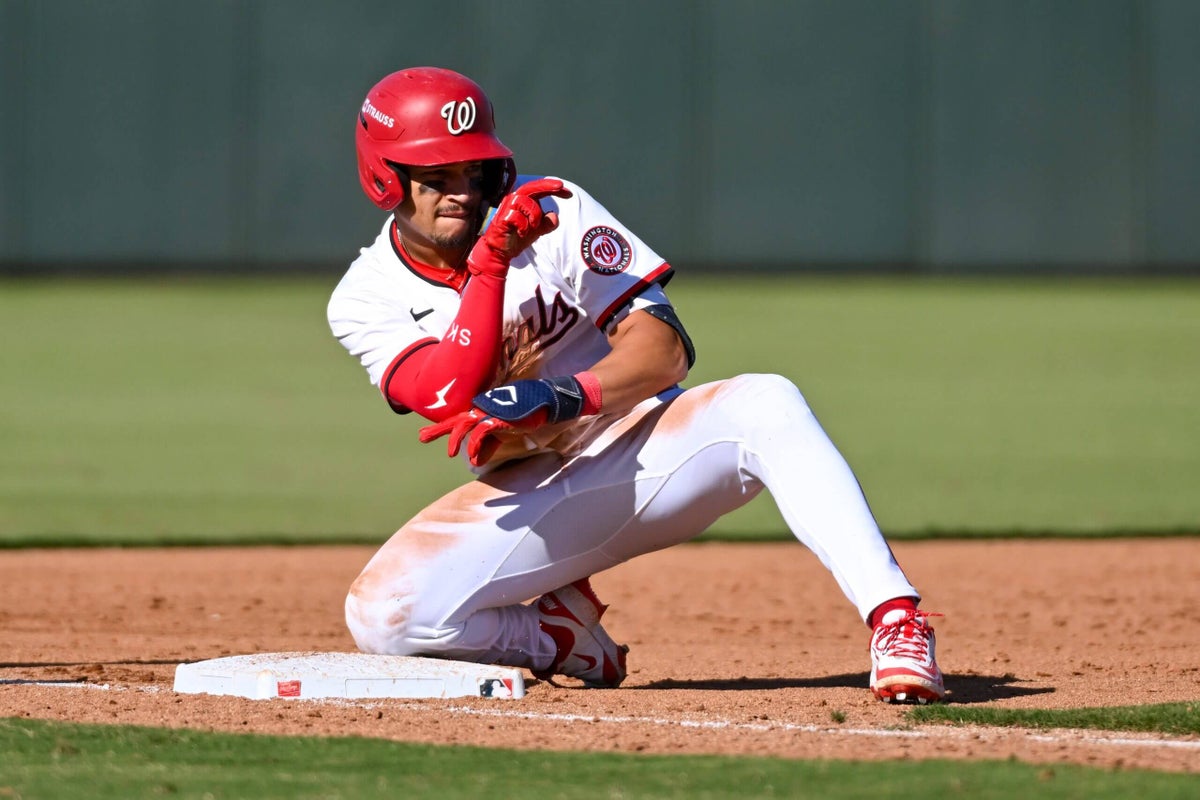
Earlier this week, I reviewed the top pitchers I saw in my five days at the Arizona Fall League. Here’s a look at the top hitters I saw in the desert:
Seaver King of the Nationals stands out on both sides of the ball; Sam Petersen an intriguing bat
Washington Nationals prospect Seaver King had the best week of any player I saw in Arizona, playing 70 (on the 20-80 scouting scale) defense at shortstop and using the whole field well. He did that while showing the above-average power that made him the No. 10 pick in the 2024 draft.
The Nationals’ amateur scouting staff believed he could play shortstop, even though he’d primarily played other positions in his one year at Wake Forest. And they were right, as he showed good range to his right and excellent hands, making one outstanding play on a weakly hit groundball that required him to get off his feet quickly and make a throw while on the run to get the runner.
King’s 2025 regular season was derailed in spring training by a specific Nationals coach encouraging him to change his swing to pull the ball in the air more. The results speak for themselves: he started in a huge funk, with a .222/.283/.333 line and 27.6 percent strikeout rate on May 15, then hit well for two weeks before a promotion to Double A.
At that level, he hit .233/.287/.313 for the remainder of the season, although at least there he cut the strikeout rate to 20.7 percent. In the AFL, he’s reverted to his college swing and approach, and he looks like a completely new player, hitting .382/.462/.706 in 39 plate appearances as of Oct. 21. More importantly, he’s using the whole field again while making much more frequent contact (just four strikeouts).
I spoke to King after one game, and he mentioned that his Double-A Harrisburg hitting coach, Jeff Livesey, who is in the AFL on Scottsdale’s coaching staff, and his AFL teammate Kevin McGonigle, helped get him to stop worrying about the shape of his swing and instead focus on getting into good counts where he can swing hard.
He’s always been an aggressive hitter who showed in college that he could even square up some pitches out of the zone, and now he’s loose at the plate again. For instance, I saw him drop his hands on a changeup down and in for a triple, whereas before he would have looked like he was squeezing the bat handle tightly enough to strangle it. I’m not sure what the motivation would be to take a first-round pick who was very good in his pro debut and try to change his entire approach before the next season. Sending King to the AFL gave him a chance to reset everything, and now he looks like a potential star again.
Nationals outfielder Sam Petersen missed a couple of days after taking a fastball to the head, which hit him hard enough to send his helmet flying in one direction and the ball in another. He returned to show a strong approach and good feel for contact, though. A 2024 eighth-round pick, Petersen has been banged up repeatedly since he signed, but when he’s played, he’s shown he can work the count and hit for average.
His profile is not going to offer much power, as he’s more of a bat-to-ball guy without great bat speed, and his chance to be a regular depends on his ability to keep up his contact rate as he faces better stuff. He looks like an outstanding pick for that spot in the draft.
Pirates’ Esmerlyn Valdez hitting the ball hard, with excellent results; Tony Blanco hits 120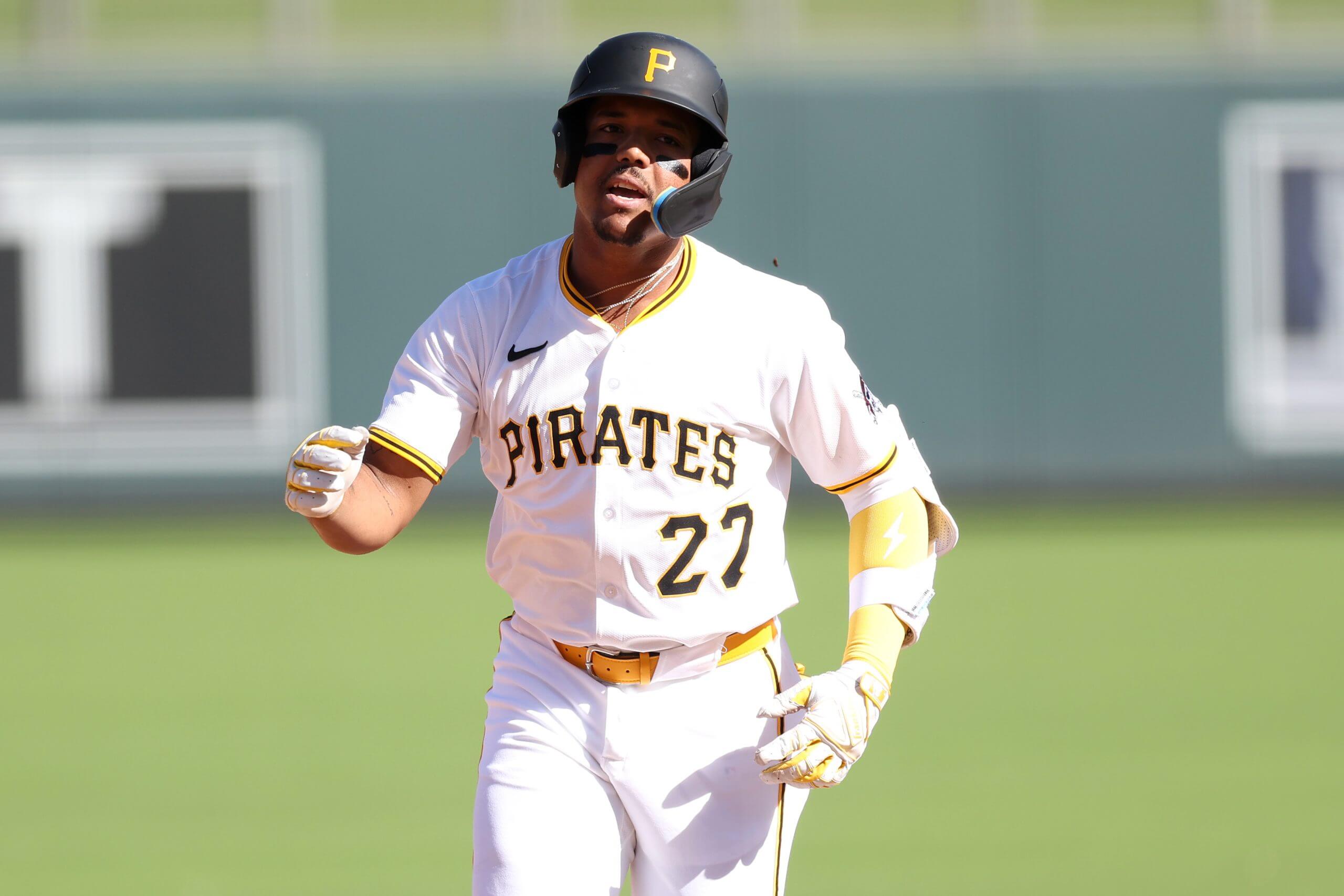
Esmerlyn Valdez took home Player of the Week honors. (Chris Coduto / Getty Images)
Pittsburgh Pirates outfielder Esmerlyn Valdez was the league’s hitter of the week and the best offensive performer while I was there. I saw him homer twice at 108 mph each time, double at 106 mph, ground out to third at 105 … and that was just in Sunday’s game before they removed him to get Will Taylor an at-bat.
Valdez’s profile is as much a hit tool as power, and he seems to recognize pitches pretty well, homering on a belt-high slider and then on a 95-mph pitch down the middle. He doesn’t chase, either, and while he’s more pull-oriented, he will go the other way.
He offers a pretty solid package of skills at the plate; he’s probably a first baseman, maybe a left fielder, so his value will entirely come from his bat.
Pirates slugger Tony Blanco Jr. hit a double at Salt River Fields at 120.4 mph, turning around a 94-mph pitch like it was put on a tee for him. He also hit balls at 111.4 and 106.7 in that same game.
Blanco Jr. is massive, listed at 6-foot-7 and I’m guessing 270 pounds or more, limited to first base if that, and he has some real plate coverage issues. He’s a prospect just because the raw power is at the top end of the scale, but contact frequency is going to be an issue for him, and it’s concerning to see someone this big before he even turns 21.
No ‘wow’ moments from Tigers top prospect Kevin McGonigle; Max Anderson swinging well
Detroit Tigers infielder Kevin McGonigle was my No. 1 prospect at the midseason update — I might flip him and Konnor Griffin right now, but I think the pair are going to be stars. McGonigle was fine in the AFL, although I was hoping for some ‘wow’ moments. I only saw two well-hit balls from him across four games, and the most impressive thing he did came on defense, where he ranged well into foul territory to catch a pop-up as the third baseman (not his natural position).
Fellow Tigers infield prospect Max Anderson was better at the plate, dropping the bat head to pull a changeup on the lower inside corner of the zone out to left for a homer one night, then driving a 87-mph pitch middle-away out to right for a homer later in the week. I still don’t see a position for him beyond left field, but he’s going to hit for average enough to find some role.
Mixed results from Rockies’ Charlie Condon; Jared Thomas hitting fastballs
Colorado Rockies top prospect Charlie Condon was a mixed bag this week, but before I get to him, let me tell you about the automated checked-swing review system, which is a joke. A couple of parks were trying this out, and it’s calibrated so that a hitter has to practically screw himself around in a complete circle for something to be called a swing: the hitter’s bat must go to a 45-degree angle beyond the front edge of home plate for the system to say he went.
Condon swung at strike three in the ninth inning of the first game I saw, but challenged it, probably knowing he had nothing to lose given the point in the game. The system said it wasn’t a swing — yeah, and I’m the last King of Scotland — and a pitch later, Condon hit a towering grand slam to left to win the game. I’m sure the system needs some recalibrating, especially after I saw nine straight obvious swings overturned by the algorithm.
Back to Condon, he’s raised his hands back up to where they were before his breakout spring for Georgia in 2024, and it’s contributing to his difficulty with breaking stuff down in the zone, which was already an issue for him before he moved his hands. He played some first base in the AFL, and he should go back to the outfield for everyone’s safety. There’s still big, big power here, and he can get to good fastballs. He’s got to get back to the hand position that made him the Golden Spikes winner in his draft year.
Rockies outfielder Jared Thomas can definitely whack a fastball, hitting the biggest homer I saw all week when he put a 95-mph fastball on the second tier of the Charro Lodge at Scottsdale Stadium. The offspeed recognition isn’t there for him to hit for much average, but he could end up a 25-30 homer guy in Colorado because of the benefit their home park affords hitters who prefer to hunt for fastballs.
D-Backs’ Jansel Luis has tools, needs refinement at the plate
Jansel Luis was on my top 100 prospect list going into 2024, had just a fair 2024 season as a 19-year-old in Low A, then bounced back this past year with a .304/.342/.422 line in High A where he slashed his strikeout rate from 21 percent to 16 percent even with the promotion.
He’s really toolsy, with great bat speed from both sides of the plate, plus running speed, sneaky pop and maybe a 70 arm that’ll let him stick at third base. He’s just inconsistent at the plate, with a swing-first approach that puts him in some disadvantageous counts, but even then, his hands are so quick that he can still foul some pitches off to extend the at-bat. I caught one at-bat where he fell behind immediately 0-2, then he snapped into two-strike mode, ending up with a sac fly in a 10-pitch at-bat.
He’s not a shortstop, and third base is probably a better bet than second. I’m a little concerned that he’ll get to Double A and pitchers will exploit his aggressiveness early in counts, at which point we’ll see if he can adjust back and show a little more selectivity.
Miami’s Starlyn Caba a future defensive star; PJ Morlando struggling to hit
Starlyn Caba is the best defensive shortstop prospect I’ve seen since Jose Iglesias in 2009-10. Caba makes every play look routine, with plus range in both directions and outstanding instincts. He barely has to hit to be a big leaguer … but that’s still a question, as the Marlins shortstop, acquired from Philadelphia in the Jesús Luzardo trade, is still so small that he can’t impact the ball or even do anything with good velocity.
Caba is still 19, turning 20 in December, and has time to get stronger, but it’s not a big frame (listed at 5-9, 160, and he might be 5-8), and it’s not a guarantee that he’ll get past the threshold of strength required to be a big-league hitter. He does have a solid understanding of the strike zone, so I’m cautiously optimistic that if he does gain sufficient strength, he can be a replacement-level or better hitter and be worth a couple of wins a year with his glove alone.
Miami outfielder PJ Morlando was the Marlins’ first-round pick in 2024 and was one of the youngest players in the AFL this year, which showed as he was just overmatched by better stuff. He’s struck out 12 times in 30 plate appearances through Tuesday, and I saw six of those strikeouts, coming on fastballs and sliders in and out of the zone. The good news is that the Marlins have refined his stance so he’s not starting so wide and can move his feet more for weight transfer and more flexibility.
Reds’ Cam Collier in good shape, playing well at third; Alfredo Duno blown up by velocity
Cincinnati infielder Cam Collier has lost some weight since the last time I saw him and played by far the best third base I’ve seen from him in pro ball. He missed almost half the year after tearing a thumb ligament early in spring training, undergoing surgery to repair it and coming back with a fraction of the power he’d shown before, going from 20 homers in 2024 to just four this year.
He’s homered once in the AFL, a no-doubter at 107 mph off a 98-mph fastball in the upper third of the strike zone, one of three hard-hit balls he had in that game. Then two days later, he looked like he’d just come from Rookie ball, punching out on fastballs up above the zone and then on off the outside corner for a pair of strikeouts. He played some first and wasn’t very good there, but third base is back on the table now that he’s improved his conditioning.
Then there’s Alfredo Duno, the Reds’ catching prospect who is coming off an outstanding year as a 19-year-old in Low A (.287/.430/.518 with more walks than strikeouts). Duno took some good at-bats when I saw him in the AFL, but he ultimately got blown up by velocity in most of the at-bats I saw.
He’s got a 70 arm and his receiving is fine, but that body — he’s listed at 6-2, 210, but I’d guess 260+ already — is trending the wrong way for a teenager and I can’t see him holding up at the position. I’ll offer one big caveat, however, which is that catchers never look good in the AFL. The year the Giants sent Buster Posey to the Fall League, he played like Parker Posey, and he turned out all right in the end.
Additional notes: Enrique Bradfield Jr. flashes the leather
• Baltimore’s Enrique Bradfield Jr. made the play of the week, robbing a home run to end a game, which is good since he spent a huge portion of his week … bunting. I wouldn’t even bother to send a guy to the AFL if that was the plan. He’s an 80 runner, so sure, there’s some benefit to him being able to push a bunt towards third base to try to beat it out, but he has bigger swing issues to work on, and instead, he’s dropping 30-mph exit velocities on the infield grass.
• Astros catcher Walker Janek had a disappointing first full season in pro ball, hitting .263/.333/.433 for High-A Asheville, a paradise for hitters and a place a 22-year-old college product should do a lot of damage. He homered twice last week, including a grand slam to left off a slider that left the bat at 104 mph, mixing a lot of hard contact with a lot of whiffs. He showed a plus arm that was pretty accurate, while his receiving was well below what I expected (again, catchers are generally bad in the AFL; they were just worse than ever this year).
• Mariners outfielder Jonny Farmelo has all of his speed back after returning from a torn ACL that ended his 2024 season in June, and still looks like he’ll be a plus defender in center field. I didn’t get a lot from him at the plate, other than a fair number of balls in play along with a strikeout against Diamondbacks prospect Drey Jameson.
• The A’s drafted Ryan Lasko in the second round in 2023, and he flopped in his first full season, hitting .232/.353/.328 in A-ball as a 22-year-old, and wasn’t any better with a return to High-A Lansing this past year. He’s hitting .346/.452/.385 through eight games in the AFL, to give you some sense of what the offensive levels can be like out there. (I still think he could be an extra outfielder — he does understand the strike zone and he has plus range in center — lacking the power to be more than that.)
• The Angels took outfielder Raudi Rodriguez in the 19th round in 2023 out of a Georgia high school, and after two years in the Arizona Complex League, he had a breakout year in 2025 in Low A, hitting .281/.372/.470 as a 21-year-old. He’s still raking in Arizona, with excellent bat speed and good hand-eye coordination. His swing can get a little long, but getting his arms extended is how he makes so much hard contact. I didn’t get much of that, unfortunately, seeing more soft contact and one futile hack at a slider in the other batter’s box, where he lost his bat. But I’ll bet on the underlying tools. Here’s hoping the Angels give him time to keep developing at his own pace.
• Mets catcher/outfielder Christopher Suero makes loud contact when he’s not swinging and missing, with a swing-hard-all-the-time approach that already started to break down when he got to Double A this summer. He is probably going to end up in left field, if anywhere, and if he ever tones down the approach to make some better choices at the plate, he could end up on a big-league bench.
A couple of players who didn’t look great, in ways that make me lower my projections for them:
• Rangers catcher Malcolm Moore, who I doubt is staying behind the plate, and whose swing decisions were poor.
• Giants infielder Walker Martin, who was challenged on the left side of the infield and showed below-average bat speed.
• Rays outfielder Brailer Guerrero, whose body has gotten thicker, didn’t seem to recognize balls and strikes at all. Guerrero now has 16 strikeouts in 29 plate appearances through Tuesday in Arizona, leading the league in strikeouts, with Moore tied for third with 13 Ks.