
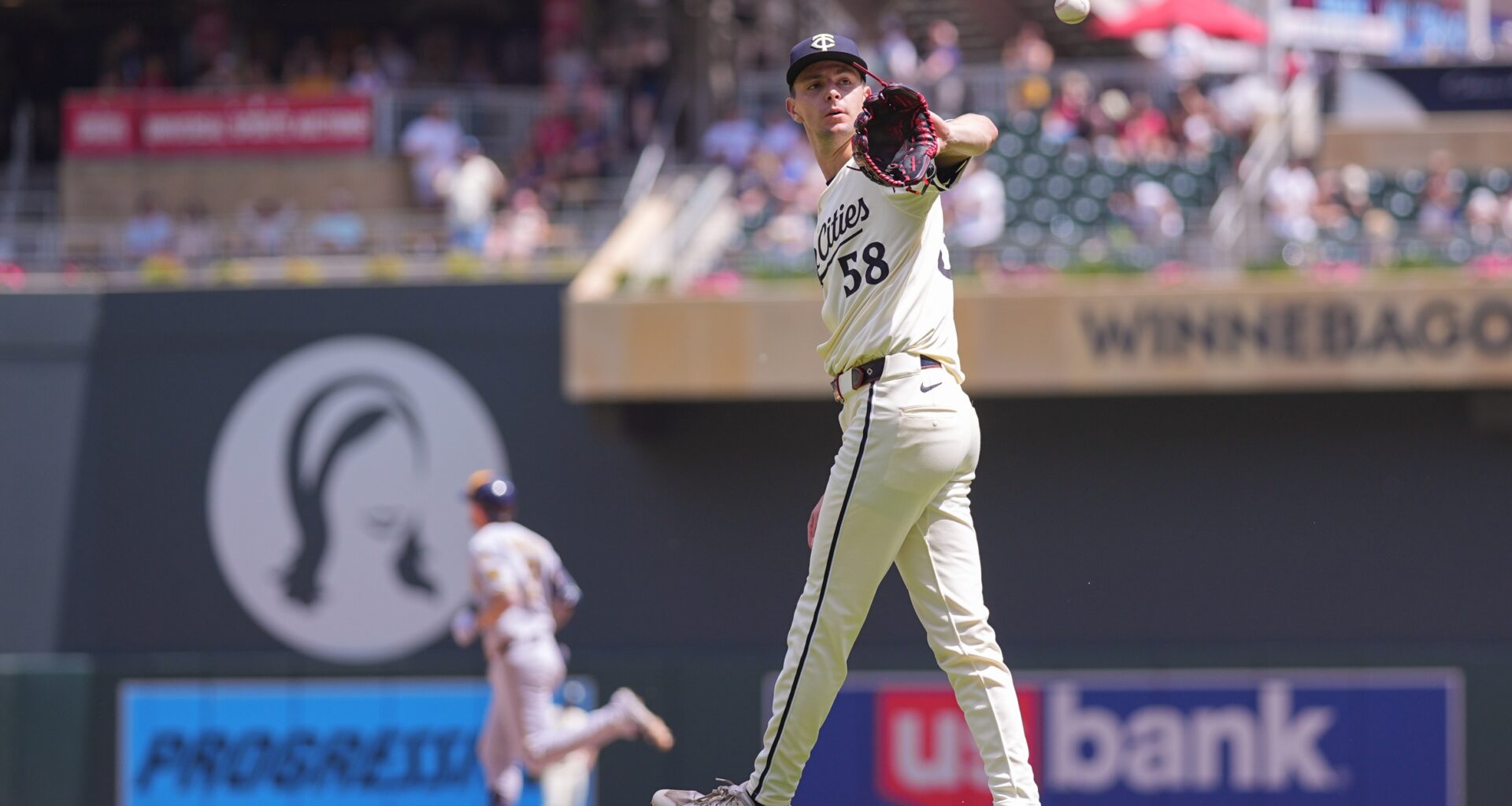
It’ll be a long off-season of rest and recovery for Twins starter David Festa. His 2025 ended early when he was diagnosed with thoracic outlet syndrome in early September.
Festa, 25, had already been on the IL since late July, when the Twins initially diagnosed him with shoulder inflammation and moved him off the active roster. After Festa visited with Dr. Keith Meister in Texas during their final road trip of the season, they discovered that Festa would not need surgery for TOS and could receive Botox injections between his shoulder and neck.
As encouraging as this news was, thoracic outlet syndrome is still one of the worst injuries a pitcher can have at any point in their career. The surgery can sometimes require the doctors to remove a rib for a player to be able to throw again. Festa was not the only pitcher to have TOS end their 2025 season. Phillies ace Zack Wheeler was diagnosed with it in late August and is unlikely to return to the mound before next May.
It’s also been a career killer for some of the more severe cases. Former Twins starter Phil Hughes suffered injury not only once, but twice, and pitched only 86 ⅓ innings over two seasons after his second surgery in 2016. 2005 NL Cy Young Winner Chris Carpenter made his final three starts in the majors after undergoing surgery for TOS in 2012. Meanwhile, Noah Lowry, whom the San Francisco Giants looked to build the future of their rotation around in the mid-2000s, never pitched a game in the majors after suffering from TOS in August 2007.
But then there are the rare oddities in this infamous fraternity of Major League pitchers, such as the Gambler Kenny Rogers, pitcher, not country singer, and one-time Colorado Rockies all-star Aaron Cook. Rogers underwent TOS surgery in 2001 and went on to pitch for seven more seasons before retiring at 43. Cook underwent his in 2004, made his lone all-star team four years later in 2008, and still holds many Rockies franchise records to this day.
If history has taught us anything about what happens after a pitcher is treated for thoracic outlet syndrome, it’s that it’s hard to predict what can come next for them.
In Festa’s case, his option of treatment was encouraging news, but Botox is still a newer alternative for pitchers to undergo and see what happens next. Still, the timeline for return could be anywhere from six to eight months, as it is for Wheeler, or a full season. Festa’s status will be unclear until pitchers and catchers report for spring training in mid-February, which is why the Twins need to operate with him in a reliever role moving forward.
As it stands, Minnesota’s rotation features eight men, including Festa, Pablo Lopez, Joe Ryan, Bailey Ober, Simeon Woods Richardson, Taj Bradley, Zebulon Matthews, and Mick Abel. The Twins will likely use most, if not all, in their starting rotation next season. Still, they should prepare for one of the eight to be in their bullpen for next year.
Festa makes the most sense right now, given how few pitchers have been able to continue their careers after undergoing thoracic outlet syndrome surgery. He will be in a bit of uncharted territory for pitchers who return from TOS after Botox surgery. He could pitch 1,000-plus innings, as Rogers and Cook did. However, there’s still a reality where he could have a similar experience to Hughes or Carpenter, where it could be a challenge just to throw.
The unpredictability is a good enough reason for the Twins to err on the side of caution with Festa in 2026 and see what he can do with a lighter workload, pitching one to two innings per outing. Their bullpen has plenty of open spaces to fill, with only three pitchers – Cole Sands, Kody Funderburk, and Justin Topa – locked into positions for the 2026 season.
Festa’s numbers when facing batters for the first time through the order also help back up the reason to lighten Festa’s workload. Opponents only hit .179/.225/.345 with four home runs in 89 plate appearances when facing him for the first time through. Transition that into the bullpen, and the Slim Reaper Festa could become a high-leverage reliever the Twins desperately need.
Even with a groundbreaking new treatment for Festa’s TOS, history shows the Twins front office is best to err on the side of caution with how they use Festa next season. Building him back up as a reliever will help keep his career going at a safer rate. If all bodes well, he could become someone dependable to use in the later innings of games.