
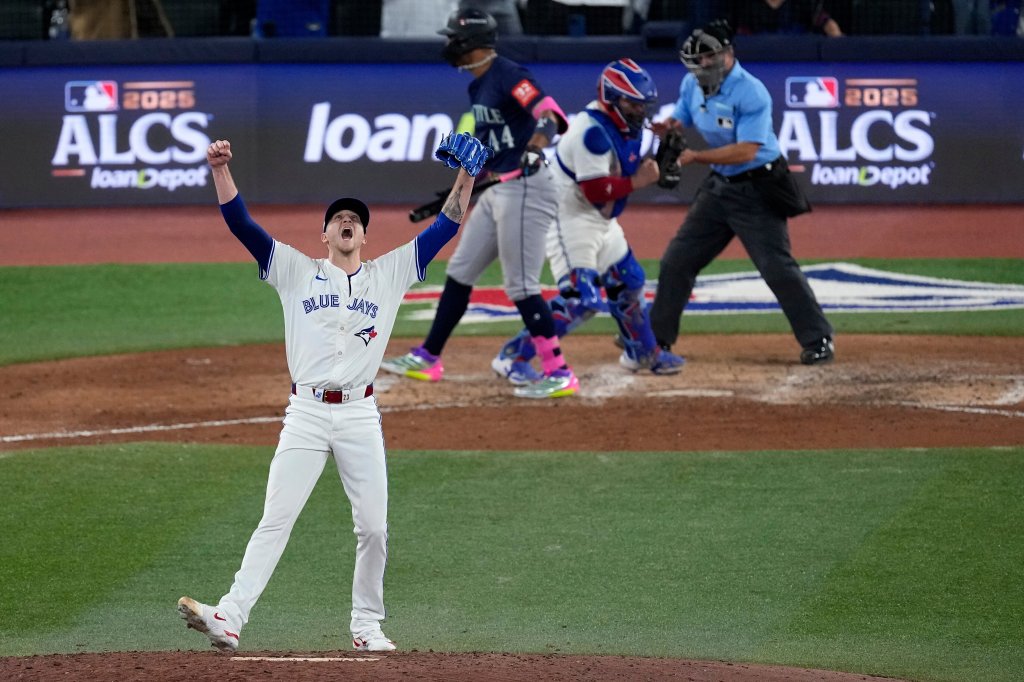
With a trip to the World Series hanging in the balance, the Blue Jays needed two former Colorado arms to get the job done.
Grandview High School alum Kevin Gausman, one of the best starters in baseball over the last half-decade, pitched a scoreless seventh inning that preceded George Springer’s ALCS-winning home run in the bottom of the frame. And former Rockies pitcher Jeff Hoffman came on two innings later to shut the door, becoming only the second hurler ever to face and strike out all three batters in the last inning of a Game 7.
An emotional Hoffman let out a scream and raised his arms to the sky after getting Seattle’s Julio Rodríguez to swing and miss at a 3-2 slider for the game’s final out. Eventually, he found himself embracing Blue Jays manager John Schneider in the postgame celebration.
“This is what full-circle looks like,” Hoffman told FOX’s Ken Rosenthal after he was asked about his hug with Schneider.
With that, the Blue Jays booked their first World Series appearance since 1993 — a showdown that begins Friday at Rogers Centre against the favored Los Angeles Dodgers. Gausman and Hoffman, both cast to the scrap heap at different points in their careers, will play key roles in Toronto’s hopes for an upset.
“You get whacked around a little bit, you get a little shaken, and it takes time to really understand how you’re going to get your outs (in the majors),” observed Bud Black, who managed Hoffman in Colorado and frequently went against Gausman during the latter’s tenure with the Giants. “Those guys have finally done that, after patience was required and adversity was overcome.”
Gausman, drafted fourth overall out of LSU by the Orioles in 2012, showed promise over six years with Baltimore. But then the O’s traded him to the Braves at the deadline in 2018. Roughly a year later, Atlanta designated him for assignment. He was picked up by the Reds and sent to the bullpen, and he posted a 5.72 cumulative ERA in ’19 — his career going in reverse.
But then he signed with the Giants in 2020, a move that jump-started his revitalization. Over two years in San Francisco, he posted a 3.00 ERA in 45 games (43 starts), ditched the wind-up to pitch out of the stretch full-time, and became an All-Star by the time the game returned to Coors Field in ’21.
“When the Giants got ahold of him, they leaned heavily into the analytical stuff,” explained Gausman’s brother, Brian. “They basically told him that he needed to throw everything off of his splitter. That he needed to stop playing an east-west game of going in and out. He needed to play a north-south game — raise the hitters’ eye level, and then throw his splitter down.”
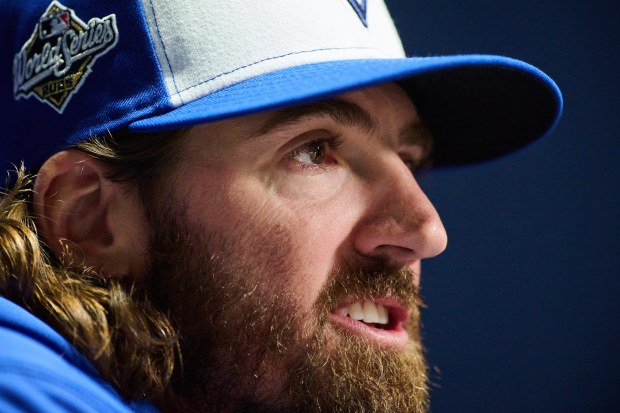 Toronto Blue Jays’ Kevin Gausman speaks to media during the Toronto Blue Jays’ media day ahead of the 2025 World Series against the Los Angeles Dodgers in Toronto, on Thursday, Oct. 23, 2025. (Sammy Kogan/The Canadian Press via AP)
Gausman’s been doing that ever since, finding success as a two-pitch starter with a fastball and his signature splitter, which drops off the table so much that the pitch earned the nickname “The Waterfall” during his days at LSU.
Black said the Rockies twice tried to sign him in free agency but “couldn’t quite get there financially.” Instead, he wound up in Toronto after his time in San Francisco and has built a career north of the border. Now in his fourth year there, Gausman has a 3.48 ERA in 125 regular-season starts for the Blue Jays. He’s been even better during Toronto’s 2025 postseason run with a 2.00 ERA over 18 innings.
Gausman throws his fastball 54% of the time, his splitter 38% of the time and mixes in an occasional slider. In the seventh inning of Game 7 against Seattle, he threw his splitter five straight times to Jorge Polanco to induce a groundout to end the frame and strand two runners on base.
“The book is out on me,” Gausman acknowledged to reporters on Oct. 3. “These guys kind of know what they’re going to get. There’s different ways where I can kind of throw a wrinkle into their mind, but I’m going to throw my best two pitches, and I’m going to throw them a lot. If I can throw my fastball to where I want to and locate my split when I need to, I feel pretty confident that I can get any righty or lefty out in the game.”
Hoffman’s road to the World Series is even more unlikely.
The No. 9 overall pick of the 2014 draft came to Colorado in 2015 as a centerpiece in the blockbuster trade for shortstop Troy Tulowitzki. But Hoffman never truly found his footing as a Rockies starter. Colorado finally moved him to the bullpen in 2020, when he posted a 9.28 ERA in 16 games before being traded to the Reds that offseason.
He showed promise as a full-time reliever in Cincinnati, with a 3.83 ERA in 35 games in ’22. But then his roller-coaster began. Hoffman was non-tendered by the Reds and signed a minor-league deal with the Twins the following spring training. His Minnesota tenure lasted a month after he didn’t make the opening day roster.
Hoffman signed with the Phillies three days later, the start of a turnaround that Rockies pitcher and close friend Kyle Freeland called “something special.” Hoffman had a 2.28 ERA over 122 relief appearances in two seasons in Philadelphia, earning an All-Star nod last year and leading to his three-year, $33 million deal with Toronto ahead of this season.
“The talent and potential was always there,” Black said. “The Blue Jays saw it as a first-round draft pick. The Rockies saw it as a key piece in a trade. … He gained confidence as he logged each season, and finally it all crystallized in Philadelphia.”
Black believes Hoffman’s changes to his arm action led to more consistency. Hoffman — who ranks in the 97th percentile in baseball in chase percentage, 90th percentile in whiff percentage and 88th percentile in K percentage — led the majors with 59 games finished this season (33 saves). This postseason, he has a 1.23 ERA and two saves in six outings.
“When we first got him, he had a naturally long, loose arm, and that caused him to be a bit too inconsistent,” Black said. “So he went from a longer circle in the back to a drastic change, a much shorter one, and now it’s evolved to something in between. He’s found an arm stroke that’s really efficient and works for him.”
Moments after recording the final out of the ALCS, Hoffman said he “couldn’t be happier” with how his career has panned out. But he and Gausman’s challenge in the World Series will be the steepest yet, with a lineup featuring future Hall of Famers Shohei Ohtani, Mookie Betts and Freddie Freeman awaiting them.
Gausman is the likely candidate to start Game 2 after Schneider announced that the Blue Jays will roll out rookie Trey Yesavage to start opposite Blake Snell in Game 1. Hoffman would, of course, be the one who closes the door in the ninth.
A World Series ring would cement Gausman as the third pitcher in the trio of gold-standard Colorado arms alongside National Baseball Hall of Famers Roy Halladay (Arvada West) and Goose Goosage (Wasson). Gausman wears No. 32 with Toronto as an homage to Halladay, who wore that number in Philadelphia (Toronto retired Halladay’s No. 34 in 2018). But even the A-West legend never got a chance to pitch in the Fall Classic.
“If the Blue Jays win the World Series,” said Chris Baum, the coach who taught Gausman his splitter at Grandview, “Kevin would definitely be third on that list.”
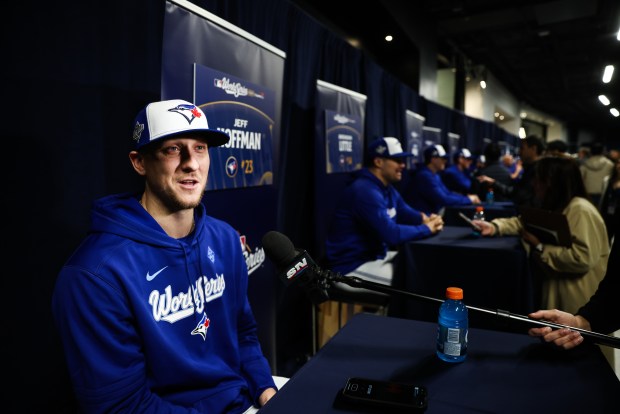 Jeff Hoffman of the Toronto Blue Jays speaks to media during World Series Workout Day ahead of Game 1 of the World Series at Rogers Centre on October 23, 2025 in Toronto, Ontario, Canada. (Photo by Cole Burston/Getty Images)
Want more Rockies news? Sign up for the Rockies Insider to get all our MLB analysis.