
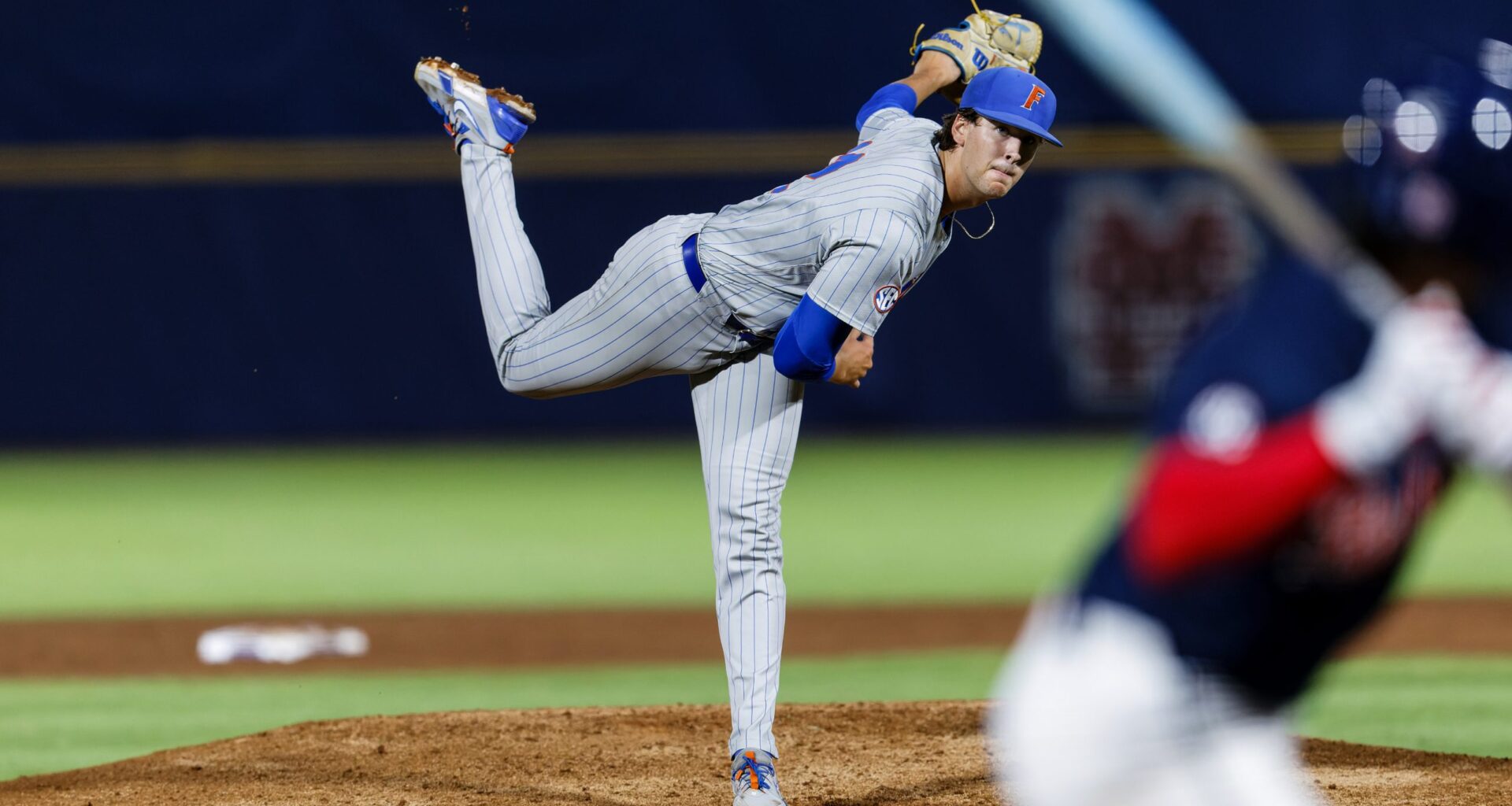
Welcome back to our offseason scouting series for the 2026 draft class. In this series, we’ll be examining some of the top players in the class by getting into the weeds with video, data and reporting as we prepare for the 2026 spring season. You can find all of our previous offseason scouting installments here. Today, we’re taking a look at Florida pitcher Liam Peterson.
Peterson is the top overall pitcher in the 2026 class. A prominent prospect out of Cavalry Christian High in Clearwater, Fla., he ranked No. 91 in the 2023 draft class and stepped immediately into Florida’s rotation as a freshman. After posting a 6.18 ERA as a freshman in 2024, Peterson made real strides in his 2025 sophomore season, logging a 4.28 ERA over 15 starts and 69.1 innings with a 31.5% strikeout rate and 10.5% walk rate. During the summer Peterson pitched with Team USA, where he threw one shutout inning in the Japan series, and ranked as the No. 3 prospect on the club.
Body & Delivery
Peterson was already quite tall in high school, but over the last three years he has begun to come into the physical projection scouts expected. He has added 20 pounds of listed weight since his prep days and now stands 6-foot-5, 220 pounds with a lean, well-proportioned frame.
Peterson tends to work from the middle or third base side of the rubber. He now does a much better job of staying stacked over his back leg throughout his leg lift and doesn’t leak out toward the plate too early like he would at times as a prepster. His direction to the plate is improved with a lower half that goes directly toward the plate compared to a high school delivery that often saw him land with a crossbody finish.
Peterson has impressive arm speed and has added more verticality to his arm slot over the years. He threw from a low three-quarters slot at times as a high schooler, then in college moved to more of a high, three-quarters slot. This fall he raises his slot even more and is now throwing from a slot that looks almost entirely over the top.
Fastball
After touching 96 mph as a high schooler, Peterson is now sitting north of 95 mph with one of the better fastballs in the class. He averaged 94 mph as a freshman in 2024, then added a tick and a half in 2025—sitting at 95.4 mph and touching 99 at peak. It’s a four-seam fastball with above-average riding life and averaged nearly 21 inches in induced vertical break during the 2025 season compared to 18 inches in 2024.
That uptick in velocity and ride helped him go from a 7.2% swinging strike rate as a freshman to an 11.3% swinging strike rate as a sophomore. In both seasons, Peterson has used his fastball at a 51% clip. It’s also the pitch he throws in the strike zone most consistently.
Peterson’s vertical arm slot pairs nicely with his ability to ride the baseball to the top of the zone, and getting a steeper release point could help him get behind the ball even more. While Peterson is largely a four-seam pitcher, he has tinkered with a two-seam variant to give hitters a different look, and that two-seam fastball could be a pitch that plays well at the bottom of the zone from his above-average release height.
While Peterson has made strides with his fastball shape and velocity, it’s also been a pitch that can get hit hard. In both his seasons with Florida, opposing hitters have managed a .288/.417/.541 slash line against the pitch, including 18 of the 24 home runs he’s allowed. His fastball control is solid, but his fastball command could use more refinement. Peterson does get more misses in the top third of the zone (20% fastball miss rate) but batters have produced an .885 OPS against the fastball there, compared to a .652 OPS against the fastball in the bottom third of the zone (and a 13% fastball miss rate).
This is a quality fastball, but it’s not the sort of Liam Doyle heater that he can just put in the zone and find automatic success. He will be reliant on command to avoid damage.
Slider
Peterson’s slider usage is the most significant year-over-year change he made from 2024 to 2025. After throwing the pitch 13% of the time as a freshman—his fourth pitch—he dialed up the usage to a 32% overall rate in 2025, making it his obvious go-to secondary.
The increased usage coincided with a 3-mph uptick in power. He threw the pitch 84.7 mph last spring and will throw his hardest sliders in the upper 80s. The pitch has excellent pure spin rates in the 2,600-2,700 rpm range and features hard, biting tilt and a gyro look overall. He has flashed a few sliders that show more of a gloveside sweeping look at times, and this fall he was consistently throwing the pitch in the upper 80s.
It’s a no-doubt plus offering and might be his best individual pitch. It’s certainly his most reliable bat-misser at the moment. He used the pitch to generate a 15.2% swinging strike rate in 2024 and while using it nearly three times more frequently in 2025 generated a 15.8% swinging strike rate. He used the pitch nearly half the time against righthanded hitters and backed off it to a 17% usage rate against lefties.
Curveball
As a high schooler, Peterson’s breaking ball frequently blended in shape between a curveball and slider. Then as a freshman in college he got a bit more separation between the pitches and actually used the curveball at a slightly higher rate than his slider. That’s no longer the case, and he has largely scrapped the pitch entirely against righthanded hitters, but it is still a nice change-of-pace offering for lefties.
Peterson throws the curveball in the 77-82 mph range with a more of a top-down look and 12-to-6 shape. Like the slider, it’s a high-spin pitch that’s consistently around the 2,600 rpm range but it’s also less consistent, less of a bat-misser and a pitch that will frequently pop up out of his hand on release.
While Peterson clearly favors the slider, the curveball has had great results with less usage in his college career. He has used it just 10% of the time in his two seasons with Florida and in that period batters have hit just .114/.162/.143 against it with a 13.7% swinging strike rate. It’s also the only pitch in Peterson’s arsenal that he has landed for a strike less than half the time.
Changeup
Peterson’s changeup was his most-used secondary during his 2024 freshman season. While it has been overshadowed by the slider, it’s a key piece of his arsenal against lefthanded hitters. Peterson throws the pitch in the mid 80s with around 10 mph separation off his fastball on average, and about nine inches of separation of induced vertical break.
He used the pitch 20% of the time in 2024 and 14% of the time in 2025. Last spring against righties Peterson used the changeup just 6% of the time, but against lefties he used it 23% of the time—making it his primary non-fastball in right-on-left matchups.
Peterson throws the changeup with solid arm speed and it features a solid amount of fade and sink. Last spring, batters hit .257/.297/.483 against the changeup with a 21.4% swinging strike rate. It’s a pitch that can have a lot of success when he keeps it down in—or below—the strike zone, but he has been quite erratic with its location. When Peterson threw the changeup in the middle or upper thirds of the strike zone, that opposing slash line jumped to .455/.455/.909 and a 12.8% swinging strike rate.
Like most changeups, Peterson’s is most effective when he keeps it down. It doesn’t have the elite movement traits to be a bat-misser in any area of the zone, but does look like a rock-solid third piece of his arsenal.
Control & Command
Peterson is trending in the right direction when it comes to his control.
During his high school draft year, Peterson was highly inconsistent with his strikes across the board—fastball and otherwise. He did walk batters at well below-average rate as a freshman with Florida in 2024 (13.5% walk rate), but he improved that rate significantly during his 2025 sophomore season (10.5% walk rate). His overall strike rate jumped from 59% in 2024 to 62% in 2025.
This is perhaps the biggest area for improvement for Peterson as he enters his 2026 draft season. He has been a below-average strike-thrower in the past and might be a fringy strike-thrower currently.
If he can continue to make strides in this area—with his fastball command specifically and just more strikes consistency from his secondaries—he could have a chance to lock down his reputation as the SP1 in the college game and move from a power-armed, but inconsistent starter, to a well-rounded pitcher who could profile as midrotation arm in the majors.
In Summary
Peterson has the physicality and arm talent to profile as a typical, top-of-the-class college righthander who goes off the board in the first 15 picks and boasts midrotation upside. While he is currently the top college arm in the class, the gap between him and the next best college arms—Coastal Carolina’s Cameron Flukey and UC Santa Barbara’s Jackson Flora—is not large.
If he can continue making the strides he has already begun to make in the control and command departments, he will have every opportunity to slam on the door on that conversation and lock himself into an early draft pick. Multiple years of starting track record in the SEC always helps, and being able to pitch in that conference once again this spring is a separator from his closest competition at the moment.