
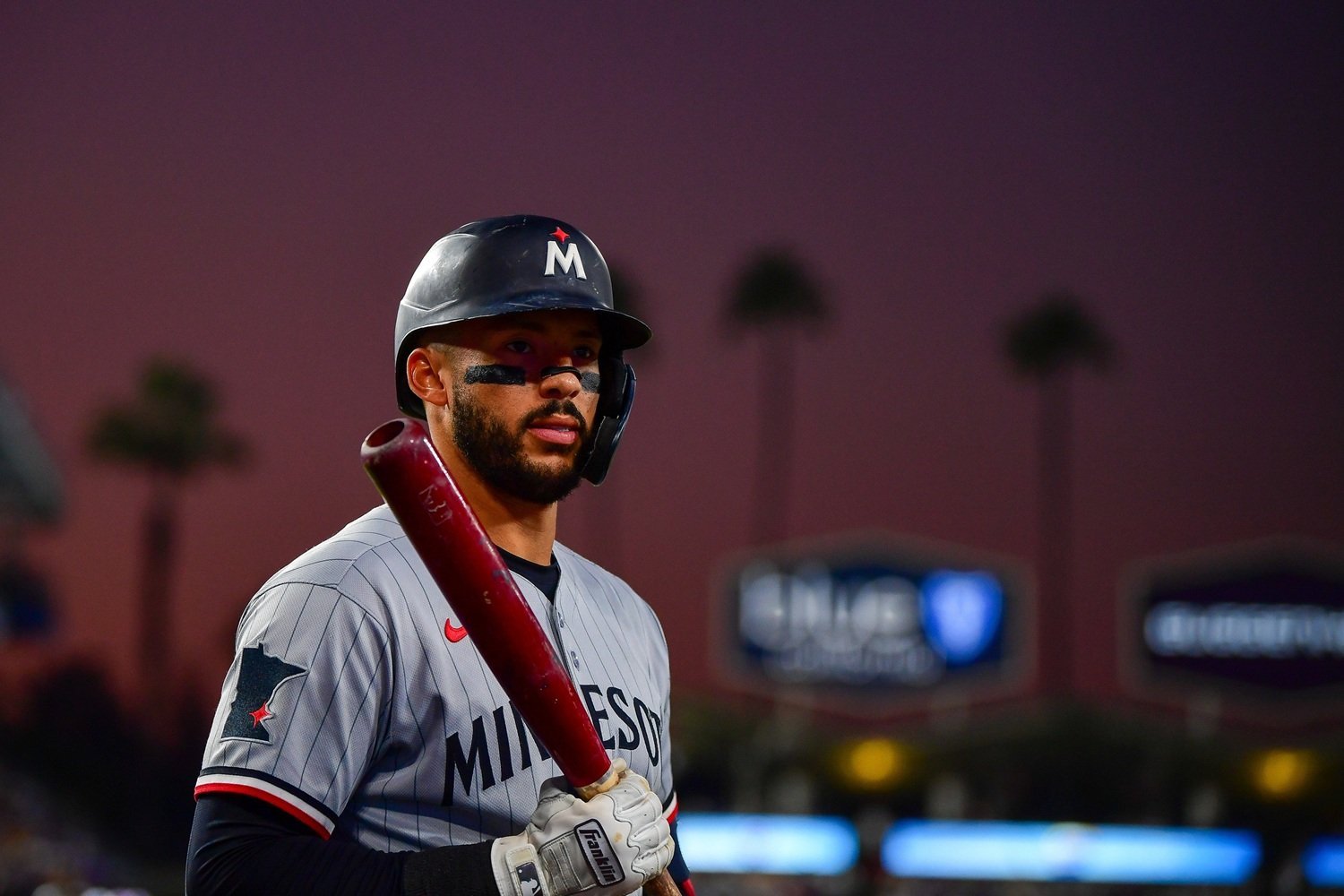
On a recent episode of Gleeman and the Geek, Aaron Gleeman and John Bonnes spent time discussing the fallout from Carlos Correa’s trade away from the Twins. Amid the disappointment of his exit, Gleeman raised an interesting notion: that Correa might actually be the best shortstop in Twins history. At first, that sounds bold. But when you look deeper, the argument gains serious traction.
Correa’s time in Minnesota was defined by flashes of brilliance, mixed with stretches of frustration. Injuries constantly limited him, including plantar fasciitis, back tightness, and even a concussion, yet he still managed to deliver in some big moments. His steady leadership and clutch hitting helped the Twins snap their postseason misery with a Wild Card win over the Toronto Blue Jays in 2023. Without him, that decades-long playoff losing streak might still hang like a cloud over the franchise.
In four seasons with Minnesota, Correa hit .271/.345/.440, with a 118 OPS+ and 10.4 rWAR. That number doesn’t leap off the page compared to the franchise’s all-time WAR leaders at the position (Roy Smalley, Zoilo Versalles, Jorge Polanco, and Greg Gagne), but context matters. Correa accumulated those numbers in fewer than 2,000 plate appearances. All four of those players logged more than 3,500 plate appearances with the Twins, making WAR a measure of longevity as much as value. On a per-game basis, Correa arguably produced at a higher level than any of them.
Roy Smalley (20.9 fWAR)
Smalley was Minnesota’s steady hand at shortstop through much of the late 1970s and early 1980s. Known for his discipline and switch-hitting ability, Smalley’s 20.9 fWAR remains the highest by a Twins shortstop. In 10 seasons, he hit .262/.350/.401 with a 104 OPS+. He made an All-Star team in 1979, and was one of the first shortstops of his era to blend patience with moderate power. However, he never posted the elite defensive metrics or enjoyed the postseason moments that define Correa’s career. Smalley’s strength was consistency, not dominance.
Zoilo Versalles (16.0 fWAR)
The first truly great shortstop in franchise history, Versalles was the 1965 AL MVP, leading the AL with a 7.2 rWAR. He was the spark plug for the Twins’ pennant-winning team that year. His blend of power and speed made him one of the most dynamic players of the 1960s. However, his peak was short-lived. After his MVP campaign, his production declined sharply, and he never regained that level of success. Versalles’s legacy is tied to one incredible season, rather than sustained excellence.
Jorge Polanco (15.3 fWAR)
Polanco began his Twins career as a middle infield prospect and grew into a dependable offensive contributor. His 15.3 fWAR ranks third among Minnesota shortstops, though much of that came while he split time between short and second base. His 2019 All-Star season stands out, but defensive struggles eventually pushed him off shortstop full-time. Polanco is one of the most underrated Twins players of this era, but he didn’t offer the same defensive impact as Correa.
Greg Gagne (14.6 fWAR)
Gagne’s calling card was defense. He wasn’t flashy with the bat (83 OPS+), but he provided stability and range at a premium position during the Twins’ championship years in 1987 and 1991. His 14.6 fWAR is primarily built on durability and defensive consistency. He never reached Correa’s offensive ceiling, but his steady play helped define an era of Twins baseball that valued reliability over star power.
Each of these players left a mark on the Twins in a different way. Smalley was the technician, Versalles the flash of brilliance, Polanco the modern offensive threat, and Gagne the glue guy of two World Series teams. Correa’s story is different, because it was shorter, but more efficient. His offensive rate stats, defensive prowess, and leadership on the field gave the Twins a superstar-caliber shortstop for the first time in decades. Even if his time ended in disappointment and a trade, his impact on the organization’s culture and postseason success is undeniable.
Ranking the Top Five Twins Shortstops
Roy Smalley – The model of consistency with offensive longevity.
Carlos Correa – Strong defense, leadership, and postseason heroics set him apart despite a short tenure.
Zoilo Versalles – The only Twins shortstop to win an MVP, but his peak was brief.
Greg Gagne – Championship pedigree and steady defense earn him a spot on the list.
Jorge Polanco – Productive hitter but limited as a shortstop defensively.
Looking at the big picture, shortstop has rarely been a position of enduring strength in Twins history. Few players have combined elite offense and defense over multiple seasons, which makes Correa’s brief run in Minnesota feel even more significant. Even with his exit, his name belongs near the top of the list of the best shortstops to ever wear a Twins uniform. For some fans, that might be a tough reality, but shortstop is a black hole in Twins history.
How would your top-five list look for the best shortstops in Twins history? Leave a comment and start the discussion.
Are you interested in Twins history? Then check out the Minnesota Twins Players Project, a community-driven project to discover and collect great information on every player to wear a Twins uniform!