
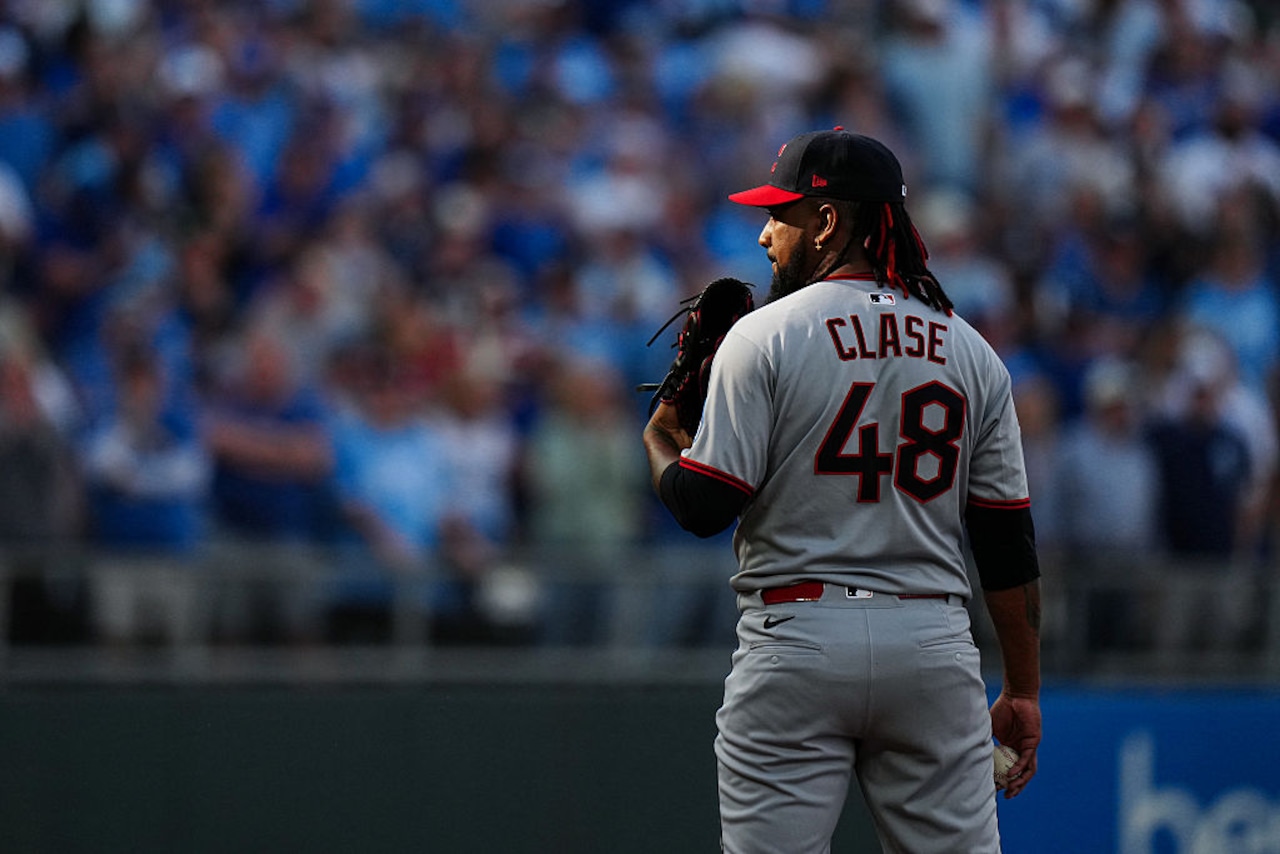
CLEVELAND, Ohio — The relationship between the Cleveland Guardians and All-Star closer Emmanuel Clase has deteriorated to a new low, as the team recently denied him permission to pitch in the Venezuelan winter league. This latest development, discussed during Friday’s episode of the Cleveland Baseball Talk Podcast, highlights the growing rift between the organization and its closer as MLB’s gambling investigation drags into the offseason.
When Venezuela’s winter league inquired about Clase’s availability, the Guardians shut the door — and for multiple reasons that reveal just how fractured the relationship has become.
“One reason was the investigation into Clase and teammate Luis Ortiz on the gambling allegations is still going on,” explained cleveland.com beat reporter Paul Hoynes on the podcast.
But the ongoing investigation is just the beginning. There’s also a complete breakdown in communication between the team and the players, with Hoynes noting that “they haven’t talked to Clase or Ortiz for months. So they have no idea how much they’ve been throwing, what their training regimen has been.”
The most revealing justification, however, speaks to the emotional toll this situation has taken on the organization. As the Guardians were fighting for a division title and pushing into the playoffs, they were doing it without their star closer.
“Clase and Ortiz, they left the Guardians high and dry,” Hoynes stated bluntly. “When they were caught up in this investigation in July, they didn’t pitch for the last three months of the regular season and the postseason. The Guardians had to scramble to replace them.”
The financial aspect adds another layer of tension. “They paid them the whole time,” Hoynes emphasized. “What’s the incentive for the Guardians to bend over backwards and help Clase out by giving him permission to pitch in Venezuela?”
The fact that Clase is actively seeking alternative places to play might itself be telling. As podcast host Joe Noga wondered aloud, “Is Clase seeking to play at any other league or any other place sort of a tacit admission of, ‘Hey, I kind of know that I’m not going to be allowed back into Major League Baseball’?”
This situation leaves the Guardians in limbo regarding their future plans. With Clase and Ortiz now on the restricted list, they don’t count against the 40-man roster, but Cleveland is still navigating murky waters regarding salary commitments, especially Clase’s guaranteed money for 2026 and his club options for 2027 and 2028.
As Guardians fans await resolution, the team must prepare for 2026 as if neither player will return. What was once a strong relationship between a franchise and its dominant closer has now devolved into a standoff, with neither side seemingly willing to bridge the widening gap.
For more insights into the Clase situation and other Guardians developments, tune into the full episode of the Cleveland Baseball Talk Podcast with Joe Noga and Paul Hoynes.
Podcast transcript
Joe Noga: Welcome back to the Cleveland Baseball Talk Podcast. I’m Joe Noga, joined by Paul Hoynes. Hoynsie, the the latest on Emmanuel Clase. We’ve learned some news out of Venezuela, actually, as the Guardians have sort of blocked Class A from playing winter ball in Venezuela after the Dominican Republic had denied Class A and Luis Ortiz the opportunity to play in the Dominican League over the winter.
Speaker B: Joe, they, you know, Class A had petitioned to, inquired, I guess, the Venezuelan Winter League to play there. But, you know, under the, under the, really, under the winter league rules, if you’re not a native of that country, if you’re not born in that country, you have to get permission from your team. So Venezuela called mlb. MLB called the Guardians, and the Guardians denied Class A permission to pitch in Venezuela because there was several reasons why they denied it. One was the investigation into Class A and teammate Luis Ortiz on the gambling allegations is still going on. A couple other reasons. They haven’t talked to Class A or Ortiz for months. So they have no idea how much they’ve been throwing, what their training regimen has been. And, you know, their reasoning is, if, you know, if they’re found innocent in this, in the investigation, why would they give them consent to pitch in Venezuela? I’m talking about Class A here when, when they, when, you know, they haven’t pitched for what they. They haven’t pitched for the last three months of the regular season, the post season. They don’t really know what conditioning they’re in. And they would want them, I would imagine, to be ready for the 2026 season. They’d have that whole, you know, spring training, build up the ramp up to spring training. So the last thing they want, would want that Class A to be doing is going into, you know, kind of a heated winter ball season and risking injury. And the final reason is Joe, Class A and Ortiz, they kind of left. They definitely left the Guardians high and dry. You know, when they, you know, were caught up in this investigation in July, they didn’t pitch for him for the last three months of the regular season, the postseason. The Guardians had to scramble to replace him if they face punishment in this investigation from, from Commissioner Rob Manfred. You know, what, what, what’s the incentive for the Guardians to bend over backwards and help these and help Class A out by giving them permission to pitch in Venezuela. And plus they paid him the whole time. You know, they paid their salaries when they were, when they were getting nothing in return. So, you know, I think this kind of really an interesting situation and we’ll see how it unfolds.
Joe Noga: Yeah, it’s, it’s interesting I guess from just a fan perspective and that that last reason is sort of another reason why fans are sort of waiting for this, the situation to be resolved. Because like you said, they were without these two players for the final three months of the season and they were getting paid. You know, I guess Cleveland’s just sitting around saying, yeah, why, why would we help you out if you do eventually get suspended indefinitely for life, anything like that? Banned for life. There’s, there’s no benefit to Cleveland actually letting these guys play and giving them permission to.
Speaker B: Yeah. And you know, if they are found guilty, that means they were working against their club, they were working against the out the outcome of the ball game, helping, helping give, you know, give Cleveland the best chance to win. So, you know, it’s, it’s kind of a two edged sword in that, in that regard, you know, okay, you know, we’re forced to pay you, but that doesn’t mean we have to really go out of our way to help you out in, in this situation.
Joe Noga: Is, is class A seeking to play at, at any other league or any other place sort of a, even sort of a tacit admission of, hey, I kind of know that I’m not going to be allowed, you know, back into Major League Baseball. I’m trying to find any place to play I can at any time.
Speaker B: I would think so. Joe, he’s trying to make some money. You know, he’s trying to, you know, stay in shape and perhaps, you know, see what, what, you know, options he has next season. You know, I think earning a salary is probably the, the major thing behind this. And of course, you know, both of them were allowed to play in the Dominican Republic. The Guardians couldn’t stop them from playing there because they’re both natives of the Dominican Republic. And the agreement that MLB and, and the players association reached when they put these two on non disciplinary paid leave in July was that, you know, there was no restrictions in winter ball if you’re a native, but it was the Dominican League that banned them.
Joe Noga: Is, does the Dominican League banning them or does the Venezuelan League sort of reaching out to Major League Baseball and sort of wanting to get clearance and permission there is that sort of reflective of a good, healthy relationship between Major League Baseball and these winter ball leagues that says, you know, we want to be able to have those major league players play in our winter ball leagues. We want that relationship with MLB to be good. So we’re going to, you know, do whatever they say, and when it comes to how to handle these, these particular players who are under investigation, I think so.
Speaker B: I mean, the relationship has to be good. The winter leagues depend on, you know, the players in the big leagues coming back home that were raised in the Venezuela, that were raised in the Dominican and playing on those teams, you know, to generate fan interest, to, you know, make money to stay viable. So, yeah, I think the relationship has to stay strong. You know, just from what I was able to gather yesterday, this isn’t exactly, this isn’t. This really doesn’t have anything to do, you know, specifically with, with Class A, you’re not being allowed to play in Venezuela. It is. I think it’s a league rul. An MLB rule that if you’re not a native of the country where you want to play winter ball, you have to get consent from your, from your big league club, and it doesn’t matter if you’re being investigated or not. That, that’s just, you know, the order of the day. And, you know, in, in this case, the Guardian said no.
Joe Noga: When we do reach a conclusion to this saga, when Major League Baseball and the Players association and everybody comes to an agreement and whatever punishment or whatever clemency or whatever is, is, is meted out to these, these two individuals and we get past this all, if they’re in a position where they’re, they’re not able to come back to Major League Baseball, or if no Major League Baseball team wants to sign them, could they play somewhere in, in the Pacific? Is, is Japan or Korea an option for these guys? Because you’ve got to start thinking beyond that, and I’m sure they already have.
Speaker B: Yeah, I would think, Joe. I, I do not know, you know, what the ramifications are, what the Japane would say, what the Korean Baseball League would say. Mexico. So I’m not sure where, where these guys go next. Could they go to Australia? But if these guys are found guilty, that’s, that’s going to follow them no matter where they go. Even if they’re allowed to play. Could you imagine the scrutiny they’d be under if, if they are found guilty and you know, every pitch is like, you know, you’re questioning every pitch, every move they make then.
Joe Noga: Well, and gambling laws have to be different in different places. I’m, I’m sure, I’m sure the gambling laws in Japan and Korea, even Australia or any other league that would be even close to comparable would be probably even more strict than they are here in the United States. So, you know, something to keep an eye on with that for sure. So as of now, we still don’t have a timeline. We still don’t have any sort of hope of getting a resolution to this investigation. The latest from the Guardians, the latest from Major League Baseball is that they’re still doing their due diligence. So Guardians fans are starting to get a little restless. Starting to, you know, I’ve seen a lot on Social about wanting to get that the club deserves a resolution. You know, feeling. Feeling sort of bad for the front office. This is not something that was any fault of. Of Chris Antonetti or Mike Chernoff’s that this is sort of just dumped in their lap and now they’re the ones dealing with it. So I guess, you know, we, it’s. It’s sort of just still wait and see.
Speaker B: Yeah. You know, that’s what Antonetti said at the end of the season meeting. Really, they have to go forward. Don’t have the Ortiz and Class A and you know, since they were put on a restricted list after the end of the regular season, that means they don’t count on the 40. Man. You can’t, they can’t trade them. But, you know, and I. The sal. Their salary situation, I guess, is in limbo. Do you tender these, do you tender Ortiz a contract? What. What about, you know, Class A’s, you know, guaranteed money in 2026 and his club options in 27 and 28? There’s a lot of questions still to be answered.
Joe Noga: Yeah, it’s the, the money situation on Class A side. Something to keep an eye on for sure. You know, the Guardians will be very interested about that. But as far as Ortiz goes, if you non tender him, it’s not like teams are going to be crawling over each other to try and pick him up. I don’t think you want a guy who’s under investigation for, you know, selling out his own team, you know, based on prop bets. Okay, so that’s the latest on Class A. Let’s, let’s focus on some more positive news for the Guardians, something that we had kind of anticipated actually happening. And we got word on Thursday. Even Kwan wins his third Fielding Bible Award in the last four years. He did not win in 2024 the award for the top defensive left fielder in all of baseball, that went to riley green. But 2022, 2023, and now 2025, even Kwon, top defender in left field in all of Major League Baseball, he wins the award for the third time in his career. A pretty strong indication that he’s going to Win the Gold Glove in left field in the American League. We’ll, we’ll wait and see on that the first week in November. We’ll, we’ll get word about that. But just another sort of outstanding recognition for probably the best, the best defender on the team right now in Stephen Kwan.
Speaker B: Yeah, Joe, no, no doubt about it. Just had another great season. And the Fielding Bible, they kind of, you know, kind of have their own statistical analysis. We know he led, led all MLB outfielders in assists, but they had, he also had 10 assists without a relay man, without a cutoff man, which I thought was pretty interesting. He received high marks for the way he, you know, he, the way he played the ball, the way his arm strength, the way he played the ball off the walls. Just, you know, they, they kind of covered the whole spectrum. So yeah, just really a well deserved award for Quan and not unexpected for sure. Joe.
Joe Noga: Yeah, and you know we talked about defensive runs saved. He was up there the most in baseball, tied with Ernie Clement. And Clement actually wins the, the multi position player award from Fielding Bible. Another good indication that he’s probably got a Gold Glove in his future there as well. But Quan just the Sports Information Solutions is the, the group that puts together the, the Fielding Bible awards and that’s sort of the data that they collect. It’s not based as much on the voting from managers and coaches, which is a component of the Gold Glove award. So this one is more of a, like a clean statistical analysis of what you contribute defensively. And I think that’s, that’s something that, you know, the numbers bear it out. We see it every day on a, on a daily bas see with the eye test that Stephen Kwan is just one of the best defensive left fielders we’ve ever seen. And he just keeps getting better. He keeps adding things each year. I think that’s a big part of it. And we talked to J.T. mcGuire in Detroit mid September just before Cleveland went on there, super hot run and they were beating Detroit. They swept them in Detroit. Quon made a couple of nice running catches in the left center field gap and back to back games there. And you know, we asked JT McGuire about it and he said he didn’t necessarily say it was easy, but he said he makes life easy as the outfield coach because he’s the standard. You have a guy like Stephen Kwan out there every day, working every day during batting practice, during their workouts, going out there fielding extra balls, figuring out how balls are going to play off the wall in each different ballpark he puts in the work behind the scenes and that’s what results in him being an elite defender.
Speaker B: Yeah. McGuire was really, really, you know, complimentary of Kwon. And you’re right, Joe. When your best outfielder sets a tone like that, you know, the other outfielders have no choice but to follow and, or you get left in the dust. So just, you know, really such a good example. Hard worker. And I just love the way he plays the balls off the 19 foot wall at, at Progressive Field. How he can deke a runner into not taking a base. I mean, he’s, he kind of, he is, he is. We’re, we’re watching a guy perfecting the art of left field play.
Joe Noga: Yeah. And every year it seems that he adds a new wrinkle to it, adds something else, adds another dimension to what makes him good. This year it was the, it was the arm strength, it was the catches, teams and runners off guard because, you know, he’s not an imposing physical presence. He’s not the guy that you would think has the big strong arm and yet he’s accurate. He’s got a quick release. More often than not, the ball is there before the runner.
Speaker B: Yeah. And he makes that play in the corner, in the left field corner coming off the wall. His back is to the runner and you know, he pivots and makes that throw so fast. Like you were saying, Joe, such a quick release. And it’s an accurate throw. One hopper to the second baseman. You kind of run at your own risk. If you’re a hitter that bangs one off the wall at, in left field, wall at Progressive Field.
Joe Noga: And it used to be that these wards that, you know, Gold Gloves, if you win one or two, then you had the reputation and everybody voted for you. And now there’s more of a statistical component. It’s harder to win consecutive or the majority of Gold Gloves when you know your position in your career just because there’s always somebody new coming up behind you and you know, the numbers don’t lie. It’s hard to sort of fool the system in terms of statcast and all that. So that just means that Quan continues to perform at that level. And it’s, it’s been a lot of fun to watch.
Speaker B: No, no doubt about it. And I was a little bit surprised that no one else from Cleveland won the award, one that, you know, was named. You know, they have, they said that Cleveland over the last four or five years has had more players win a fielding Bible award than, than any team, than any big league team. Quan was the Only representative this year.
Joe Noga: Yeah, these are the Fielding Bible Awards are kind of actually harder to win than Gold Gloves. I think there’s a little bit higher of a standard there. And you know, the Guardians don’t have Andres Jimenez anymore. You know, he was a Fielding Bible favorite for, for several years. They had multiple Fielding Bible award winners for a bunch of years. And I think in the last, in the last four or five years, they’ve got seven or eight award winners. That’s the most in all of baseball. So just a big tip of the cap to the defensive work that the, the Guardians have been doing over the last several years. You know, we’ll see how much that changes or if that changes with Kai Correa departing with any other sort of manager or not managerial, but coaching staff changes in the upcoming season. We’ll, we’ll see what happens there. But for right now, at least you got to feel good about the defense being played in left field by Stephen Kwan. Okay, let’s shift focus here. We found out the Guardians made not necessarily roster moves, but they resigned catcher Cameron Barstad and infielder Diane Frius to minor league contracts with major league spring training camp invites. So these are some of the firsts that we’re hearing of spring training invitees. Cameron Barstad, Dian Frius Catcher infielder There will be many more spring training invitees on the list. Who do you expect should also get an invitation to Major League camp prior to sometime in, in February?
Speaker B: Yeah, I’m looking forward to Bizarre Bazana, seeing if, if they invite him to camp. I would imagine they would, Joe, if, if he’s healthy. But I’d really like to get a, you know, kind of an extended look at him and see, you know, just how close he is to the big league.
Joe Noga: Yeah. And what about Cooper Engel, another guy who’s at the top of the, the list in terms of Guardians prospects? Really? You give these spring training invites to guys who are, maybe they’re not on your 40 man roster, but they’re guys that you expect at some point during the, the upcoming season are going to impact your, your big league roster, your active roster. So you want to make sure that the coaches are familiar with them, have at least been around them, seen them, know their tendencies, know their routines and vice versa. You want the players to know what the, what the coaches expect.
Speaker B: Yeah. You know, Cooper Engle was in camp last year, in big league camp last year. Joe, he’s a catcher. Really? I thought he did a great job. You know, he can swing the Bat that’s, you know, that’s kind of, you know, jumped out at you. Just his, his offensive ability and what he was able to do. So, you know, this is a catcher, you know, more leaning toward offense. We’ve got a couple catchers but in the big leagues right now that are, you know, play defense mostly or you know, defensive oriented. So it’ll be, you know, see how we’ll have to see if Engle can take the next step, how close he can, he’ll get to the big leagues this year.
Joe Noga: Yeah, it’s very interesting just to see, like we said, there will be a lot more names rolling out, you know, sporadically throughout the off season here as, as to guys who get spring training invites and we’ll keep an eye on that. Big news in Major League Baseball tonight. Game one of the World Series taking place north of the border in Toronto for the first time in 32 years. The Dodgers are going to start in, you know, game one. It’s Blake Snell and Treus Savage goes for the Blue Jays. Hoynsi, are you expecting this to be a blowout, A sweep, close series? How many games is this going to go?
Speaker B: You know, Joe, I, I don’t know. I mean the Dodgers were so dominant in the NLCS over a really a good Milwaukee team that led, that led the big leagues in wins during the regular season and they just kind of brushed them aside. So, you know, I, and to me, you know, we’ve talked about this before. Toronto has a, as a offense a lot like Milwaukee’s, you know, but you know, Vlad, Vlad Guerrero Jr. Is probably the exception there. You know, a guy that has been red, red hot in the postseason. So, you know, it’s going to be, it’s going to be really interesting to see how these two teams match up, you know, with Ohtani and Guerrero. I mean, who do you like out of those two guys? Who do you think is going to have the bigger series?
Joe Noga: I think you can’t argue with Shohei Ohtani and just him being sort of the X factor, being able to go out there and pitch as well, give you a start and win a pivotal game if you need it. But this is a guy who can hit 450 foot home runs without even thinking about it. So they’ve got a, it’s a, it’s going to be a tall challenge for Shane Bieber and those guys on the, the, the Toronto pitching staff to, to sort of keep him in his little mini slump that he was in before busting out in game four with three home runs. Shoehe Ohtani, this is this sort of his moment, I think, to take over. And you think about it, Shohei Ohtani was a guy who was looking at, you know, I don’t know how strongly he considered Toronto as an option, signing for $700 million with the Dodgers, but I wonder what kind of reception he’s going to get north of the border when he, when he steps into the box for the first time and faces the first pitch of the World Series tonight at around 815. All right, Hoyns, that’s going to wrap up today’s edition of the Cleveland Baseball Talk Podcast. We’ll be back next week, another full week of talking baseball and talking World Series here on the podcast.
Speaker B: Good deal.
If you purchase a product or register for an account through a link on our site, we may receive compensation. By using this site, you consent to our User Agreement and agree that your clicks, interactions, and personal information may be collected, recorded, and/or stored by us and social media and other third-party partners in accordance with our Privacy Policy.