
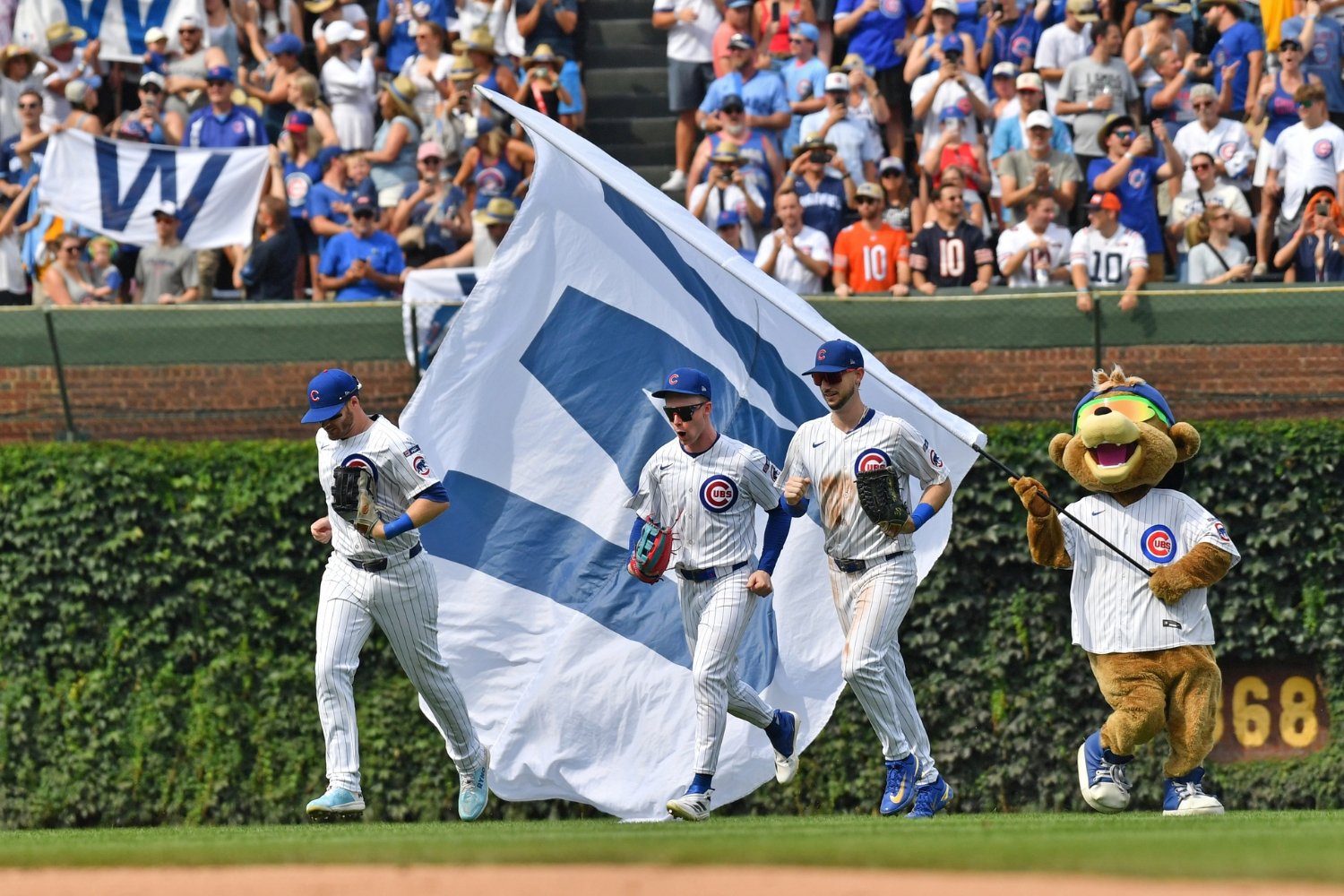
The outfield figured to be the Chicago Cubs’ strongest position group coming into the season, and believe it or not, they did perform as such. The group’s 122 wRC+ was second in baseball behind the Yankees, and they posted 14.3 WAR, which was third, according to FanGraphs.
It makes sense. They added Kyle Tucker to the fold in hopes of bolstering the lineup with a superstar-level player. They were going to get a full season of Pete Crow-Armstrong, and while there were several questions with the bat, there was no doubt he was going to help defensively. Ian Happ has been as consistent as they come.
That doesn’t even factor in Seiya Suzuki, who was hoping to continue improving into one of the league’s best hitters this season. It ended up being a bit of an up-and-down campaign for this group, but nonetheless, a successful one. Let’s take a look at how each player performed this season:
Ian Happ: C
I have no choice but to grade each player based on their expectations, and thus, I have no choice but to give Ian Happ a C. The veteran has been as consistent as it gets over the past four seasons, posting metronomic wRC+ numbers: 122, 118, 121, and 116.
Unfortunately for the Cubs and Happ, 116 is the low figure, and that number was produced this season. Combine that with a weird decline in baserunning, and he put together 2.8 fWAR after three straight seasons of producing at least three wins.
That’s still good, of course. While nobody gets overly excited about a three-WAR player, that’s still a player that everyone will take on their team every day. As I continue to watch postseason baseball, I have found myself wondering what the national perception is of Happ vs. Randy Arozarena. Happ has outproduced Arozarena over the past four years, per fWAR, but it feels like Arozarena gets a little bit more national attention because of some of his big playoff moments. Happ had one playoff moment this year. Let’s hope for more to come.
Pete Crow-Armstrong: B
I really struggled with this grade, and I am sure it’ll be the most polarizing. Crow-Armstrong had what I am now referring to as a Game of Thrones season (potential spoilers coming!). He had an elite first half of the season, with a 131 wRC+ and 4.6 fWAR, and was a legitimate threat to steal the National League MVP award from Shohei Ohtani. We all knew it was probably unlikely to happen, but it wasn’t completely insane to think.
Then, he kind of forgot about the Iron Fleet (this is a joke for at least one person) and put up a 72 wRC+ and 0.8 WAR in the second half. He wasn’t much better in the playoffs, either. He failed at the most recent, and most crucial, part of the season, and that’s going to leave a bad taste in a lot of fans’ mouths this offseason. The landing wasn’t stuck.
That doesn’t negate what he did in the first half, though, just like the last couple of seasons of GoT don’t negate all the awesome moments that preceded it. We still have Hardhome, and we still have the grand slam in May against the Reds, among many other highlights.
If you’d had told any Cubs fan prior to this season that the young center fielder would put up a 109 wRC+ and 5.4 fWAR for the full season, they would have taken that in a heartbeat. So, I have no choice but to give a good grade here. Besides, Game of Thrones is still one of the best rated television shows on IMDb.
Kyle Tucker: C
Both Tucker and the next player on this list had similar seasons to Crow-Armstrong, except the highs weren’t quite as high, and the lows weren’t quite as low. Despite everything that feels so incomplete about Tucker’s season—the injuries, the slow second half, etc.—he was still a top-30 offensive player in baseball by fWAR, and a top-20 hitter.
Tucker ended up right back where he was in Houston during his 2021, 2022, and 2023 seasons. Rightly or wrongly, fans in Chicago expected a bit more. After all, he did post a 179 wRC+ in an injury-shortened season just last year, and that dropped to 136 this season. Was 179 ever realistic? Probably not, but it gave us all reason to believe this was a potential super superstar, and not someone who is just going to consistently post really good seasons. Not that that is even a bad thing. Also, only 22 home runs on his stat line this season sticks out like a sore thumb.
All in all, it almost feels as if Tucker’s first, and likely lone, season with the Cubs was incomplete. It wasn’t bad by any stretch of the imagination, but it also hasn’t left Cubs fans clamoring for the team to re-sign him. For what it’s worth, I’d still pay him in free agency; consistently elite bats are hard to find, even if Tucker’s ceiling never again goes beyond that.
Seiya Suzuki: C
This is another one that I really struggled with. Suzuki had an incredibly productive first half of the season, slugging 25 home runs, however, a lot of those home runs came at the expense of his ability to get on base, both with a walk, or with any hit other than a home run.
Then, when the home runs stopped coming as often in the second half, things crumbled for Suzuki for a good long while before he finally righted himself at the best possible time. I upped the grade from a D to a C because he proved to be one of the Cubs’ few reliable hitters in the playoffs, along with Michael Busch and Nico Hoerner.
With that said, it’s still hard not to view this season as a disappointment for the Japanese star. After steadily increasing his wRC+ in each of his first three seasons in the United States, his 123 wRC+ this year was his lowest since his rookie campaign.
If we want positives for next season, it should be noted that Suzuki posted a 152 wRC+ when he played the field this year, compared to a 109 wRC+ when he was the designated hitter. I’m not convinced that is anything other than a coincidence, though it at least bears monitoring if the Cubs let Tucker walk and reinstall Suzuki as their full-time right fielder again in 2026.
Bench: Incomplete
Outside of those four players, the Cubs only gave 102 plate appearances to any other player at an outfield position. Willi Castro led the way with 62 plate appearances, followed up by Owen Caissie with 19, Kevin Alcantara with 12, and Vidal Brujan with 9.
None of them, save for Caissie, were particularly productive with that time. It was also so few and far between that it doesn’t feel fair to give them a poor grade. If the Cubs have one smaller thing to accomplish this offseason, it’s making sure they have a backup center fielder on the roster that they are comfortable starting for Pete Crow-Armstrong on days where there are tough lefties on the mound. It’s hard to take his defense out of the game, but it was clear by the end of the season that he could have used an extra couple of days off every month or so throughout the regular season. He can always be installed for defense later in the game.
In the end, the Cubs’ lack of outfield depth didn’t come back to bite them too bad in 2025, and with Caissie ready for a full-time gig at the MLB level, there isn’t a pressing need to overhaul the position group, even with Tucker set to leave. It was mostly a ho-hum season for the outfield corps, but given how high expectations were coming into the season, merely meeting them is an achievement itself.