
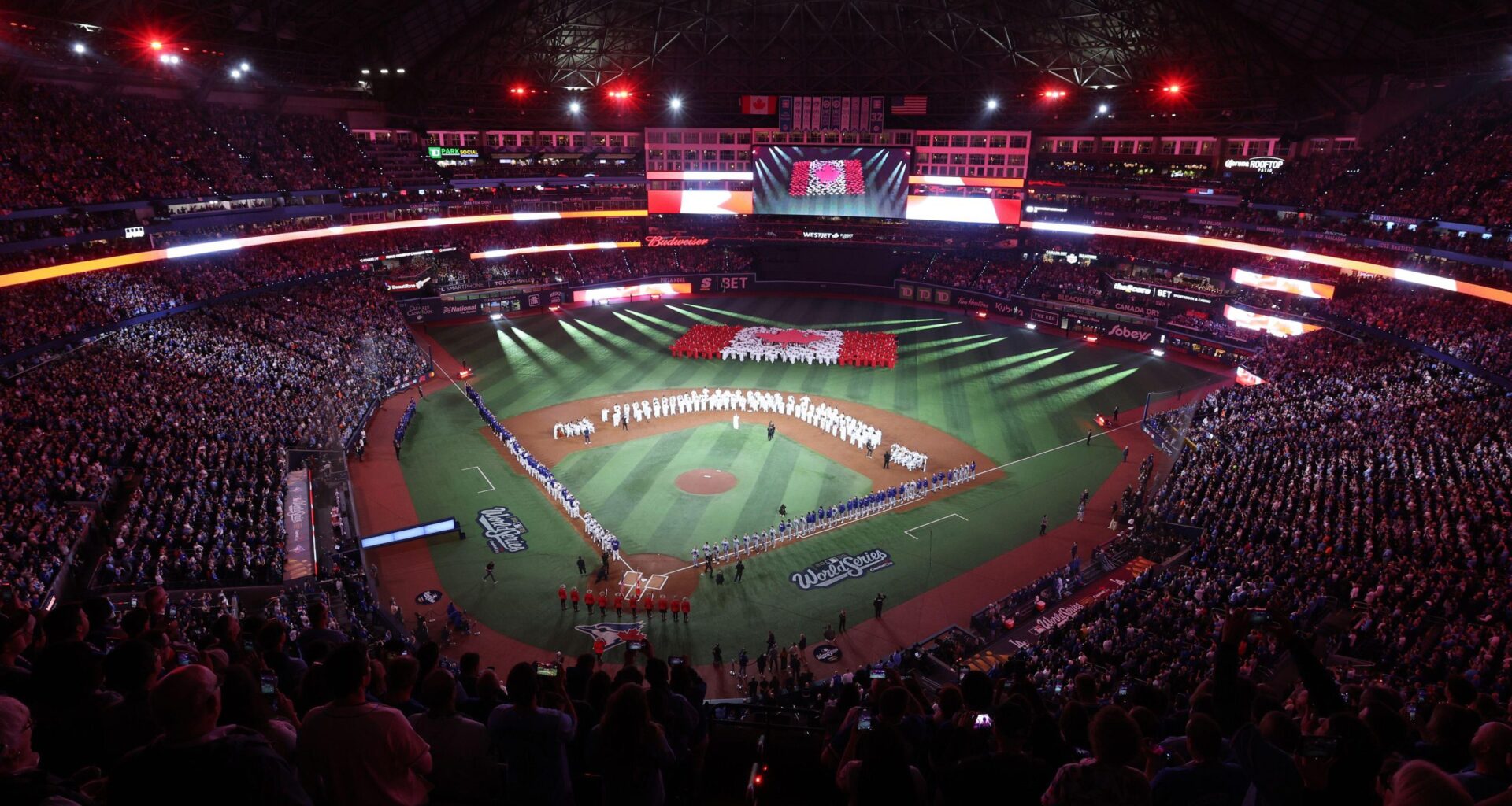
For the first time since 1993, the Fall Classic is north of the border. What will that mean for viewership in the United States?
Because Canada is not included in U.S. Nielsen estimates, Canadian teams are in essence the ‘smallest-market’ clubs in any league. Even the (relatively) small U.S. markets like Memphis, New Orleans or Green Bay contribute at least something to the national audience. But the likes of Toronto and Vancouver — major global cities — contribute nothing. So as a general rule, Canadian teams rarely appear on U.S. national television.
That is, unless they force the issue by advancing to the championship round.
The Blue Jays are back in the World Series for the first time since their back-to-back championships in 1992 and 1993. In the 32 years since their last appearance, only nine other times has a Canadian team advanced to a pro sports title round. Eight were NHL teams, including the Oilers the past two years, and the seventh was the only one to win — the 2019 NBA champion Raptors.
Of those nine series, six declined from the prior year. The exceptions were the 2024 Panthers-Oilers Stanley Cup Final, a seven-game series that aired exclusively on broadcast television and benefited from a favorable comparison to a five-game, cable-exclusive series the year before.
Another was the Lightning-Canadiens Cup Final in 2021, which benefited from an even more favorable comparison to a fanless, football-season series in 2020. (The third was Rangers-Canucks on ESPN in 1994, the series that prompted SI to proclaim the NHL as “hot” on its cover.)
To say those are anomalies is an understatement. The more typical result is a decline of about 9-14%. Raptors-Warriors in 2019 declined 14 percent, and that was after a strong finishing kick in Games 5 and 6. The Stanley Cup Final declined 12 percent in 2011, 14 percent in 2006 and nine percent in 2004 — featuring Vancouver, Edmonton and Calgary respectively — and that is despite all three series going seven games.
Viewership for major pro sports title series featuring Canadian teams
Since Blue Jays last made World Series in 1993
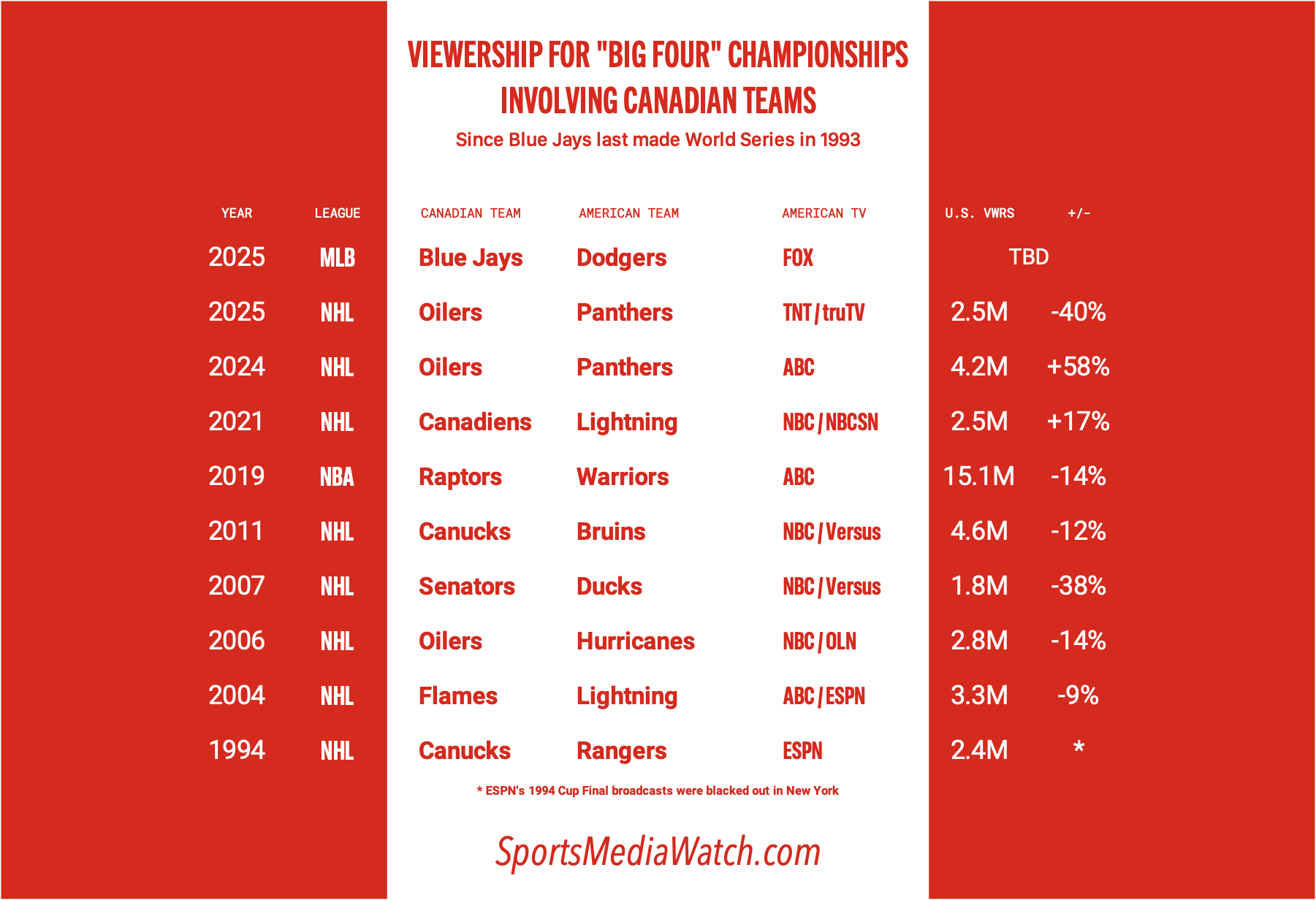 Viewership for major pro sport title series involving Canadian teams.
Will this year’s Fall Classic buck the trend? No. To begin with, last year’s World Series was the best-possible matchup as the Dodgers faced the Yankees — and even in an uncompetitive five-game rout, the series average of 15.2 million is a high bar.
But because last year’s World Series set such a high bar, a decline in line with prior Canadian series would result in what is a strong viewership number by modern standards. A decline of 9-14% would put viewership in the 13 to nearly 14 million range, which would surpass each World Series from 2020-23 and put the 2018 and 2019 editions in reach.
Notably, even a decline of 21% — approaching a full quarter — would still result in the second-most watched Fall Classic since 2019. There is a lot of room for this year’s series to fall and still qualify as a ratings success.
And this year’s matchup is appealing on paper. Generally, it’s ideal to write these predictions before the series begins for an assessment that is unaffected by any on-field circumstances. It so happens that this prediction was largely written after the Blue Jays opened an 11-2 lead in Game 1, making a statement to a skeptical baseball-watching public that they will not be an easy out.
The Blue Jays’ Game 1 outburst certainly makes the prospect of a long series more realistic, and given the starpower in this matchup, a long series has real potential.
The reigning champion Dodgers boast the most famous player in baseball, Shohei Ohtani, who is coming off of a performance in the NLCS that was widely described as the greatest in the history of the sport. They play in a Los Angeles market that is so massive that it alone makes this year’s World Series a bigger market matchup than 2023 (Dallas and Phoenix), 2022 (Philadelphia and Houston) and 2021 (Houston and Atlanta).
A competitive series involving these Dodgers should be a healthy draw, regardless of the opponent. And though the Blue Jays’ fanbase will not count toward U.S. viewership, it is hard to imagine that Toronto has zero following in the United States. Featuring a superstar in Vladimir Guerrero Jr. and coming off a Division Series defeat of the hated Yankees, this high-scoring Toronto squad may not exactly move the needle south of the border, but they aren’t sending viewers for the remote either.
It was just on Monday that the Blue Jays played in the most-watched game of this year’s postseason, their ALCS Game 7 against the Mariners that averaged 8.91 million across FOX and FS1. Yes, viewership would have been better with two American teams, but that was still the second-largest LCS audience in the past five years.
Of course, that superlative — like all ratings data since September 1 — comes with the caveat that Nielsen has changed its methodology. Nielsen in February expanded its out-of-home viewing sample to cover 100 percent of markets (up from about two-thirds previously) and in September shifted to a new “Big Data + Panel” metric that adds data from smart TVs and set-top boxes to its traditional panel. These changes have generally given viewership figures a built-in leg up on past years.
But baseball viewership was up even before “Big Data,” and the numbers have been up so much during the postseason that methodological changes are unlikely to explain all of it. Los Angeles is big enough to make up for the absence of Canadian viewers, the stars are big enough to grab the attention of casual fans, and after Game 1 it is safe to say that the Blue Jays at least have a chance.
Thus, there is no reason to believe that this series will be anything but a healthy television draw in the United States.
And if it isn’t? Well, one can always tout a combined U.S. and Canadian audience figure, as the NHL has done the past two years and the NBA did in 2019.
Prediction
Toronto’s statement Game 1 win infuses this World Series with uncertainty. It no longer appears that it will be a Dodgers walk-over.
On Programming Insider earlier this week, this writer predicted 13.5 million viewers for a six-game series, and especially given the result of Game 1, there is no reason to back off of that stance.
Updated to include the 1994 and 2007 Stanley Cup final series, which included Vancouver and Ottawa, respectively.