
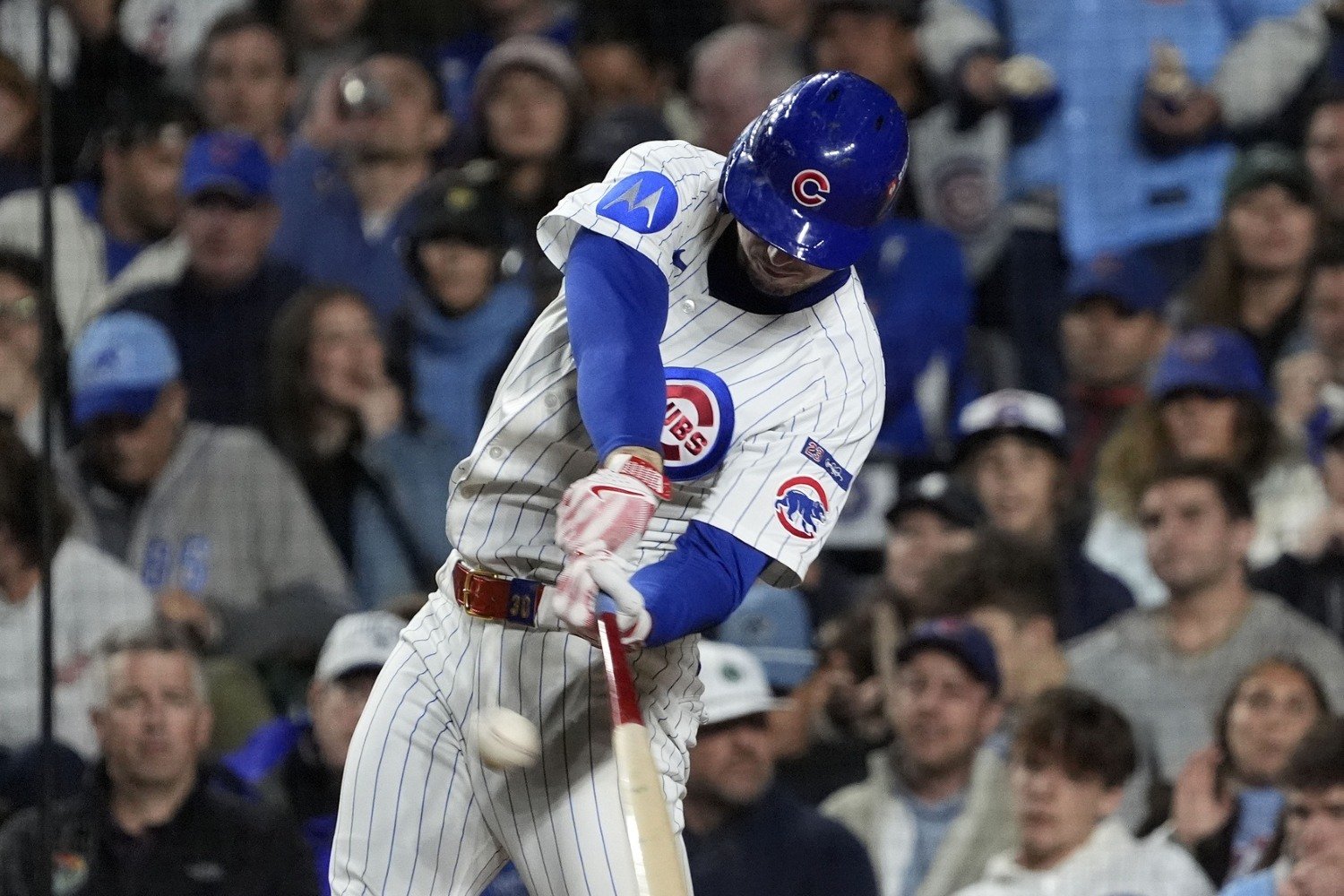
Since 1947, there have been 28 player-seasons in which a right-handed Cubs batter hit at least 35 home runs. That’s a respectable number, though obviously, it’s a bit inflated by the presence of two men: Sammy Sosa and Ernie Banks. Sosa had 10 35-homer seasons in a Cubs uniform; Banks had six. Still, there have been plenty of other sluggers who found significant success. Hank Sauer, Aramis Ramírez and Derrek Lee each had multiple 35-homer campaigns, too.
By contrast, the only three 35-home run seasons by left-handed Cubs batters were:
As I’ve discussed here before, the temptation is to imagine that Wrigley Field is truly symmetrical. Its marked dimensions are:
355 feet to the left-field corner
368 feet to left-center
400 feet to center
368 feet to right-center
353 feet to the right-field corner
In reality, though, that symmetry is an illusion. The 400 marker is essentially in dead center, but the deepest part of the park is to its right, as the wall slopes away in that direction. (Wrigley is one of just a few parks in the league at which the farthest fence is not marked.) The “well” in the left-field corner is longer and flatter than the one in right field, which means the ball sneaks out of the park down that line better than to right. The wall arcs away more in right field, so that the 368 is farther toward center field in left than in right.
The effects of the wind have always been better for hitters aiming for left field, too. When the wind blows in, it usually comes from right field, knocking down balls hit that way. When it blows out, it has a much more democratic positive effect on fly balls, and if anything, it often pushes it better toward left. Arguably, that’s all been heightened by the renovations since 2015.
Since 2021, pulled batted balls in the air at Wrigley have broken down by handedness as follows:
Left-handed batters: .602 average, 1.290 slugging, 96.7 MPH exit velocity, 24° launch angle, 15.6% home runs
Right-handed batters: .576, 1.258, 94.7 MPH, 24°, 17.2% home runs
The raw numbers are better for lefties, but that’s because we’re working with a better selective sample. Despite hitting the ball two miles per hour harder at the same launch angle, lefty hitters are getting the ball out of the park less often. Hitting homers to right field at Wrigley is just too hard to make it a fair fight.
Obviously, this doesn’t mean the Cubs should abandon the effort to maintain lineup balance. In truth, though, they already have it. Michael Busch only managed 34 homers during the regular season, but he was arguably the Cubs’ best hitter. Pete Crow-Armstrong had a brutal second half, but he’ll be back in the lineup next year and still has significant offensive upside. Ian Happ is a better hitter from the left side. At least one of Moisés Ballesteros and Owen Caissie is likely to play a major role in 2026. That’s plenty of left-handed talent. They’re extremely unlikely to re-sign any of Kyle Tucker, Cody Bellinger or Schwarber, but they can get by without those guys. Tucker, in particular, proved not to be an especially good fit for Wrigley Field at this stage of his career.
The lineup needs more right-handed thump, though. Seiya Suzuki leads the charge from that side, and was perfectly adequate in that regard in 2025. Dansby Swanson was better this year than in either of his previous campaigns with the Cubs, including hitting 24 home runs. Nico Hoerner was a great all-around hitter. However, the team’s first-half power binge gave way to a second half with a dearth of punch from the right side.
If Miguel Amaya comes back and has a healthy 2026, he and Carson Kelly could give them a bit more consistent production at catcher. Matt Shaw went on a tear during the second half, although it now reads more like a hiccup between long, bad stretches than like a turning of the corner toward stardom. Rather than put all their hope in the incumbent options, though, the Cubs need to sign a slugger this winter. Eugenio Suárez is the most obvious fit, but another intriguing one could be long-time Cubs nemesis Pete Alonso.
Although reportedly looking for a seven-year deal, Alonso is much more likely to settle for a four-year pact this winter. He would make a tremendous addition to the heart of the Chicago order, as the team’s DH against righties and a right-handed platoon partner for Busch at first base. Right-handed power is fairly expensive, but relatively plentiful. There are several ways to solve the problem. The Cubs just need to choose wisely.