
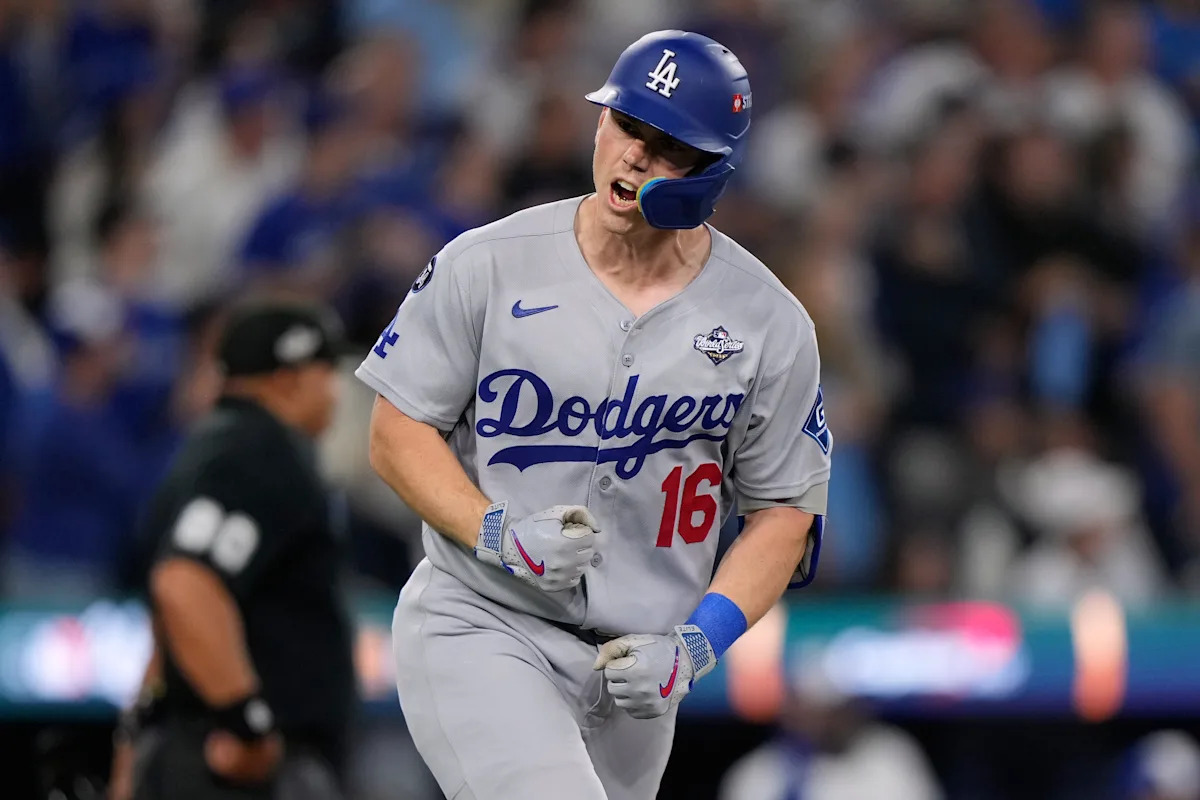
TORONTO — From a personality perspective, Will Smith is very much a Will Smith.
The Dodgers’ catcher — who has the United States’ most common last name and sixth-most common first name — is not the most effusive character. Far from it. When interacting with the media, Smith tends to play it snooze-inducingly straight. He is a master of the cliche, quick and nimble with banal phrases such as “one pitch at a time” and “not trying to do too much.”
Advertisement
“Just trying to simplify, put together a good at-bat, swing at the right pitch and move forward,” he told reporters in the locker room after his 404-foot, seventh-inning moon shot broke a 1-1 tie on Saturday, propelling the Dodgers to a series-evening, 5-1 victory in Game 2 of the World Series.
To be fair, Smith’s job is not to captivate the masses with charm. It’s to clobber home runs and call effective games behind the plate — a line of work that he does exceptionally well.
And on Saturday, Smith made quite the impact, shepherding Dodgers starter Yoshinobu Yamamoto through the first World Series complete game in a decade and delivering the decisive blow in a game that pushed this seven-game series back in Los Angeles’ favor.
Smith also opened the scoring in Game 2, with a well-struck RBI single up the middle off Toronto starter Kevin Gausman that gave L.A. a lead in the top of the first. But the veteran hurler settled in quickly and held the Dodgers scoreless until the seventh with a barrage of fastballs. Gausman has secured generational wealth in large part because he boasts one of the sport’s nastiest split-finger fastballs. It’s a dastardly pitch that looks like a strike for most of its lifespan — until it dives toward the turf as it crosses home.
Advertisement
On Saturday, Gausman zagged, opting to lean quite heavily on his fastball. For most of the evening, that approach worked beautifully, as he retired 17 consecutive Dodgers after Smith’s knock in the first. But in the seventh against Smith, the strategy backfired. Gausman started the three-time All-Star with five straight heaters, with Smith working the count full.
[Get more L.A. news: Dodgers team feed]
Then the Jays’ starter went to the four-seamer one time too many, missing his target by the entire width of the zone and leaving a meatball on a plate for Smith to dispatch into the upper deck.
The pitch was so thoroughly destroyed that the typically reserved Smith watched his work for an extra beat before smoothly dropping his bat, turning toward his joyous dugout and hollering an appropriately cliché “Let’s f***ing go.”
“You know, it’s a big swing, obviously,” he waxed postgame when asked about his out-of-character display of passion. “The emotions are running high, but also trying to get the guys going, you know?”
Advertisement
That’s exactly how it turned out, with the Dodgers tacking on three more runs after Smith’s long ball. It was a big moment for Los Angeles’ lineup, a group that appeared disjointed and sluggish through the first 15 innings of this World Series. But L.A.’s late-game burst served as a reminder that this remains a dangerous, formidable unit.
Smith is a big part of that.
Although the stalwart backstop has been hitting for a high average this October (.314 through Saturday), his crucial crank in Game 2 was his first extra-base hit this postseason and his first home run in nearly two months. That dearth of power is likely related to the hand injury Smith suffered late in the regular season. A foul tip clonked him flush on the top of his right hand on Sept. 3, causing a hairline fracture that kept him out for most of the regular season’s final month.
“That week off, I think, got him over the hump,” Dodgers manager Dave Roberts explained postgame, referring to the Dodgers’ break between the NLCS and the start of the Fall Classic. “It was the first time in a while he’s pulled a ball like that, so I think that’s part of the healing process.”
Advertisement
When asked whether his now-healthy hand played a role in his show of power, Smith was less definitive.
“I hope so, sure, but that’s me. I’m just trying not to do too much, move the ball, help this offense score runs,” said the catcher with the fifth-highest slugging percentage this century.
That Smith is available and playing at all is a welcome sight for the Dodgers, considering that there were serious concerns about whether the catcher’s injury might limit or sideline him for the postseason. He was left off the roster for Los Angeles’ wild-card obliteration of Cincinnati. He returned in the NLDS against Philadelphia, entering as a substitute in Games 1 and 2. Since then, Smith has caught every inning for the juggernaut Dodgers as their rotation has continued to pitch at a historically great clip.
Advertisement
Smith is also raking, as he’s paid handsomely to do. His slash line this month is up to .314/.400/.400. That’s more of the same from the guy who just produced one of the best offensive seasons we’ve seen from a catcher in quite some time. Smith’s adjusted OPS was 52% better than league average this season, good for the 12th-best mark from a backstop in the wild-card era. Yet he went relatively under-the-radar, which is understandable considering that Smith was neither the best hitter on his team (Shohei Ohtani) nor the best-hitting catcher in baseball (Cal Raleigh).
A year ago, Smith struggled mightily at the plate during Los Angeles’ World Series run. Although he contributed defensively — he caught every inning but one last October — Smith finished the postseason with an uncharacteristically poor .143 batting average and a downright ugly .568 OPS. By the end, he was tired and worn down. His swing lacked its typical explosiveness.
As a result, the Dodgers were more intentional this season about monitoring Smith’s workload. He played less than in years past. Thanks to L.A.’s stacked roster, the team could afford to play the long game. They understood the bigger picture. And now, when it matters most, Smith seems to be benefiting from that extra rest, not to mention the month off spent recovering from his hand injury.
Advertisement
Asked whether he thinks Smith looks healthier and fresher than he did at this point last season, Roberts was resolute.
“Absolutely. Catching is such a demanding position,” he said, “but I think overall, mental clarity, the body’s fresh.”
Smith himself wasn’t as sure.
“Maybe?” he said with a shrug. “I don’t know.”
But he certainly knows how to hit.