
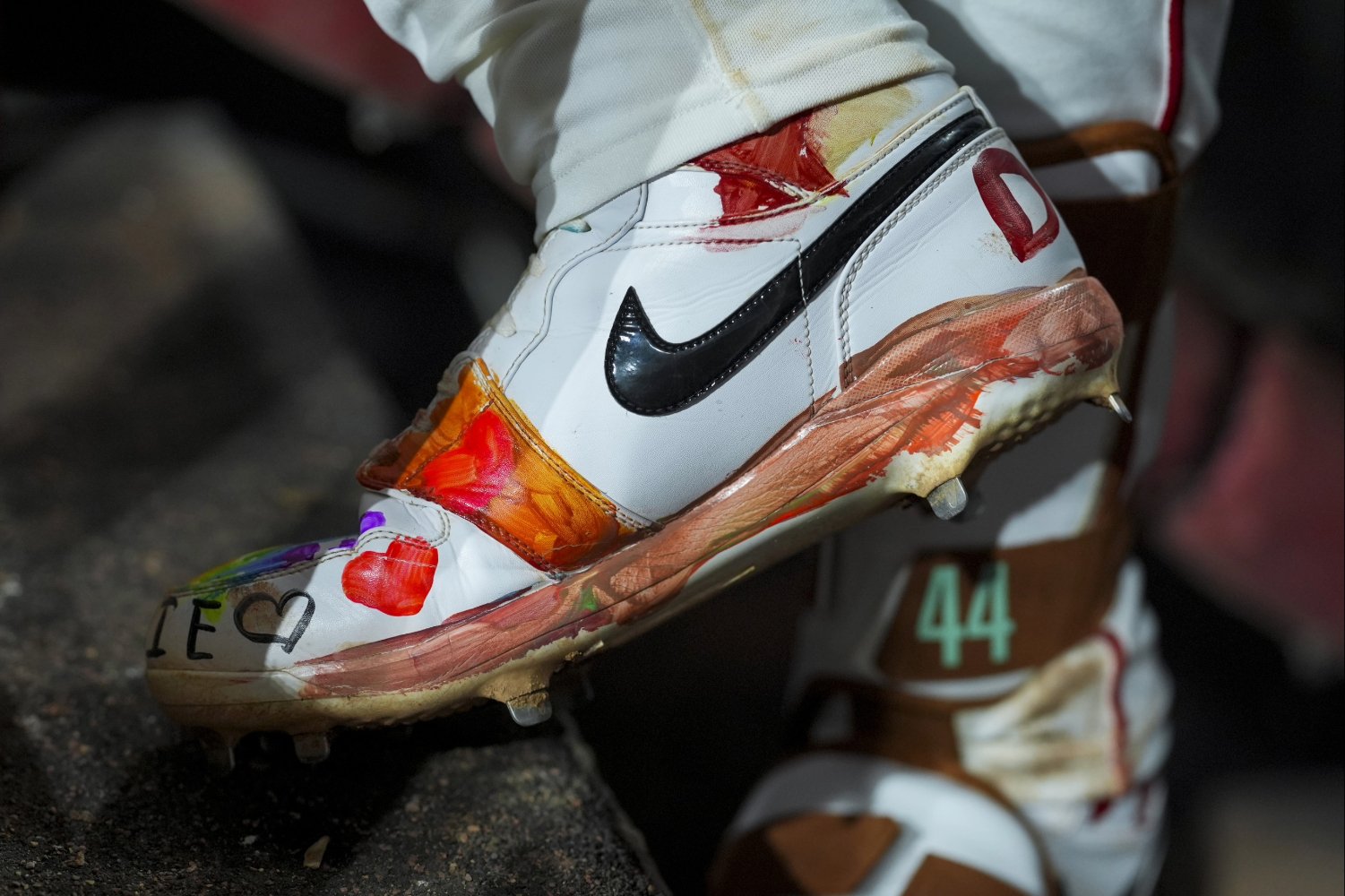
I’ve always been a sneaker head. (My heels are reserved for special occasions.) Throughout my adult life, I’ve moved between various apartments, with shoes (and books) making up the bulk of my belongings. Shoes can elevate a simple outfit. When meeting someone for the first time, their shoes are one of the first things I notice. To quote Carrie Bradshaw: “Shoes are the exclamation point at the end of an outfit.” Different shoe styles can reveal a lot about an individual’s personality.
Since I was a teenager, New Balance has been my go-to shoe brand. I sport their 574 sneakers daily. New Balance offers a solid collection ranging from lifestyle shoes to running shoes. As a Boston sports fan, I appreciate their connection to the city. In an Instagram post dating back to February 1, 2021, former Red Sox second baseman Dustin Pedroia was listed as “The Founding Father” of New Balance Baseball.
As a member of Generation Z, sneaker culture is a major component of my identity. Nike has dominated the sneaker scene for as long as I can remember, with its Air Force 1 and Jordan lines being iconic staples for sneaker heads. I used to work in the auction industry, and I was surprised to learn that Sotheby’s and Christie’s, two prominent auction houses, have special departments for sneakers/streetwear. A rare pair of Michael Jordan’s Prototype Air Jordans netted a staggering $325,085 at auction.
This past summer, several reports indicated that Nike’s revenue share was expected to drop. Bloomberg even has a special page on Nike’s Upheaval. Recent reports suggest that Nike still holds a substantial market share, and its revenue is about the same.
Nike holds a special place in baseball’s history. In 1996, in partnership with former Mariners player Ken Griffey Jr., Nike created the Nike Air Griffey Max 1, a shoe that became synonymous with the iconic Swingman Logo. In more recent years, Nike has garnered a more negative reputation in baseball. The company’s reputation took a hit after the 2024 MLB uniform controversy, which even has its own Wikipedia page. Following Nike’s takeover of the MLB’s uniform contract, their decision to place their swoosh on the front of players’ jerseys left a sour taste in my mouth. Although I typically avoid American football like the plague, my in-depth research revealed that the swoosh is located on the sleeves of NFL jerseys. Why can’t MLB follow suit? In the past, Majestic subtly placed their logo on the jersey sleeves, far from the conspicuous placement that Nike has chosen.
Athlete sponsorships help brands gain name recognition. When star athletes wear said brand’s gear, it builds their brand awareness and provides positive promotion. If you’re reading this, you’ve probably watched an MLB game on TV recently, so you’ve seen Shohei Ohtani’s New Balance commercial, which features the ear-worm “Hollywood Swinging” by Kool & The Gang. The song is infectious, and I often find myself humming “Hey, hey, hey. What ya got to say?” long after the commercial ends.
New Balance’s growth is remarkable. Their rise to prominence has given Nike a run for its money. Intending to reach $10 billion in revenue, New Balance set a record $7.8 billion in 2024, putting them on track to hit their target in the coming years. Outside of baseball, New Balance sponsors several notable athletes, including tennis superstar Coco Gauff, Buffalo Bills’ quarterback Josh Allen, Los Angeles Sparks forward Cameron Brink, and Cooper Flagg, the first pick of the 2025 NBA Draft. In the offseason, you can catch the varying renditions of New Balance’s commercial featuring professional athletes from the aforementioned list.
Constantly watching Ohtani’s New Balance commercial throughout the baseball season led me to wonder, which brand’s athletes have generated the most WAR?
*Note: Players can choose their preferred equipment. Just sporting a specific brand’s gear doesn’t mean that brand sponsors them. I’ve included players who have appeared on a brand’s social media page, have been posted in a brand’s press release, or have the brand listed in their social media bio. These are indicative of a brand’s sponsorship of an athlete.
4. Adidas
Adidas ranked last among the “Big 4” sports apparel companies. In 1924, Brothers Adolf and Rudolph Dassler founded the company in the industrial town of Herzogenaurach, located in Bavaria, Germany. The company rose to prominence following the 1936 Olympics. Adolf Dassler convinced Jesse Owens to wear spiked running shoes supplied by him. Owens won four gold medals at the Olympics, propelling Adidas into the forefront of the athletic footwear industry. When discussing Adidas’ history, it’s worth mentioning the company’s troubled past. The Dasslers were members of the Nazi Party, and Adidas supplied boots to Nazi Germany’s Armed Forces during World War II.
Given Adidas’ European heritage, it’s no surprise that they sponsor elite football (soccer) clubs including Manchester United, FC Bayern Munich, Juventus, Arsenal, and Real Madrid. Adidas is the official supplier of the FIFA World Cup and UEFA Champions League, two of the largest global soccer tournaments. Baseball seems more like an afterthought on their individual sponsorship list.
José Ramírez leads the Adidas pack with 57.7 fWAR. Younger players signed to Adidas include Julio Rodríguez (21.2 fWAR), Jackson Chourio (6.9 fWAR), and Oneil Cruz (6.9 fWAR). Whether Jackson Holliday’s (1.2 fWAR), the first overall pick in the 2022 MLB Draft, performance will meet expectations, and whether Pete Crow-Armstrong’s (7.8 fWAR) first half of the 2025 season was a fluke, remain open questions, and will determine if Adidas can maintain its relevance as a sponsor for professional baseball players.
While Adidas may not have a strong presence in baseball, its foothold in the soccer industry has propelled the Samba shoes to become one of the most iconic and widely worn sneakers globally, and it will continue to be a dominant brand outside of baseball.
3. Under Armour
Under Armour is the newest company on this list. Founded in 1996 by former University of Maryland special teams captain Kevin Plank, the company’s first product was moisture-wicking shirts to wear under jerseys. That same year, Under Armour landed its first major apparel sale with Georgia Tech, and several other Division 1 Football programs signed deals with the company. In 2010, Under Armour hit $1 billion in annual revenue. In 2016, Under Armour signed a deal to become the official uniform provider to MLB. Two years later, they withdrew from the agreement, citing financial restraints. Nike quickly swooped in and replaced Under Armour as the official sponsor of MLB uniforms.
Under Armour has the smallest group of athletes with seven, five fewer than Adidas. However, their athletes have generated 218.2 fWAR, 29.6 more than Adidas. Their roster is carried by established stalwarts Freddie Freeman (64.7 fWAR), Juan Soto (42.3 fWAR), and Bryce Harper (55.6 fWAR). Moreover, younger five-tool players like Gunnar Henderson (18.2 fWAR) and Bobby Witt Jr. (26.7 fWAR) help the company accumulate WAR.
Despite the company’s waning popularity in the United States, Under Armour holds a strong presence in Asia as a streetwear brand. The Red Sox’s designated hitter and the “Best Baseball Player” in GQ Japan’s 2023 “Men of the Year” series, Masataka Yoshida (1.5 fWAR) is endorsed by Under Armour.
2. New Balance
In 1906, Irish immigrant William J. Riley established the New Balance Arch Support Company in Boston, Massachusetts. As its original name suggests, the company sold arch supports, designed with three primary support points, to alleviate stress and offer more balance. New Balance designed its first shoe, the Trackster, in 1960. The Trackster featured the first ripple sole for additional grip support and was offered in varying widths. Beforehand, running shoes came with metal spikes, prompting New Balance to establish itself as a sneaker manufacturer. Its prime location in Boston allowed the Trackster to gain popularity with local college cross-country teams, Boston University, Massachusetts Institute of Technology, and Tufts. In 1972, Jim Davis, the company’s current CEO, bought the company, then with only six full-time employees, on Patriots’ Day. Today, New Balance is a global company. Forbes reports that the company employs 7,500 people and generated $6.5 billion in revenue in 2024.
In 2017, Francisco Lindor (60.4 fWAR) signed with New Balance to be the face of New Balance Baseball. Four years later, the Lindor 1, Lindor’s signature cleat designed in collaboration with New Balance, dropped. Additional models of the cleats have been released in the following years. Two-way superstar Shohei Ohtani (49.7 fWAR) joined the New Balance Family in 2023. Just from watching the National League Division series, you can see that Ohtani is decked out head-to-toe in New Balance gear.
Over the past year, New Balance’s baseball family has grown faster than a Mormon family can multiply and replenish the earth. The company has been aggressive in signing individual sponsorships with up-and-coming baseball players. Nick Kurtz (4.6 fWAR), the presumptive 2025 American League Rookie of the Year, is signed to the company, as is Cal Raleigh (22.9 fWAR), arguably the frontrunner for the 2025 American League MVP. James Wood (4.6 fWAR), Jeremy Peña (14.5 fWAR), Jacob Misiorowski (1.2 fWAR), and Ceddanne Rafaela (4.9 fWAR) round out New Balance’s younger core alongside their established stars.
1. Nike
*signed to the Air Jordan brand
Originally called Blue Ribbon Sports (BRS), Nike was set up by Oregon Ducks track athlete Phil Knight, along with his coach, Bill Bowerman. Knight was used as a test subject to try out prototypes of Bowerman’s running shoes. BRS started as a distributor for the Japanese footwear brand Onitsuka Tiger in 1962. For about 18 years, BRS and Onitsuka Tiger maintained a successful working relationship. By 1971, the two companies cut ties regarding disagreement over supply chain distribution rights. Following their breakup with Onitsuka Tiger, BRS rebranded as Nike. Graphic designer Carolyn Davidson designed the omnipresent swoosh in 1971. Three years later, on January 22, 1974, the swoosh was registered with the U.S. Patent and Trademark Office. (For a more in-depth overview of Nike’s history, read The Street’s write-up.) Nike currently holds a 16.4% market share, the largest in the global sportswear market. The company sponsors uniforms for the NBA, WNBA, MLB, and NFL.
Mike Trout, who has accumulated a total of 87.2 fWAR, the highest among active players, is endorsed by Nike. When healthy, Ronald Acuña Jr. (31.9) is another WAR machine. Nike endorses some of the best promising players in baseball, including Corbin Carroll (17.6 fWAR), Paul Skenes (10.8 fWAR), Roman Anthony (2.7 fWAR), and Yoshinobu Yamamoto (7.9 fWAR).
Nike allowed Michael Jordan to create his own brand within their umbrella. Today, Air Jordan endorses Aaron Judge, Elly De La Cruz, Vladimir Guerrero Jr., Mookie Betts, and Jazz Chisholm Jr. MLB Air Jordan sponsorees have amassed 172 fWAR. By themselves, Nike’s sponsored athletes rack up 302.2 fWAR. When you combine the two brands, WAR, you get a whopping total of 474.2 fWAR.
Company
Total fWAR
Nike
474.2
New Balance
366.6
Under Armour
218.2
Adidas
188.6
If Air Jordan were considered its own company, New Balance’s sponsored athletes would lead with 366.6 fWAR. Air Jordan by itself is a powerhouse with 172 fWAR, putting it just behind Adidas (188.6 fWAR). In recent years, Under Armour has been relatively stagnant in recruiting new athletes. With the wave of NPB players expected to be posted this offseason, I’m curious to see if any of them sign with Under Armour. Could New Balance overtake Nike in the future? Possibly. The face of the baseball is tied to their brand, and their young core could propel them to the front of the pack, but competing with Nike’s established roster will be difficult. Expect New Balance to continue to be aggressive in signing new baseball players over the next year. Following the conclusion of the 2026 MLB season, I’d like to revisit this list. In the meantime, I’ll keep sporting my 574s.