

We are closing in on the sixth anniversary of the most recent trade between the Miami Marlins and St. Louis Cardinals. It’s one of the longest active “trade droughts” involving the Marlins and another MLB franchise, and I don’t expect it to continue much longer.
There has been a leadership change in the Cardinals front office entering the 2025-26 offseason, with Chaim Bloom replacing John Mozeliak as president of baseball operations. You may remember Bloom from his stint running the Boston Red Sox, but way before that, he got his start with the Tampa Bay Rays. Bloom gradually climbed the ranks from Rays intern to one of their top executives, a career path later emulated by Peter Bendix. For more than a decade (2009-2019), their tenures in Tampa Bay overlapped. Bendix is now Miami’s POBO.
If there is an opportunity for the Marlins and Cardinals to link up on a mutually beneficial deal moving forward, their decision-makers should be able to work together harmoniously.
In Bloom’s own words, “our top priority will be to build our talent base for the long term” (h/t Katie Woo, The Athletic). In Bendix’s own words, “this offseason’s gonna be about trying to find ways to improve our club” after posting a 79-83 record in 2025.
Allow me to present one hypothetical trade that would satisfy both objectives.
Marlins get: OF/1B Alec Burleson, LHP JoJo Romero, 3B Nolan Arenado and $7 million cash
Cardinals get: INF/OF Andrew Salas, RHP Eliazar Dishmey, OF Victor Mesa Jr. and RHP Adam Mazur
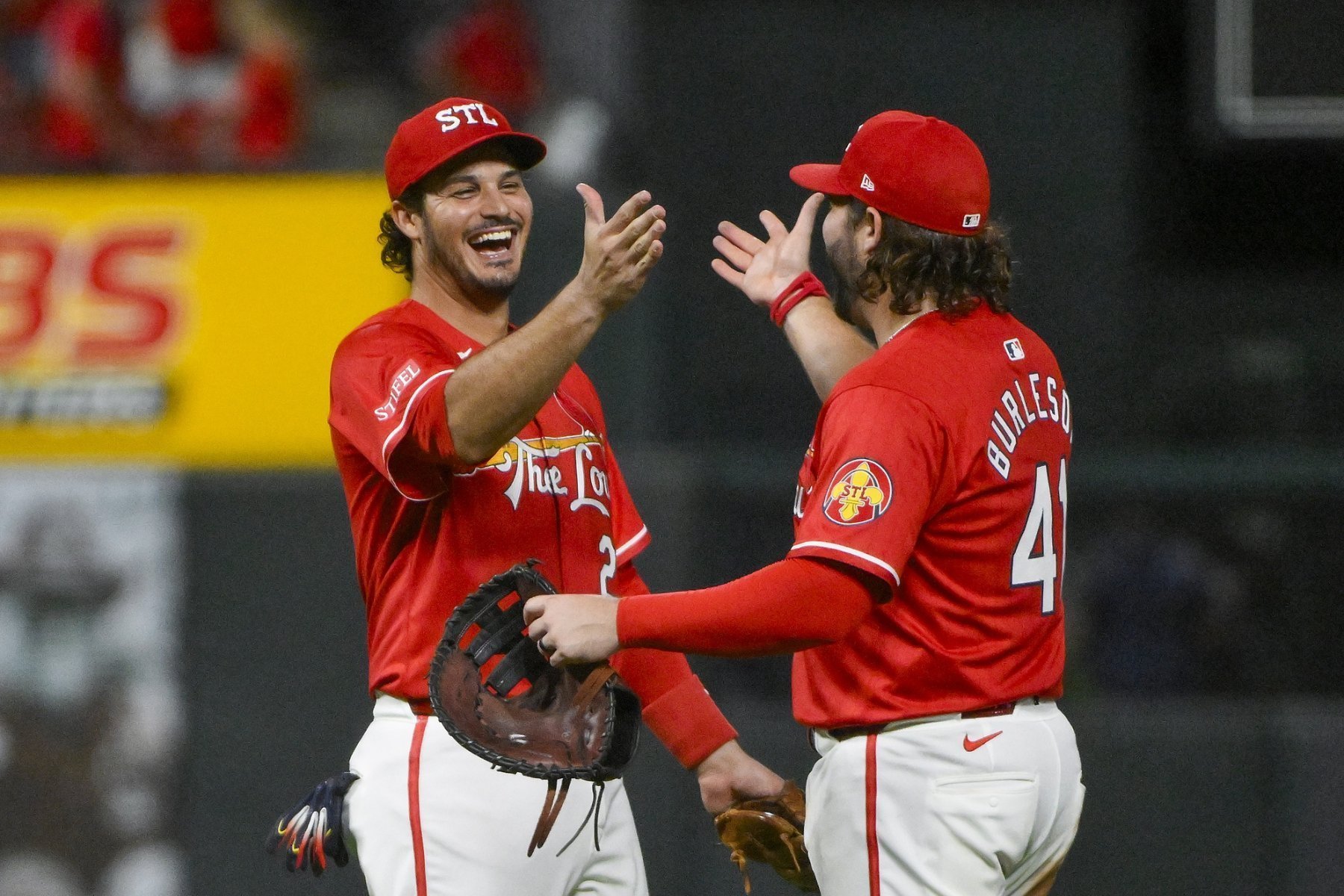
While Nolan Arenado is the most recognizable face in this deal (much more on him shortly), Alec Burleson is the real centerpiece.
Burleson has steadily improved at the plate during his MLB career, from a 56 wRC+ in 2022 to a 89 wRC+ in 2023 to a 106 wRC+ in 2024 to a 124 wRC+ in 2025. Specifically from May 2025 onward, he was one of the most consistent hitters in baseball. And that was only his age-26 campaign—there could still be more meat left on the bone.
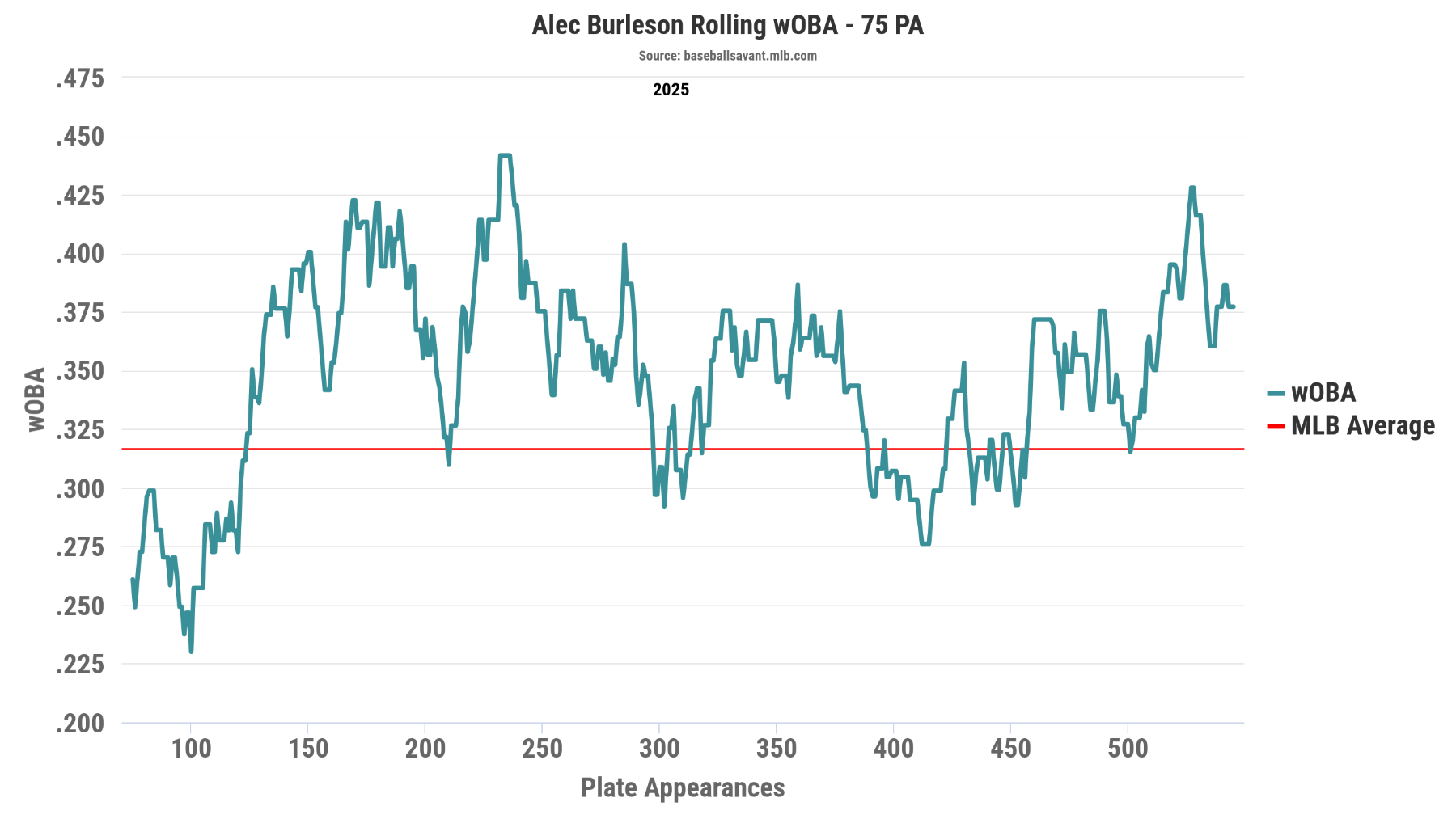
If nothing else, you can bank on Burleson making contact as he perennially ranks in the 80th percentile or above among MLB hitters in whiff rate. He previously had some trouble barreling up breaking balls, but that turned around this season with a .512 slugging percentage and 92.2 mph average exit velocity against them.
The Cardinals tried to develop Burleson as an outfielder, but he continues to be a mediocre defender in both corners. He’s usable there in emergencies, but the Marlins are well-situated as it is with Kyle Stowers and Jakob Marsee atop their outfield depth chart and a handful of intriguing in-house options to complement them. With his new organization, Burleson would focus fully on first base, a position where the Marlins have been multiple wins below league average (in terms of WAA) during each of the last four seasons.
Burleson is projected by MLB Trade Rumors to earn approximately $3.5 million entering his first year of arbitration eligibility. He’ll remain under club control through 2028 via arbitration.
Surely some of you readers will suggest that the Marlins hoard their prospects and just address first base via free agency. Ryan O’Hearn, in particular, has a similar skill set and recent track record…except he’s five and a half years older than Burleson. The few “better” players on the FA market will be prohibitively expensive for the Fish. Burleson is the right fit for them.
JoJo Romero is also coming off a career year. He posted a 2.07 ERA in 61 innings pitched, and that doesn’t even account for his brilliant knack for stranding inherited baserunners (only three of 26 inherited runners scored). Romero’s slider has been a plus pitch throughout his Cardinals tenure and it continues to be his main putaway pitch. He had 33 strikeouts and zero home runs allowed in 106 plate appearances ending with sliders this season.
d958f234-c73d7476-3c56f5a1-csvm-diamondgcp-asset_1280x720_59_16000K.mp4
The 2025 Marlins never had a balanced bullpen and it repeatedly burned them. Rookie Cade Gibson rose from obscurity to provide one source of competence from the left side, but even he had big reverse platoon splits. Unfortunately, you can’t place any expectations on Andrew Nardi in his attempt to return from a year-long, potentially career-altering back injury. Reinforcements are needed.
Romero’s projected arb salary is $4.4 million, then he’ll be eligible for free agency. Relievers are always in high demand at the trade deadline, so if for whatever reason, the Marlins regress next season and reluctantly sell at the deadline, at least they should be able to recoup some of the prospect capital that they originally gave up to acquire the 29-year-old.
This brings us to the future Hall of Famer Arenado, who was already traded once in his career when his contract was perceived to be underwater. He finds himself in that awkward predicament yet again. He trudged through the worst season of his career at age 34, setting new lows in batting average, on-base percentage and slugging percentage while also spending a quarter of the season on the injured list with a right shoulder strain. The Cardinals owe him $22 million in 2026 and $15 million in 2027; the Colorado Rockies are paying him an additional $5 million in ’26, though that is only relevant to his bank account, not his current market value.
Both Arenado and the Cardinals have spoken candidly about his imminent departure from St. Louis. Although he has full no-trade protection, that isn’t expected to be an obstacle like it was last winter.
In the same way that development isn’t always linear, the same applies to decline. A new environment can reinvigorate a frustrated veteran, as could new coaches. The Marlins staff puts an emphasis on swing decisions and it’d be fascinating to see how their messaging is received by the typically aggressive Arenado (16th percentile in chase rate this season). If he’s determined to extend his career into his late 30s, he’ll be open-minded.
This might be 2023 Yuli Gurriel all over again—a slick-fielding contact hitter who is invaluable in the clubhouse, but too power-deficient to start regularly at a corner infield spot. In that case, the Marlins have Graham Pauley, Connor Norby and Maximo Acosta eager to prove themselves.
Yes, financial relief is a factor from the Cardinals’ perspective, but they aren’t desperate enough to accept a package of lottery ticket types. They will insist on covering some of Arenado’s contract in order to get talent with the upside to actually help them win games in future seasons. I think a reasonable compromise is paying down his 2026 salary to match his 2027 salary at $15 million apiece, leaving the Marlins on the hook for $30 million total.
Andrew Salas (#6 on the Fish On First Top 30) spent his entire age-17 season with Low-A Jupiter, making him the youngest player in any organization to get a full season of Low-A reps this year. Salas slashed .186/.319/.245 with 39 stolen bases in 104 games, showing clear signs of fatigue toward the very end. Unconventionally, the Marlins rotated him between six different defensive positions, most frequently center field and shortstop. His long-term success will hinge on adding more strength and attacking pitches earlier in counts.
Eliazar Dishmey (FOF #15) is a likely big league arm with a mid-rotation ceiling. He commands his sinker well at the bottom of the strike zone and generates whiffs with both his changeup and sweeper. He excelled in his first taste of High-A (2.19 ERA and 2.07 FIP in 24.2 IP). Dishmey just turned 21 on Saturday. He’ll be Rule 5 draft-eligible after the 2026 season.
TzAwQjlfWGw0TUFRPT1fQmdaWlVWWU1Vd1FBQ0ZZR1VBQUVBUUJWQUZFRlV3SUFWRlVOVTFjRUFBUUJCd0lI.mp4
The clock is ticking on both Victor Mesa Jr. and Adam Mazur, who would be more useful to the Cardinals than the Marlins given the latter’s surplus of outfielders and rotation candidates. Mesa is a .272/.335/.456 hitter with 20 homers and nine steals in 122 Triple-A games, but his progress has been hindered by various injuries. Mazur has struggled to the tune of a 6.22 ERA and 5.60 FIP in 14 career MLB starts despite good control because of his lack of a reliable putaway pitch. They each have one minor league option left.
Even accounting for the money owed to Burleson, Romero and Arenado in 2026, the Marlins would be projected for a bottom five MLB payroll. They must consider making other sensible additions to maximize their postseason chances.
But let this proposal serve as a reminder that the Marlins are not limited to the universe of players on the free agent market. In relatively short order since Peter Bendix’s arrival, they’ve built a deep organization, and that can be leveraged to get creative trades done this offseason.