
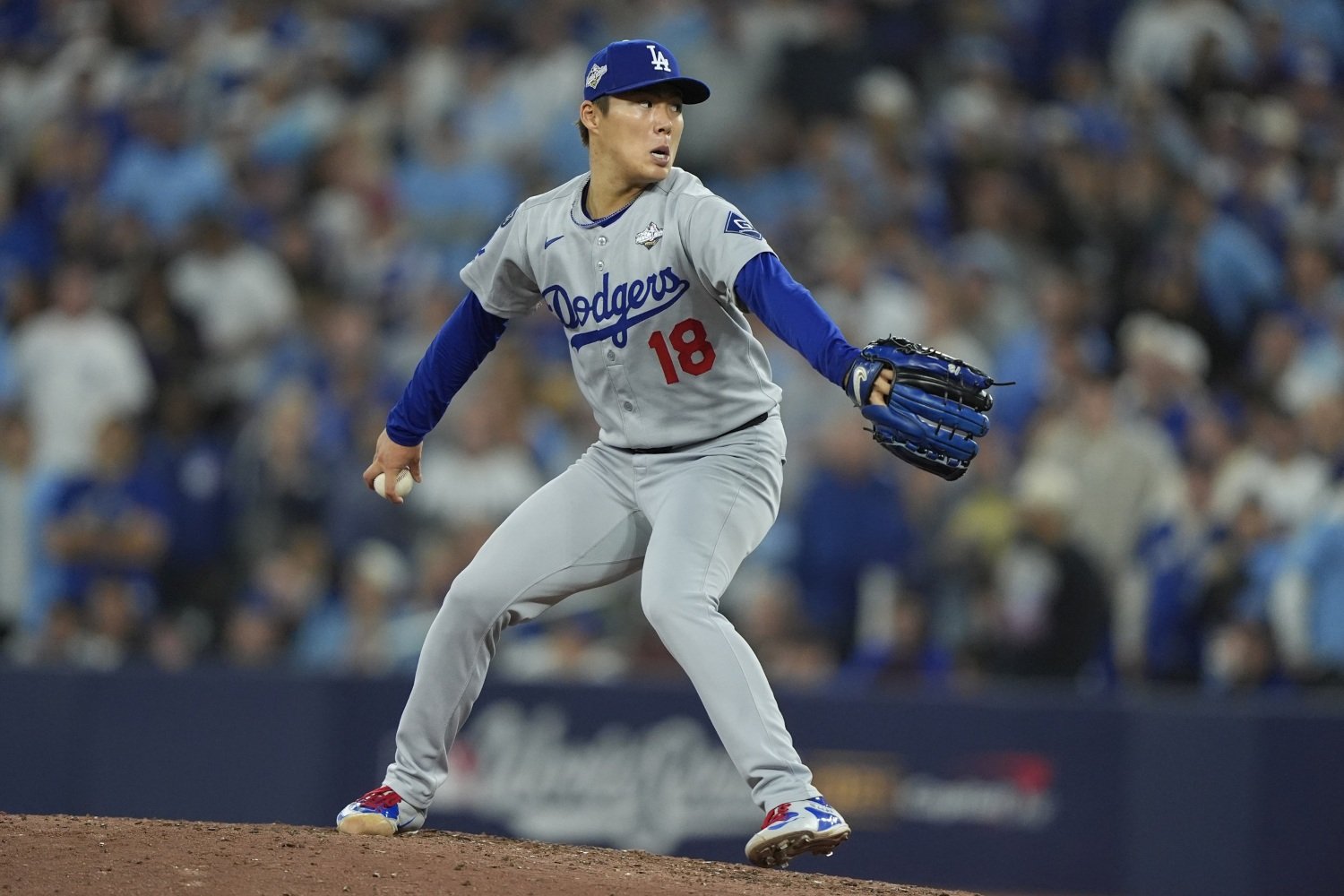
If you’re anything like me, you’ve been watching a lot of playoff baseball. Whether the Cubs are involved or not, it’s just something I do every October, like clockwork. Something I really enjoy doing, while watching, is trying to spot the small things that the two World Series teams are doing that other teams might try to emulate going forward. The most obvious one for this year’s edition featuring the Los Angeles Dodgers and Toronto Blue Jays is to spend money. Both teams are in the top five in payroll, and will pay the luxury tax.
I could wrap this piece up in three paragraphs. The Cubs need to spend more money. We all already knew that, though. We also know, in all likelihood, that it probably won’t happen—at least not to the extent that we want it to.
So what else is there? If you’ve been watching the World Series to this point, you might have noticed that there are a whole lot of splitters being thrown. This is likely due to the starting pitchers who happened to be throwing in Games 1 and 2 of the series. Of the four pitchers who have started to this point, three (Trey Yesavage, Kevin Gausman, and Yoshinobu Yamamoto) heavily feature a splitter. With Max Scherzer and Tyler Glasnow set to start Game 3, you’ll probably be seeing fewer of them in the immediate future, but the trend prevails.
According to Statcast, at 9.3% of their total pitches, the Blue Jays threw the most splitters in the regular season. The Dodgers, at 7.1%, were third.
They’ve both doubled down on that in the postseason, too. The Blue Jays have upped their splitter usage to 15.4% in the playoffs, which is mostly a factor of the aforementioned Yesavage playing a greater role. The Dodgers have upped it to 9.4%, mostly thanks to increased splitter usage by Shohei Ohtani.
Some of this is probably happenstance. Gausman, Yamamoto, Ohtani, and Yesavage are all good pitchers who happen to throw splitters. The former three all were throwing splitters before their current teams awarded them with big contracts. Yesavage credits his college pitching coach, Austin Knight, with teaching him a splitter, and was made a first-round pick last year partially because of the success of the pitch. This isn’t necessarily a case of the Blue Jays and Dodgers teaching guys how to throw a splitter better than everyone else.
With that said, it’s hard to watch these guys use the pitch so effectively on the biggest stage in baseball and not wonder what the Cubs can do to better utilize the pitch among their staff. After all, the presence of the pitch has been slowly rising across baseball the past few years. All stats courtesy of FanGraphs:
Year
Splitter %
2025
3.3%
2024
3.0%
2023
2.2%
2021
1.6%
The Cubs, for what it’s worth, were eighth in splitters thrown this season, with 4.9% of their pitches being splitters. That is mostly thanks to Shota Imanaga: 31.4% of his pitches this season were splitters. 12.1% of Colin Rea’s pitches were also splitters. No other Cub who worked more than 15 innings this year threw the pitch more than five percent of the time, and neither of those pitchers are guaranteed to be with the team for next season.
There’s some recent history with the Cubs and trying to teach players a splitter. Just two years ago, they taught one to Jeremiah Estrada. According to an ESPN article by Alden Gonzalez, he never got comfortable with the pitch and came up with his own grip. Unfortunately, he wasn’t with the Cubs long enough for them to benefit from it. He was picked up by the San Diego Padres and has blossomed into one of the best relievers in baseball over the past two seasons, in large part due to his splitter.
For those unaware, a splitter is typically thrown with your fingers “splitting” the baseball. You place the baseball in between two of your fingers, typically your index and middle finger. This allows the pitch to look like a fastball out of your hand until it drops suddenly at the last second because there’s so little spin on the ball. Here’s an example of a well-thrown splitter from Gausman on Saturday night:
TDZYZE1fV0ZRVkV3dEdEUT09X0JnZ0RWMXdEVjFNQUNGQUtWUUFIQWxBSEFBQUhVVkVBVjFkUkNWSURDVkJUQWxOZg==.mp4
The pitch is typically effective against opposite-handed hitters. If anyone remembers, this is why the Cubs used to bring the splitter-heavy Mark Leiter Jr. in to face left-handed hitters. Can you think of anyone on the Cubs who has struggled against opposite-handed hitters and could use a new pitch? Of course. That would be Ben Brown.
I’m aware it’s much more complicated than that, and there are just so many factors at play with whether or not a pitcher learns to throw a pitch effectively enough to get major-league hitters out with it. Regardless, as you watch all of these pitchers continue to dazzle with their splitters in the World Series, keep this tucked in the back of your brain throughout the offseason. Splitters have been slowly proliferating over the past several seasons, and with them taking the spotlight in the World Series, it wouldn’t shock me if a Cubs player shows up to Spring Training in February with a fancy new splitter.