
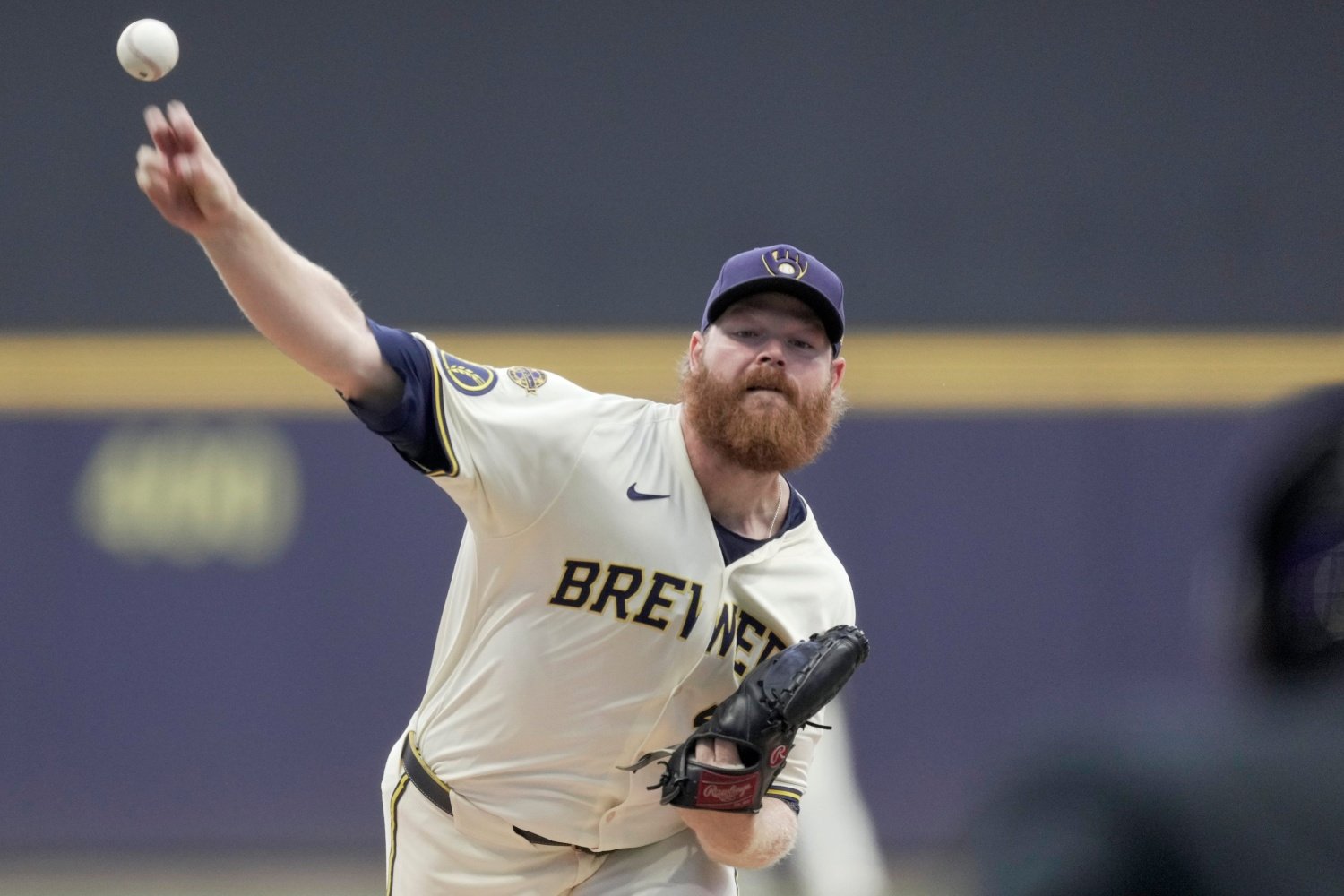
Brandon Woodruff encapsulates the Milwaukee Brewers in many ways. He’s shown the adaptability, fierce competitiveness and aggressiveness that typify this franchise. He adds as much off the field as he does on it. However, questions remain about his on-field production. Can he remain healthy over a full season, for the first time since 2022? Can he regain his former fastball velocity? Most importantly, what will his market value look like?
Can Brandon Woodruff stay healthy?
The first question is the most difficult to answer, and perhaps the hardest about which to be optimistic. Pitchers can pick up long-term injuries at any time, a matter Woodruff has become well-acquainted with after untimely injuries both in 2023 and in 2025—each time, within days of what would have been a playoff start, and with a free-agent payday in sight.
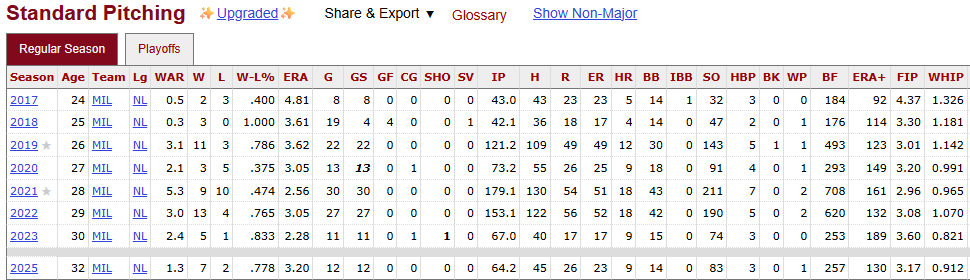
He hasn’t been injury-prone his whole career. Woodruff was one of the team’s trusted starting pitching trio from 2019 through 2022, before beginning to falter in 2023. That season, he dealt with a strained lat, ankle tendinitis and (finally) the shoulder capsule injury that held him out for almost 20 months. Upon returning to the mound in July, Woodruff looked healthy, but he wore down as the season neared its conclusion, eventually succumbing to another lat strain that he referred to as a “ticking time bomb” following his shoulder rehab. The question, now, is with how much of a role he can be trusted heading into 2026.
Though it came as a reliever, Aaron Ashby’s workload this season gives some hope that Woodruff’s shoulder can hold up next season, but you never quite know when these things will rear their ugly heads again. Woodruff will be 33 by the start of spring training, which makes questions of durability harder to shake and figures to limit him to relatively short-term offers this winter. Whether it be a recurrence of the same trouble he’s had for the last two years or something wholly new, something is likely to stop Woodruff from making 32 starts in 2026. Workload management will be needed.
Can Brandon Woodruff pitch like a top-of-the-rotation arm once more?
Woodruff showed immense development in the depth of his arsenal in 2025, with pinpoint command allowing him to mow down hitters despite a substantial drop in velocity across the board. Woodruff is optimistic about that velocity returning in the future, and the case of Aaron Ashby after a similar surgery is proof that there is a chance.
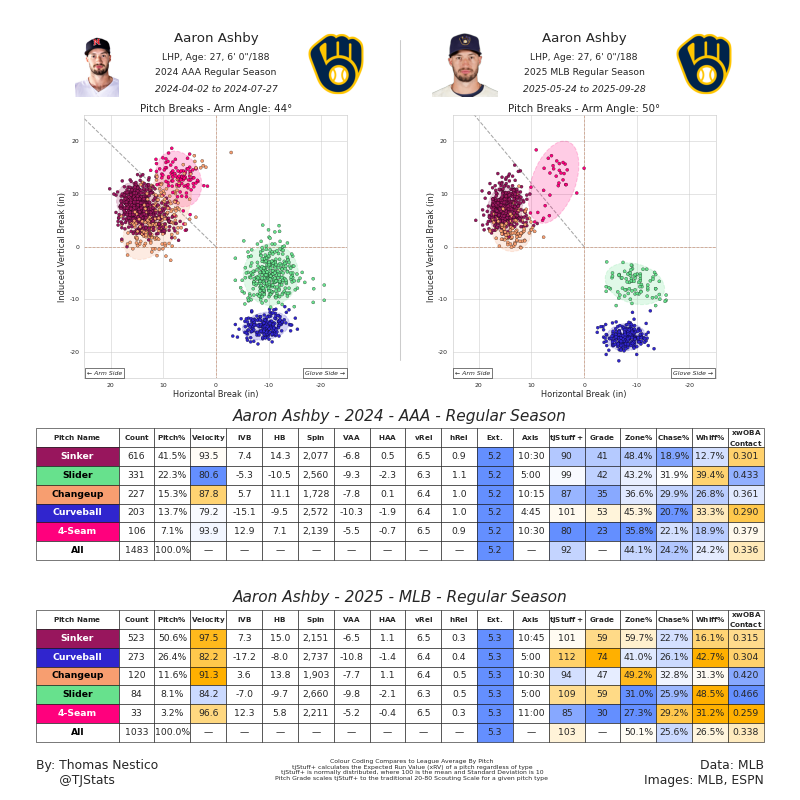
The first chart is from Aaron Ashby’s first four months at Triple A in 2024, as a starter; the second is from his outings in long relief throughout 2025. Ashby’s velocity is up almost four miles per hour on his primary fastball. Ditto for his slider, curveball and changeup. His spin rates have also significantly increased.
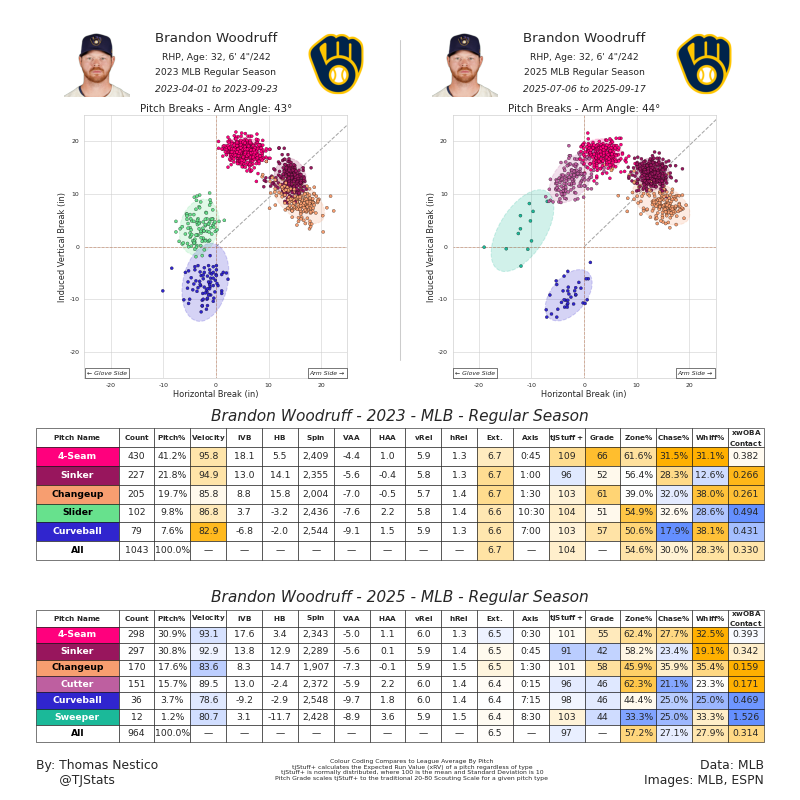
With a clean offseason, there’s a chance Woodruff may rediscover his raw stuff from 2023. Even if not, perhaps with an even more well-rounded arsenal, he can end up becoming a more complete pitcher. He may find more wiggle room to mitigate mistakes, after a career-high home run rate in 2025. The difference isn’t as extreme for Woodruff as it was for Ashby. There are several ticks missing from his fastball, and the lower spin rates across the board are notable, too.
What Will Brandon Woodruff Command On The Open Market?
Woodruff will almost certainly decline his side of the $20-million mutual option on his contract for 2026. Due to the $10-million buyout, it would effectively mean that Woodruff is returning for only $10 million on a one-year deal, which is significantly below market value for a pitcher who’s showcased his ability to dominate with his best stuff and compete with diminished velocity. Woodruff is also likely to seek future security with a multi-year deal, given his history and age.
This fall’s season-ending injury deprived Woodruff of a platform in the playoffs to really gain some momentum entering free agency. The Brewers could stack things in their favor by extending a qualifying offer, which Woodruff could accept to lock up a small raise but which would not commit Milwaukee beyond 2026. That way, if he signed elsewhere, the Crew would get a draft pick to compensate them. With Woodruff’s upside, there’s no such thing as a bad one year deal.
If he declines, that would mean any potential suitor would be penalized, depending on a few factors:
If a team exceeded the luxury tax threshold in 2025 (as have the Dodgers, Yankees and others), they would lose $1 million in international bonus pool money and their second- and fifth-round picks for the 2026 MLB Draft
A team that receives revenue sharing (like the Rays) would lose its third-round pick
A team meeting neither of these qualifications will lose their second-round pick and $500,000 in international bonus pool money
If the Brewers believe Woodruff is searching for a longer-term deal in the $50 million range across three years, this could be an intelligent gamble with limited downside. The penalties are harsh enough to give some teams pause, so attaching hte QO would deflate Woodruff’s market.
Jack Flaherty, of the Tigers, could end up being a relevant comp to Woodruff at this stage of the veteran’s career. Though they’re different pitchers who have traced different arcs, they end up being fair facsimiles of one another as free-agent cases. Flaherty signed a two-year deal with Detroit last winter that guaranteed him $35 million, with the chance to see that rise to $45 million if he stayed healthy in 2025—as he then did. Now, Flaherty can opt for free agency or stick around to finish off that deal in 2026. Woddruff could sign a similarly flexible and incentive-laden deal with the Crew.
One other factor in this. There has been a lot of chatter about how the Brewers would be loathe to let him go, and they worked incredibly hard to retain him during his last free agency period. in actual fact, Woodruff commented that the Brewers hadn’t been in touch, and he’d been about to sign with another organization (the Red Sox, or perhaps the Cubs) when they finally reached out with a superior offer. There’s a clear affinity between team and player, but no sense of inevitability in their staying together.
There’s a very real chance that Woodruff will return to the Brewers this offseason. It almost definitely will not be by accepting his side of the option, though. The most likely outcome is that Woodruff wants a long-term deal, and a guaranteed sum of money that truly sets him and his family up for life. Three years and $50 million may be the mark to pass. Would you make that offer, as the Brewers front office? Or do you think he’ll get more elsewhere? Let us know your thoughts in the comments below!