

 Listen to this article
The Minnesota Twins baseball team and its fans will be watching from afar as the defending champion Los Angeles Dodgers and the resilient Toronto Blue Jays conclude the World Series this week, as they have for 62 of the club’s 65-year existence here in the state. The only exceptions were 1965, 1987 and 1991, when the club went to the World Series, losing in seven games in 1965 and prevailing in a pair of seven-game series the latter two times.
The absence of the Twins from post-season play comes at the end of a season in which a former Twins ballplayer lost a contest in another forum: the Minnesota Court of Appeals.
It is one of a series of lawsuits involving Twins personnel over the years, losing most, but winning one, which are worth recalling on this occasion.
The most recent defeat occurred this when a pitcher with a short-lived stint with the Twins lost a child-support case. But the case was no ordinary child-support litigation. The losing litigant was Randy Jackson, who was sued here to enforce a judgment against him in a court in Japan, where the child and his mother reside.
The litigation warrants review as the baseball season draws to a close sans Twins, again.
Japanese joust
The joust between Jackson, known as “Jay,” arose out of his playing days in Japan during a break in his mediocre six-team Major League career that ended with a short spell with the Twins. Jackson, a self-described “journeyman,” pitched in 20 games with the Twins last year, 13 at Target Field, with a 1-2 won-lost record, and a miserable 7.50 earned run average (ERA).
 Marshall H. Tanick
While in Japan, he fathered a child with a Japanese woman, who later sued him for child support under the law in that country. She prevailed there and obtained a judgment in an amount not specified in the appellate court ruling.
When she tried to collect it here, the ex-Twins pitcher argued that it was not enforceable. See L. Brown, “Court of Appeals: Ex-Twins pitcher must pay Japan child support” in the June 2, 2025, edition of Minnesota Lawyer.
The judgment in Japan was registered in Hennepin County under the Uniform Interstate Family Judgment Act, Minn. Stat. § 518C.101-905, which exists in all 50 states.
But the ex-hurler struck out in Hennepin County District Court, when the enforcement action was brought, which upheld the Japanese decree.
So did the Court of Appeals in the published decision, Kiya v. Jackson, 23 N.W.3d 857 (Minn. App. 2025) rejecting the reliever’s claim of lack of personal jurisdiction over him and lack of personal service of process.
The appellate tribunal, in a decision written by Judge Kevin Ross, pointed to Jackson’s “Minnesota-based employment as a professional athlete,” underscored with leasing an apartment while with the local club. He was subject to personal jurisdiction here because “he was domiciled in Minnesota” when the child’s mother began the administrative proceeding. These features sustained jurisdiction since it evinced his intent “to continue living in Minnesota indefinitely as a member of the Twins,” although it turned out to be a short-term relationship.
The judgment was enforceable under the Uniform Act because the Japanese laws and procedures were “substantially similar” with Minnesota protocols, though not identical, and satisfy the statutory enforcement standard. The ballplayer’s defense of lack of personal service of process was rejected under the Act since a proceeding under the Uniform Act is “an administrative action distinct from a judicial action.”
“Baseball is like church: many attend, but few understand.”
Longtime baseball manager Leo Durocher (1905-1991)
* * * * * * * * * *
“Baseball is 90% mental and other half is physical.”
Yankee iconic catcher Yogi Berra (1925-2015)
* * * * * * * * * *
“Baseball was, is, and always will be the best game in the world.”
Slugger Babe Ruth (1895-1948)
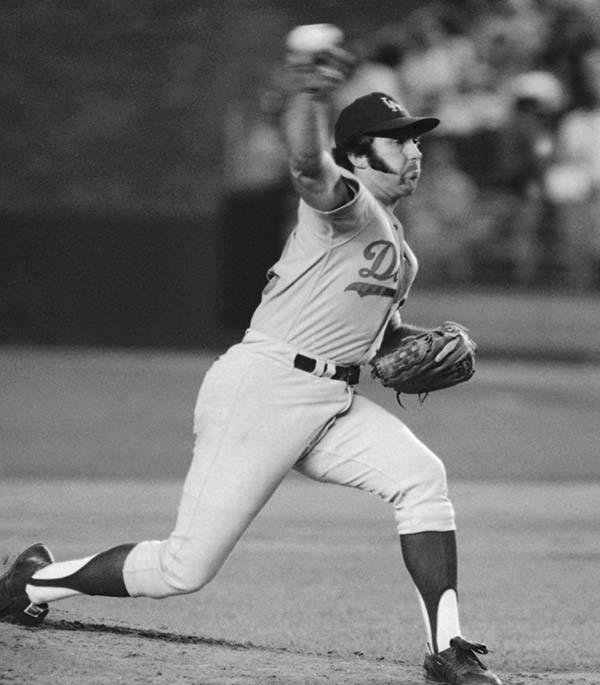 A reliever of greater prowess and renown, Mike Marshall, the 1974 National League Cy Young winner with the Los Angeles Dodgers, took an “L” in a post-marital dissolution case in Marshall v. Marshall. In this August 1974 file photo, Marshall pitches to a New York Mets batter during a game in New York. (AP file photo)
Marshall matter
The Jackson defeat was not the first time a Twins relief pitcher suffered a family law setback in the Minnesota appellate court system.
A reliever of greater prowess and renown, Mike Marshall, the 1974 National League Cy Young winner with the Los Angeles Dodgers, took a “L” in a post-marital dissolution case in Marshall v. Marshall, 350 N.W.2d 463 (Minn. App. 1984).
After completing his 15-year career, including a stint with the Twins in 1978-1980, the two-time All-Star relief pitcher challenged four determinations in his 1982 marital dissolution proceeding in Hennepin County District Court, losing all of them.
One concerned the inclusion in the marital estate of a deferred compensation plan he obtained during a year with the New York Mets after leaving the Twins. He contended that a waiver signed by his spouse to his “income” kept that out of the divisible assets. But the lower court disagreed, as did the Court of Appeals, which held that the waiver only applied to his 1981 salary, but not to “a retirement benefit which she is entitled to share.”
The deferred comp, a common feature of many pro athlete contracts, was “more analogous to a pension plan than to income.” Based on Supreme Court precedent, it constituted “property, subject to the equitable distribution.” Thus, it upheld the trial court’s equitable distribution of it, with each party paying taxes on their respective shares.
Another issue also was resolved against the former pitcher. The lower court’s ruling of maintenance “for a limited time” was appropriate because of his ex-spouse’s experience attending law school for the “next three to four years” while taking care of a minor child at home. The existence of education trusts previously set up for the couple’s three children did not bar child support because it “would be unfair and defeat the intent of providing education for all [three] of the children.”
The former pitcher also got no relief on a claim by his former spouse for one-half of any tax relief in 1982 attributable to his 1981 wages, which he had refused to pay over to her.
Age & analytics
Another case, like Jackson, with a global theme involved a longtime Twins international scout who was terminated after the team shifted to a more data-based mode of reviewing potential players in Norsetter v. Minnesota Twins, 2021 WL 5173764 (Minn. Ct. App. Nov. 8, 2021)(nonprecedential).
The suit was brought by a 59-year-old man who had been an international scout stationed in Australia for the Twins. After his contract was not renewed and he was not considered for a scouting position in the United States, he sued for age discrimination. The Twins denied it, asserting that the reason for his termination was that the team made a “business decision” consistent to greater reliance on statistical data, known as analytics, in lieu of conventional on-site reviewing of players.
After some discovery skirmishes, the scout’s case was dismissed on summary judgment by the Hennepin County District Court. The appellate court affirmed under the three-part burden shifting standard of McDonnell Douglas Corp. v. Green, 411 U.S. 792 (1973), reasoning that the Twins had a “legitimate business reason” to throw the scout out, regardless of his age, and the scout did not show that its rationale was pretextual.
Uhlaender undertaking
But one Twins player managed to prevail in a landmark Minnesota lawsuit in Uhlaender v. Henricksen, 316 F. Supp. 1277 (D. Minn. 1970). The case was an undertaking by the nascent Major League Baseball Players Association as a class action in the name of Ted Uhlaender, a mediocre but serviceable center fielder for the Twins, against a manufacturer that, like latter day video amusements, used the names and statistics of real-life ball players.
U.S. District Court Judge Phillip Neville in Minneapolis ruled in favor of the player on grounds that a player’s “identity, embodied in his name, statistics, and other personal characteristics, is the fruit of his labors” and is a type of legally protectible “property.” Invoking the term “right of publicity,” the decision became the progenitor for the Name, Image and Likeness (NIL) doctrine designed four years ago from the landmark Supreme Court rulings in NCAA v. Alston, 594 U.S. 69 (2021), and the case was later imbedded in the common law right of publicity in Lake v. Walmart Stores, 582 N.W.2d 231 (Minn. 1998).
This quartet of cases show that, while they often strike out in litigation like the two relief pitchers and the scout, Twins personnel occasionally hit a homer in court like Uhlaender, who only hit 36 homers in his eight-year Major League career for the Twins and two other clubs.
It was a dramatic three-run homer in the final game of the American League championship play-off that propelled the Blue Jays into the Series for the first time since 1993, the second of their two consecutive World Series titles.
Who preceded them? The Twins.
Hope springs eternal!
RELATED: More Perspectives columns
PERSPECTIVE POINTERS
Top 10 Twins Pitchers
Camilo Pascual: Cunning Cuban curve-baller
Jim Kaat: Played in four decades in Majors, then Hall of Fame
Jim “Mudcat” Grant: Led team to 1965 World Series
Al Worthington: Relief star of 1965 squad
Jim Perry: 1970 Cy Young winner
Bert Blyleven: Twins winningest pitcher, 141 games, and Hall of Famer
Frank Viola: 1987 Series hero
Jack Morris: 1991 Series star, 1-0 seventh game winner
Joe Nathan: Most relief games, 260
Johan Santana: Two-time Cy Young winner, 2004, 2006
Marshall H. Tanick is an attorney with the Twin Cities law firm of Meyer, Njus, Tanick, Linder & Robbins, PA.