
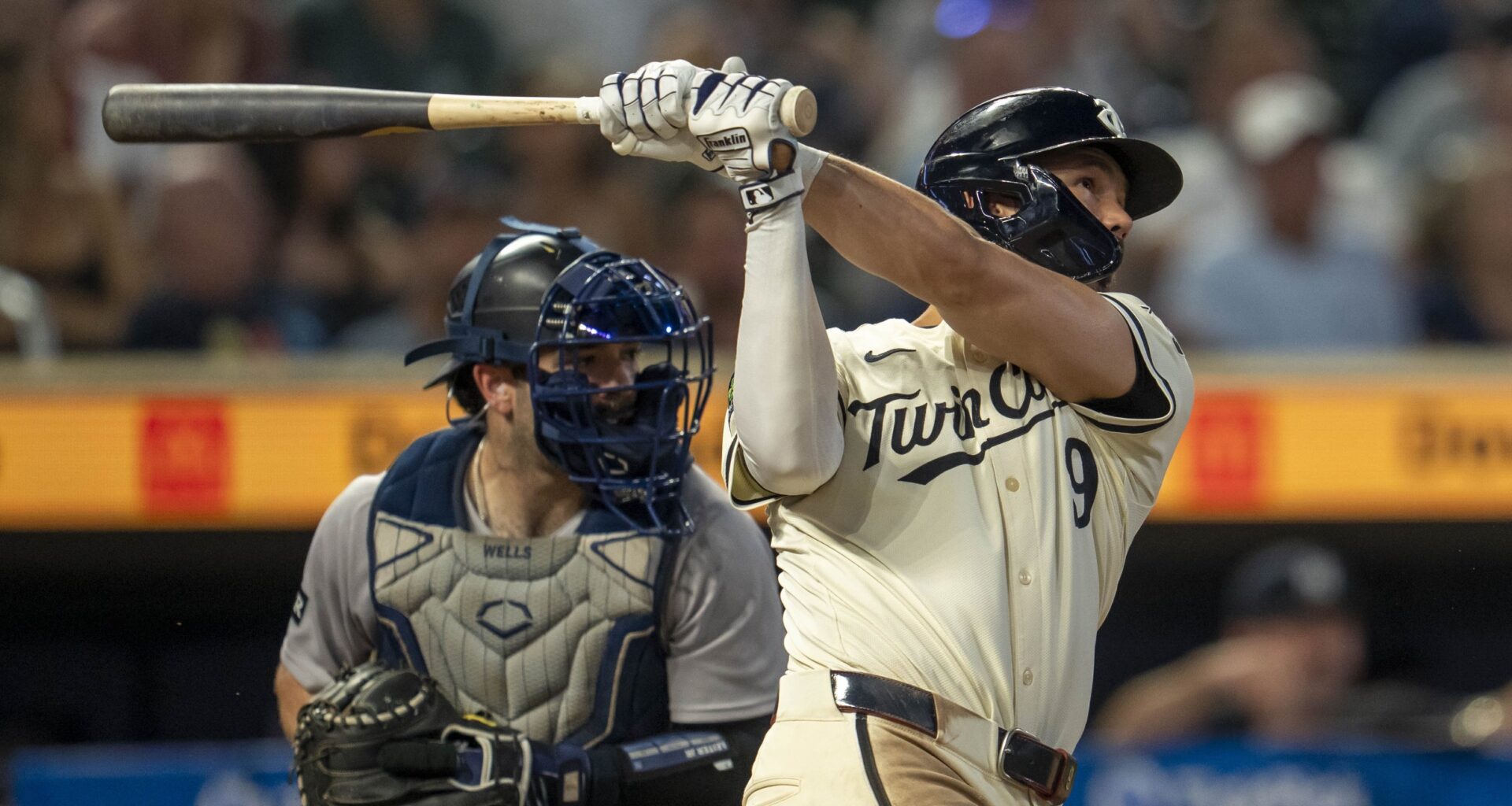
Trevor Larnach‘s development as a major-leaguer was slow and full of setbacks, but what made one feel confident was the steady trend of improvement. He debuted with a meager .672 OPS in 2021, then improved to .712 in 2022 and .727 in 2023. Even by this point, at age 26, the production remained unspectacular, but there were a lot of intriguing aspects in his underlying metrics and trajectory.
Sure enough, the pieces came together in a breakout 2024 season for Larnach. He slashed .259/.338/.434 for a .771 OPS that was 16% better than league average. He became a fixture near the top of Rocco Baldelli‘s lineups against righties, and Larnach taking another step forward in 2025 was integral to the Twins’ vision for an all-around offensive rebound.
Larnach came out of the gates this year as regular cleanup hitter. And he just never really got going. There were modest bursts of production from time to time but Larnach couldn’t find a rhythm, slumping to the finish line and finishing with a regressive .727 OPS. Like Matt Wallner, Larnach was heavily suppressed when pitchers buckled down in run-scoring opportunities, and he offered even less value than Wallner in the field (leading to almost three-quarters of his starts coming at designated hitter).
It all amounted to roughly replacement-level production in 142 games. Larnach was one of the biggest drags on Minnesota’s dormant offense. He plays at a position of abundance, and he’s in line to get a decent raise via arbitration — so naturally there is talk about moving on. I think that would be a mistake. But let’s take a look at what needs to do to rejuvenate this career if he remains in the team’s plans.
Limitations to Overcome
Larnach has two primary things working against his value as a player, and neither one seems likely to change for the better at this point. First, he can’t hit lefties. He just can’t. The Twins greatly increased his opportunities against southpaws in 2025, hoping he might come to at least hold his own in same-sided matchups –– but he posted a .608 OPS, in line with his .585 career mark. Second, there is the total lack of defensive value. He’s slow and unlike Wallner he doesn’t have much of an arm.
Both of these factors were hindrances in a campaign that saw Larnach finish with 0.2 fWAR, but they don’t preclude him from being a valuable contributor at the major-league level. I will grant that Larnach’s persistent inability to fully unlock his potential makes a solid case against keeping him around, but if he can lock back into what he does well, Twins fans will quickly come to remember what he can offer.
Seeing Red Again
The 2024 season, especially the final stretch, was a rough one for many Minnesota hitters. Not Larnach, though. He enjoyed a career year, and actually finished strong while the rest of the team tanked, posting an .804 OPS in August and September. I look at Larnach’s Statcast profile from that season and I see all of the qualities that made him a first-round draft pick and a highly regarded young bat: the outfielder did everything well at the plate with the exception of swinging and missing (where he improved dramatically from the previous year).
He faded across pretty much every facet in 2025, for whatever reason. Maybe his skills are already dulling as he approaches 30. Maybe there were health issues quietly being managed. Maybe it was plain and simply a bad year, and one he can put behind him in pursuit of an eventual free-agent payday.
It all comes down to Larnach maximizing his theoretical main strength: mashing right-handed pitchers. That was a persistent struggle this year for the Twins, who slashed just .237/.308/.400 against righties. Larnach’s .758 OPS vs. RHP wasn’t good enough, but also it’s a solidly above-average baseline and he packs more explosive upside than a lot of other players crowding the corner-outfield mix.
Enough Rebound Potential to Stay Relevant?
Larnach is in a tough spot. Turning 29 this winter, he no longer offers youthful projection in the same sense as Alan Roden, whose acquisition at the last deadline puts Larnach in the expendability crosshairs. He also doesn’t have the proven track record of high-end production of Wallner; at his best Larnach hasn’t been able to level up from good to great.
Still, as we all know, baseball development is nonlinear and late bloomers are all around us. Larnach has shown the traits of a very good hitter, and the Twins clearly recognized that. Projected to make $4.7 million in arbitration, he’s feeling the crunch as Wallner, Roden, Austin Martin, Emmanuel Rodriguez and maybe even Walker Jenkins all contend for playing time in the outfield corners or DH.
Is the upside the flashed in 2024 still within Larnach? Was it even good enough to be worth betting on? We’ll find out soon enough how the Twins feel.
Explore previous entries in the “Road to a Rebound” series: Brooks Lee, Royce Lewis, Matt Wallner