
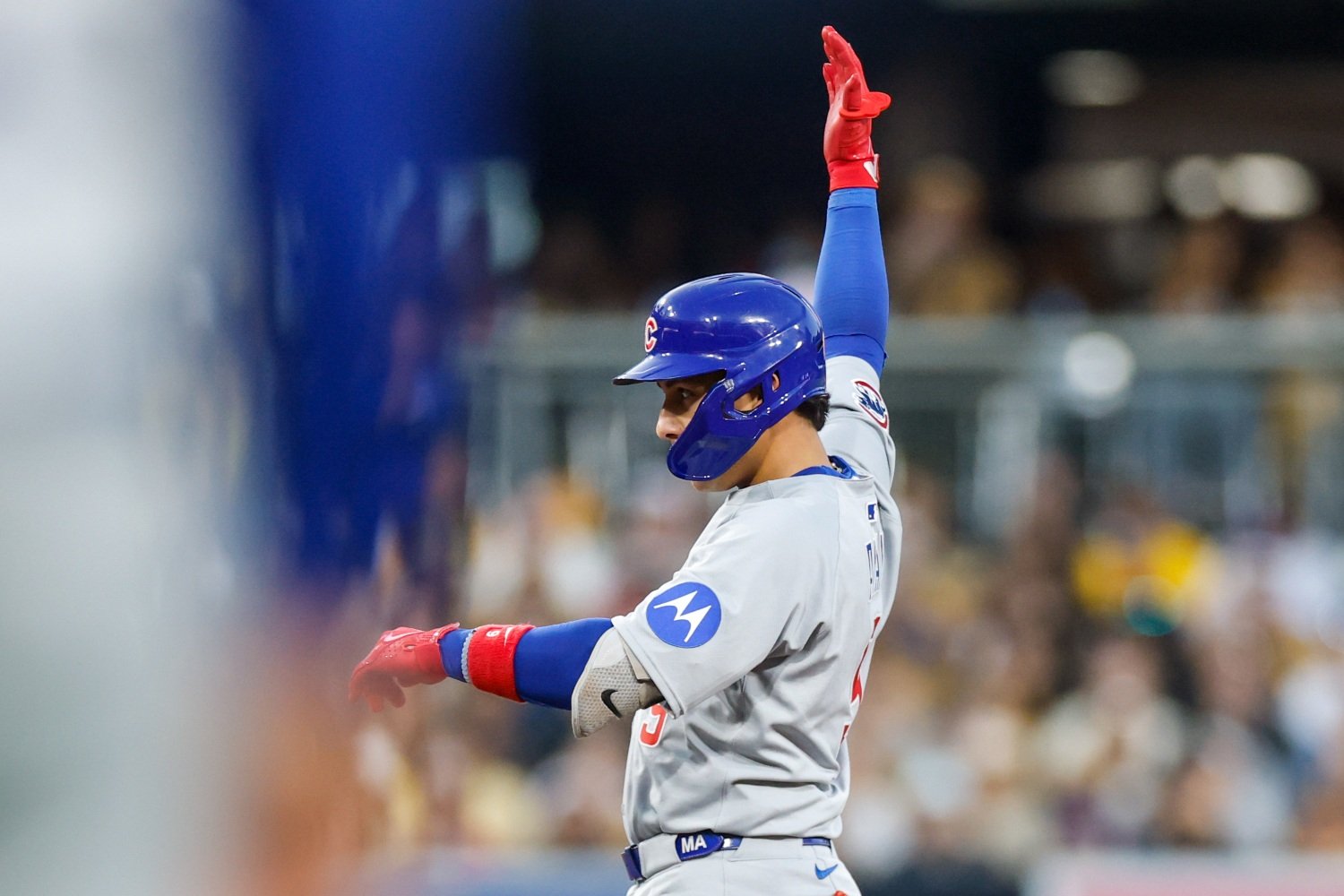
The offseason is right around the corner, and Miguel Amaya is poised to enter it with 2 years, 130 days of MLB service. That’s very close to the cutoff for Super Two eligibility for arbitration in recent years, but according to a review of the players who make up the pool of candidates for that status, it’s likely to fall roughly five days short of the line for 2025-26. Amaya, 26, is still an out-of-options player coming off an injury-shortened campaign, but he had a strong season and will be easy to bring back as half the projected catching corps for the 2026 Cubs.
All players with between three and six years of MLB service time qualify for salary arbitration each winter. Amaya fell about six weeks shy of a full year of service (172 days on an active roster) in 2023, though, so although he’s been credited with full service years in 2024 and 2025, he’s not yet at three years. However, of all players with between two and three years of service who accrued at least half a season (86 days) in the foregoing year, 22% are made eligible for arbitration each winter, giving them a fourth year in that progressive system before they hit free agency.
We don’t yet have official confirmation of the cutoff, but a careful review of the nearly 180 players who fall into that service bracket (about 160 of whom amassed enough service time in 2025 to be eligible for the early entry into the arbitration ladder) suggests that this year’s line will fall around 2 years, 135 days. That could break either way, by a few days, but it was 2 years, 132 days last fall and it looks as though it will slightly rise this time around.
That leaves Amaya out in the cold, but makes the Cubs’ life easier. They don’t even have to make a decision about him as an arbitration-eligible earner. It would have been a pretty easy decision, anyway, but assuming he does come up short of the line, he won’t even have to be tendered a contract ahead of the non-tender deadline next month. The Cubs can renew his contract at any salary north of the league minimum. They’re likely to pay him around $800,000, which is roughly $650,000 less than the estimate of his arbitration earnings (should he qualify), according to Cot’s Contracts.
A bit over half a million dollars sounds like small potatoes for a big-market team like the Cubs, because it is. However, there are a couple of other considerations that make it more valuable than it sounds to them if he has to wait another year to start making seven-figure money. First, reaching arbitration a year early means boosting the platform for earnings in each subsequent year of arbitration. Amaya not being Super Two-eligible will save the team less than $700,000 in 2026, but that could easily be $3 million or more if he plays well and the Cubs end up wanting to keep him for the full term of his team control. It would just spread out across those years.
Saving that much on Amaya also gives the team more leeway to bolster their catching depth organizationally, by signing a player to a split contract or a minor-league deal. They retained Reese McGuire on that kind of contract in 2025, which paid huge dividends when Amaya got hurt. It would be a further boon to the team to have such a player around in 2026, not only to give the team however much cover it needs to keep Moisés Ballesteros in the minors so he can develop as a catcher, but to fill in for Amaya should he go down again.
Though he had an admirable overall season, Carson Kelly wore down once the lion’s share of the catching duties passed to him. He had long stretches of unproductive at-bats at the plate; he’s much better as Catcher 1-B in a tandem. As the main backstop, he’s a bit underwhelming. Kelly also received $500,000 in performance bonuses from the team this year: $250,000 apiece for 81 and 91 games started. He would stand to do the same in 2026, so if the team can shift him into a smaller role, it will save them another modest but noticeable chunk of change—and they’ll probably get better play out of him, to boot.
Amaya is very likely to miss out on arbitration. One teammate with one day more service time—righty reliever Ethan Roberts—is guaranteed to do so. Roberts didn’t get 86 days of service time in 2025, so even if the Super Two cutoff turns out to be 130 days or lower, it will be without having factored in Roberts, and he won’t be eligible to go to arbitration.
Unlike Amaya, Roberts has one minor-league option year remaining. He can still be sent to the minors when the team deems him not to be one of their best 13 pitchers at any given time in 2026, and since he’ll be making the league minimum and have roster flexibility, Roberts might (improbably) survive yet another winter on the 40-man roster. He might be jettisoned right away, just to make room for the needed early moves (like re-adding players who finished the year on the 60-day injured list or adding players to shield them from the Rule 5 Draft in December). If he survives that, though, Roberts might sail right through the winter. Teams love optionable pitching depth.
Small roster rules like these rarely make the entire decision on a given player for a team. They just nudge things a bit in one direction or another. For the Cubs, Amaya missing out on Super Two status looks like a money saver and a small squirt of grease for the wheels of their offseason. Roberts being disenfranchised by that wrinkle in the rules also makes him easier to keep. The Cubs will pay plenty of extra money and lose a bit of team control this fall, in good ways, but there will also be small wins in the early days of the offseason, like Amaya being as cheap as possible to retain and promote.