
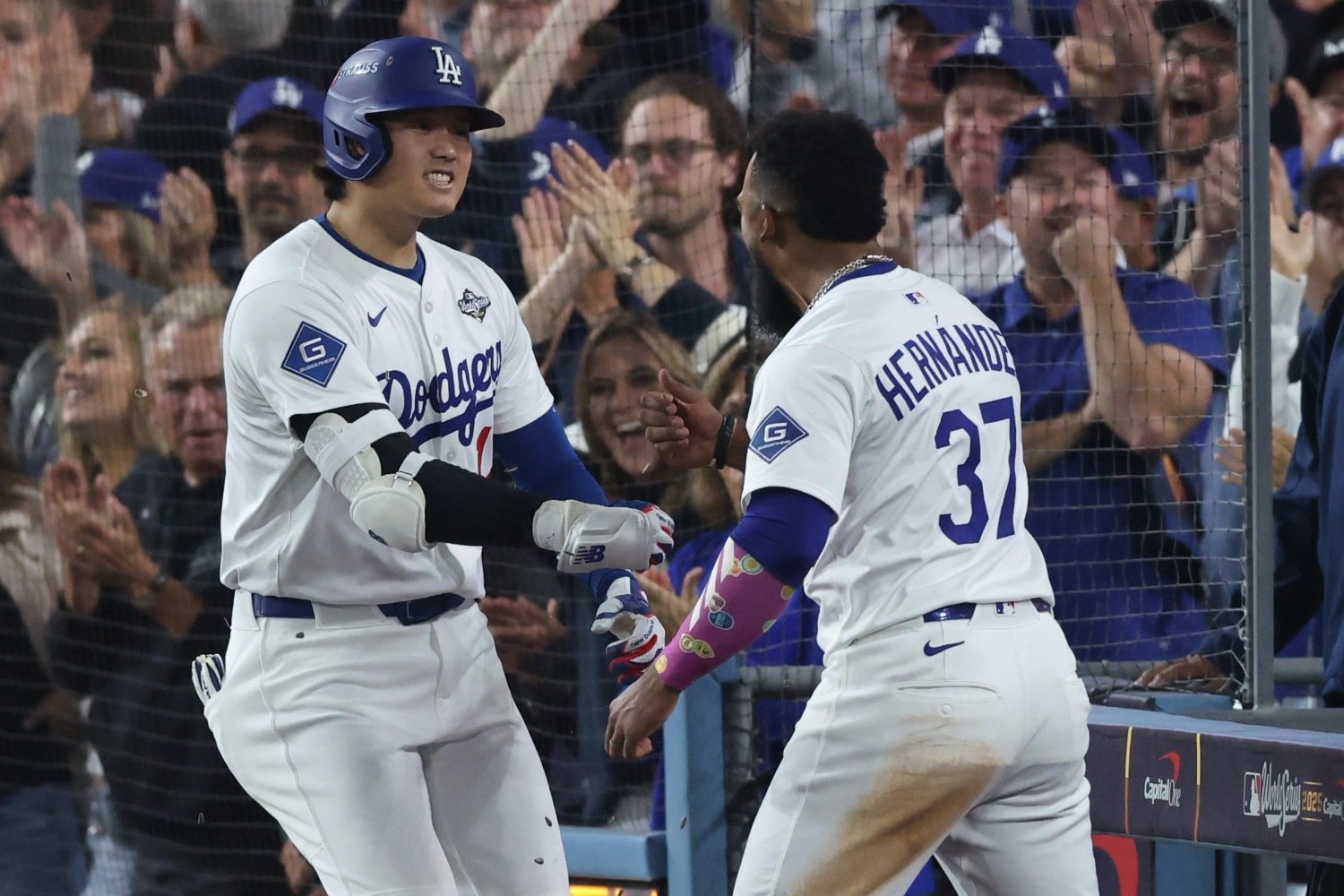
The list of comparable phenomena in the history of sports is short. Shohei Ohtani is the best baseball player ever, without a close or serious rival, and the way he’s swept up the sport—advancing it as a global interest while simultaneously wrapping the whole apparatus around himself, becoming the center of its attention and the source of its gravity—has very few precedents.
In whichever order you care to consider them, the people who have had a similarly profound impact on their sport to the one Ohtani is having on baseball right now are:
Tiger Woods
Michael Jordan
Pelé
Simone Biles
If we acknowledge the fundamental and irreconcilable differences between team and individual sports, we can cull that list down to Ruth, Jordan, and Pelé, and thus have a more serious conversation. Ohtani is transcending his sport in a way no one but those three has ever done, and in a way few are ever likely to do again. His latest trick, of course, was becoming the first player since 1906 to notch four extra-base hits in a World Series game—which he did in the first seven innings of Game 3, thereafter drawing a record five walks in the Dodgers’ 18-inning triumph. He reached base nine times, and although the Blue Jays refused to let him be the one who sank the dagger into them, their inability to get him out (and unwillingness to even try, once he forced the game to final at-bat leverage with his game-tying seventh-inning home run) eventually led to Los Angeles’s win. His next trick will be taking the ball to start Game 4 of the Series on the mound.
Baseball is not a game one can take over as completely as is possible in basketball. The Jays had a mechanism to work around Ohtani that is much more robust than the double-team defense teams could sometimes run at Jordan at the peak of his powers. Ohtani, however, stretches baseball to its breaking point. He’s far more impactful than Ruth was, even at his best. By being both a dominant pitcher and such an otherworldly offensive weapon, he’s become more of an all-around force than any soccer player can consistently be. Jordan is the only real comparator—and it’s becoming a more apt one almost by the day.
Michael Jordan had a great career in the world’s second-best basketball league before being drafted by the Chicago Bulls; he was a star in NCAA for the North Carolina Tar Heels. Jordan won a national title and was the National Player of the Year during his college years. He then won the Rookie of the Year Award in 1985, and he won the NBA MVP Award in his fourth season in the league.
Shohei Ohtani had a great career in the world’s second-best baseball league, before coming over to the United States. With the Nippon Ham Fighters, he won a Japan Series and was the Pacific League MVP in 2016. He then won the Rookie of the Year Award in 2018, and won his first MVP Award in his fourth season in the American League.
Each player also achieved international glory. Jordan was on the 1984 Gold Medal-winning Team USA basketball team at the Seoul Olympics. Ohtani closed the championship game of the 2023 World Baseball Classic. However, each was driven—at first bemusedly, then furiously—by the desire to win the championship of the world’s best league in their respective sport. Neither felt complete without it, even as each did things their sport had never seen before and achieved fame and wealth that sport had never before afforded to anyone.
In their seventh seasons in those top leagues, each finally made it to the mountaintop. Jordan’s victory, of course, felt more like the culmination of a long climb, whereas Ohtani seemed to take a running start and fly to the peak, but the result was the same. Each had quieted any possible (at least any halfway serious) critics, but neither was remotely satisfied. In fact, each came back (if anything) more driven the following year, and somehow got even better. In Ohtani’s case, it was by sustaining the new level of offensive brilliance he’d reached in 2024 while returning to the mound. In Jordan’s, it was by conserving his energy better during the regular season so he could explode for 34.5 points in over 41 minutes per game during the 1992 Playoffs.
Ohtani won’t be able to singlehandedly carry his team to a second straight title, as Jordan sometimes seemed to do. However, he won the NLCS MVP Award by finishing off the Brewers with the best single-game performance in baseball history. Now, in the first three games of his second World Series, he’s batting .500/.667/1.417. He’s relentlessly dominant. Even when they go miles out of their way to stop him from landing the killing blow, the opponents can’t stop him from pushing his team to the win. Intentional walks to Ohtani led to the pivotal runs in Game 4 of the NLDS and Game 1 of the NLCS. Teams could double- and triple-team Jordan, but he still created scoring chances for the Bulls in ways they couldn’t neutralize—and he still played shutdown defense, at times, taking the opponent’s offense out of its rhythm. Ohtani is the only team-sport athlete who has matched Jordan narrative beat for narrative beat, and who can also match his all-around flair.
Yes, LeBron James is a better basketball player than Jordan was. But he didn’t have the chance to reinvent the game; Jordan had already invented a version of it that will last as long as the sport does. He also couldn’t match the competitive ferocity or the results that Jordan produced. Similarly, no baseball player can now reinvent the game in any real sense. Ohtani has cracked it open and created whole new swaths of possibility. Nor, apparently, can an Ohtani surrounded by sufficient talent be stopped—because he’s showing the same dangerously indomitable will Jordan had. It’s a unique pleasure to watch the heir to Air Jordan’s legacy at work. He’s not as charismatic as Jordan could be, at least to English-speaking audiences, but it’s clear that he has every bit of the ambition that set Jordan apart from lots of other extraordinarily talented people.
He’s on the precipice of his second straight World Series ring. Maybe another one (or four) awaits after that. Maybe, even after this long season, he’ll go fight to win a second World Baseball Classic next spring, the same way Jordan went and won a second medal in Barcelona on the heels of his second NBA Finals. Maybe injury or the vagaries of the game will rob Ohtani of some of the glory Jordan achieved. By now, though, there’s no more question that he’s that same combination of freakish talent and utterly unwavering commitment to winning. It’s almost psychotic. It’s not the attitude of a perfectly well-adjusted person. It is, however, what the very best athletes are made of.