
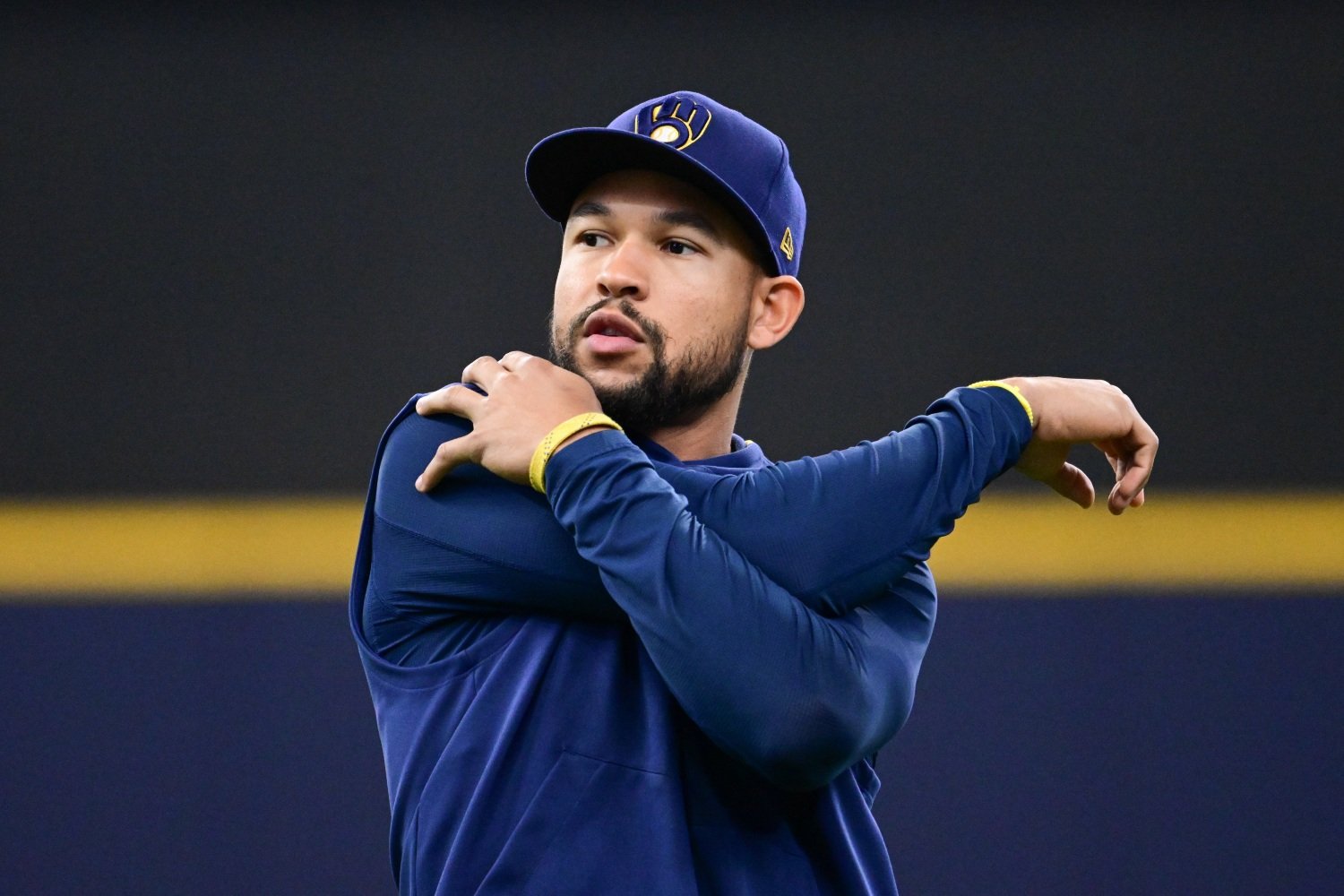
Entering this offseason, Blake Perkins has 2 years, 133 days of official MLB service time. That puts him extremely close to the line between those players in the two-to-three-year service tier who qualify for arbitration eligibility under Super Two rules, and those who don’t, according to a review of the eligible players. The line fell at 2 years and 132 days last fall, but looks likely to be 2.135 this time around. That would drop Perkins just below the threshold, and the Brewers would be able to retain him for roughly the league’s minimum salary.
If, instead, Perkins clears the line and slots in among the 22% of players with 2-3 years of service who become arbitration-eligible, he’s likely to make around $1.6 million, according to Cot’s Contracts. The difference is less than $1 million, but if Perkins does qualify for arbitration, it would create one low-friction deadline at which the Brewers could decide to cut the switch-hitting outfielder loose. It seems likely that the Brewers keep just one of Perkins and first-time arbitration-eligible teammate Garrett Mitchell this offseason. If Perkins is made eligible for arbitration, he might be the one who goes. On the other hand, if he remains essentially free, Mitchell could have one foot out the door.
With some higher-priced players, the alternative to keeping them might be non-tendering the guy and letting him test free agency. In this case, though, there’s little economic incentive for the Brewers to do that. Rather, the pressure to choose between Perkins and Mitchell comes from the crowding of the Milwaukee 40-man roster. Both players still have multiple seasons remaining in which they can be optioned to the minor leagues, so they offer ample flexibility. With the farm system producing so much young talent that could force its way into the big-league picture this winter, though, there are better ways the team might need to use a final roster spot than a fifth or sixth outfielder. As a result, the path forward is to trade one of the two.
Perkins missed the first half of this season after fracturing his leg with a foul ball early in spring training, and his season was rough even after he returned to the active roster. Never much of an offensive force, he was worse in 2025, and his defense got a tick worse, too. Mitchell, however, has shown no ability to stay healthy at all. He was working his way back from an oblique strain when, in mid-June, he suffered another major shoulder injury while diving back into first base during a minor-league rehab assignment. In his 133 career games, he’s batted .254/.333/.433, and he can be just as good a defender in center field as Perkins, but Mitchell’s injuries make it hard to believe that he’ll ever be reliably available when the team really needs him.
Even so, Mitchell is younger, toolsier, and a former first-round pick, whereas Perkins was signed as a minor-league free agent. His projected arbitration-driven salary is lower than Perkins’s, if the latter makes it over the aforementioned line. Each player has trade value, but Mitchell’s is slightly higher, because of his greater upside.
Jackson Chourio, Isaac Collins, Sal Frelick, Christian Yelich and at least one of Mitchell and Perkins will be pieces of the team’s outfield rotation heading into next season. They can retain Brandon Lockridge for virtually nothing, and they nearly always find another player in this vein to scoop up during the fall, as players throughout the league reach minor-league free agency. At some point, Mitchell and Perkins become redundant, and if Perkins is a Super Two guy, he becomes the better trade candidate.