
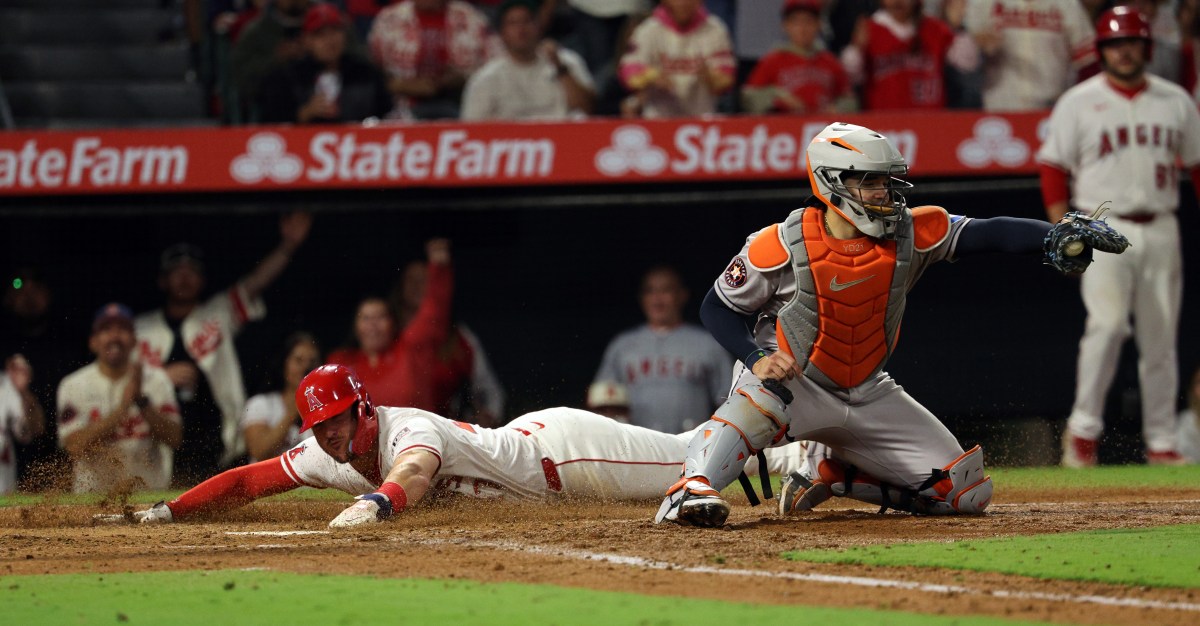
One of the more interesting subplots this offseason, to me, is what the Astros decided to do at catcher in the near term. We all know the organization is interested in bringing Victor Caratini back, but whether that happens won’t be determined for a while. Then there is Yainer Díaz, who has three more years of club control left. It is easy, though, to envision a scenario where Caratini is re-signed and Díaz continues to be the primary starter behind the plate in 2026. And that course of action would be defensible, especially if the Astros feel Díaz has more room to grow as a catcher with some hope of seeing a bounce-back as a hitter.
It is also possible to envision a scenario where they decide to change things up at the position.
By Wins Above Average among catchers, the Astros ranked 12th (0.4 WAA) among all thirty teams. For Offensive WAR, they were 11th (2.2). That’s not great, but certainly not terrible. It isn’t like the duo of Díaz and Caratini were unplayable. Not in the slightest. But you can’t help but notice that the ceiling, particularly for Díaz, is perhaps lower than what was expected even a year or two ago. Catching full-time isn’t easy work, as it is the most physically demanding position on the field. It wasn’t necessarily a shock to see Díaz’s offensive numbers take a hit as his playing time behind the plate and the strain on his legs increased. But his regression as a hitter in 2025 only accentuated the lineup’s overall weaknesses last season.
Defensively, though, Houston’s catchers were lacking compared to their peers, ranked 19th (-5 Fielding Runs). Neither Díaz nor Caratini graded out well by Fielding Run Values (FRV), finishing with negative values among the bottom half of qualified catchers. Of the quantifiable defensive metrics for catchers, the duo wasn’t particularly effective in most areas. While we can’t quantify how games were called or how they handled the pitching staff, it didn’t seem like either was a glaring issue. But, again, we’re talking about a catching corps that wasn’t terrible, but also not that good. Middling feels like an apt description for the duo.
This offseason, I think one question Dana Brown needs to ask is how he and Joe Espada feel about Díaz as a full-time catcher going forward. It would be one thing if his defense improved, even with some regression offensively. And he did carry a 116 wRC+ in 2024 as the primary catcher, so it isn’t like he couldn’t hit while catching more. But the fact that he remains below average behind the plate by quantifiable measures, in addition to his various issues as a hitter this season. That much at least invites speculation about whether the position remains a viable option for Díaz on a full-time basis moving forward. It doesn’t feel like a coincidence any longer that his best offensive season in 2023 (127 wRC+ in 104 games) was when he caught only 399 innings compared to 882 innings in 2024 and 990 innings this year. For as much as I bemoaned the lack of playing time for him under Dusty Baker in 2023, there is a real question now about whether a full-time catching role would allow Díaz to maximize his current skillset, namely as a hitter.
This is where roster construction becomes a bit more complicated for the Astros. In an ideal world, Jose Altuve would handle second base, Yordan Alvarez remains a designated hitter and part-time left fielder, and Díaz could seamlessly fit within a part-time role as both a catcher and designated hitter. Defensively, however, Altuve’s days at second base are preferably behind him. As such, his ideal spots on the roster would be a part-time left fielder and part-time designated hitter, sharing those duties with Alvarez. When one plays in the field, the other is just hitting. But there isn’t any room in that alignment for Díaz, essentially keeping him as a full-time catcher. Díaz’s value, though, is at its highest when he performs offensively. Again, we saw him perform relatively fine in 2024 with a starter workload, maintaining a .325 on-base percentage and slugging above .440. With that said, we’ve now seen two consecutive seasons of diminishing returns as a hitter that coincides with full-time catching duties, with a .284 on-base percentage and a slugging percentage dipping to .417 this year.
It is certainly possible that Díaz rebounds in 2026 and reminds us why we all clamored for him to play more in 2023. But with three years of valuable club control remaining, you’d have to explore whether you can help the team in different areas of the roster by trading Díaz. There are holes throughout, specifically on the pitching staff, to address, and another team might be willing to deal an arm or two, hoping to capitalize on Díaz’s offensive profile, possibly in a position where he doesn’t catch nearly as much as he has in the past two seasons. And if Houston re-signs Caratini, it might behoove Brown to find a more defensively apt catcher anyway in either free agency or via trade to shore up deficiencies there. Any decision also hinges on the organization’s internal thoughts about former first-round pick and catching prospect Walker Janek, who has played reasonably well in the Arizona Fall League thus far.