
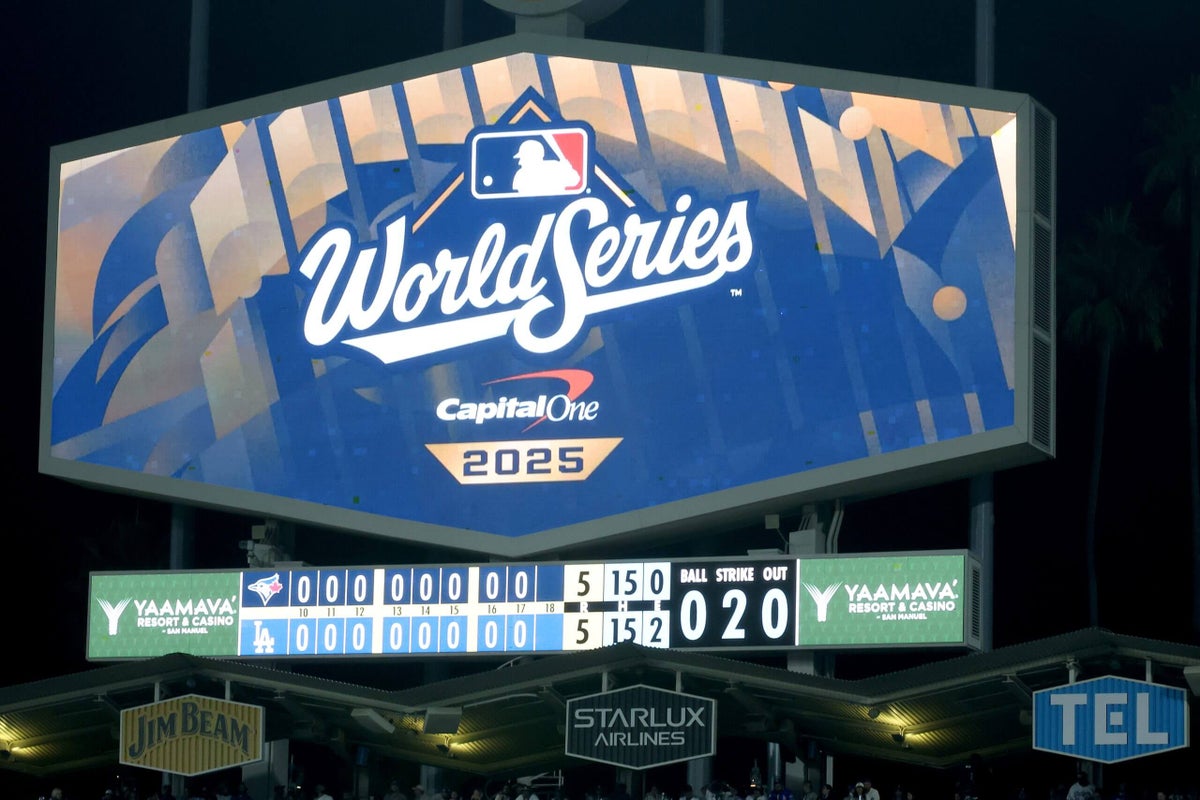
For 399 minutes on Monday night, the Los Angeles Dodgers and Toronto Blue Jays staged an epic for the ages. Game 3 of the 2025 World Series featured 609 pitches thrown over 18 innings. Its gravitational pull involved nearly every player who was eligible to take the field. It stretched and strained the limits of possibility.
By the time the Dodgers’ Freddie Freeman homered in the middle of the night to send the Blue Jays to a bitter 6-5 defeat, the game had long passed into territory reserved for instant classics. It is perhaps one of the best baseball games ever played.
The pressure brought forth both boneheadedness and brilliance. Pivotal plays were decided by mere inches. The outcome lifted spirits, crushed souls, and drained everyone associated with the spectacle. And the teams only had a few hours to rest before doing it all again in Game 4 Tuesday night.
Monday night’s six-hour, 39-minute test of endurance raised a question: What are some of the most dramatic marathon sessions across all sports through the years?
World history and NBA history on a Thursday in ‘89
Date: Nov. 9, 1989
Sport: NBA
Length: Five overtimes; three-plus hours
Outcome: Milwaukee Bucks 155, Seattle SuperSonics 154
Nov. 9, 1989 should have been a ho-hum, four-game NBA Thursday night, especially when most of the world’s attention that day was focused on watching the fall of the Berlin Wall.
The host Milwaukee Bucks and Seattle SuperSonics tipped off long before a game in Oakland, Calif., between the Los Angeles Lakers and the Golden State Warriors. Still, the Warriors and Lakers finished first.
The Bucks prevailed 155-154 in five overtimes, still the longest game in the shot-clock era. The game was so long that the Basketball-Reference.com snapshot can’t hold all of the line score.
Three players played at least 60 minutes and a fourth, Bucks guard Alvin Robertson, played 59. Sonics sharpshooter Dale Ellis set an NBA record by playing a leg-burning 69 of the 73 total minutes and scored a career-high 53 points. Sonics forward Xavier McDaniel played 68 minutes, the second-most in history. Bucks guard Jay Humphries played 62 minutes.
We may not be mentioning this game if the Bucks had held on to a 10-point lead in the fourth quarter, or if Humphries had canned two free throws at the end of the second overtime with the score tied 120-120. Humphries’ misses led to three more overtimes before the Bucks finally outscored the Sonics 17-16 in the fifth OT.
You can watch and thank the NBA for culling this three-plus hour marathon into a “brief” 19-minute highlight package.
Kickers gone wild and the making of an epic NFL playoff marathon
Date: Jan. 10, 2004
Sport: NFL
Length: Two overtimes; 4 hours, 6 minutes
Outcome: Carolina Panthers 29, St. Louis Rams 23
Narrowing the selection down to the Super Bowl era, the 1971 classic between the Miami Dolphins and Kansas City Chiefs stands as the longest game in NFL history and deserves some love, as does the 1977 “Ghost to the Post” game between the Oakland Raiders and Baltimore Colts. The 2012 divisional-round game between the Baltimore Ravens and Denver Broncos is the most recent double-OT classic.
Our choice is the 2003 NFC divisional-round game between the Carolina Panthers and the St. Louis Rams. The Panthers squandered a 23-12 lead late in the fourth quarter, which included allowing the Rams to recover an onside kick (which was recovered by the kicker himself, Jeff Wilkins). The Rams got down to the 15-yard line with 35 seconds left and let the clock run down for Wilkins to kick a game-tying field goal.
This was when overtime was sudden death, and less than five minutes into the extra period, the Panthers got set up for a potential game-winning 40-yard field goal. John Kasay made it right down the middle. But a late whistle for a delay of game nullified the play and backed the Panthers up five yards. Kasay’s ensuing 45-yard kick sailed just wide right.
The Rams then got into Wilkins’ range but his 53-yard field goal fell short. The Panthers punted on their next drive, then the Rams ended their possession with an interception. Carolina’s next possession started poorly. In their own territory, they lost a yard on a run and quarterback Jake Delhomme took a sack to end the first overtime.
But on the first play of the second overtime, with Carolina facing third-and-14, Delhomme delivered a perfect strike to wide receiver Steve Smith, who turned up the field for a walk-off 69-yard touchdown.

Lots of celebration at Kyle Field after the Aggies outlasted LSU in a sport-changing game. (Daniel Dunn / Icon Sportswire via Getty Images)
The five-hour clash that changed college football’s overtime rules forever
Date: Nov. 24, 2018
Sport: College football
Length: Seven overtimes; five hours
Outcome: Texas A&M 74, LSU 72
It’s the five hours and seven overtimes that literally changed how college football games are decided.
Down by seven with 30 seconds left, Texas A&M quarterback Kellen Mond tossed an interception around midfield. But his knee touched the ground when picking up a dropped snap before the pass, giving the No. 22 Aggies a reprieve even as LSU coach Ed Orgeron was doused in Gatorade. A few plays later, Mond tossed a 19-yard touchdown pass as time expired, and a PAT sent the game to overtime at 31-31.
With the teams getting alternating possessions at the 25-yard line, they combined to score 84 more points over seven overtime periods, with mandatory two-point attempts after touchdowns starting in the third period.
A year before he won the Heisman Trophy and a national title, Joe Burrow threw for 270 yards, ran for 100 and accounted for six total touchdowns for No. 7 LSU. But his final two-point pass failed and Texas A&M won 74-72 with its own touchdown and two-point conversion following a wild sequence of penalties. A postgame altercation ensued involving the nephew of Texas A&M coach Jimbo Fisher and LSU assistant Kevin Faulk as Aggies fans stormed the field.
The teams combined to run 197 plays, 56 in overtime. The 146 total points by Texas A&M and LSU remain the most scored in an FBS game in the past century.
Though there had been four previous seven-overtime games, this was so long that the NCAA changed overtime rules so that two-point attempts became mandatory after the second OT period — resulting in such results as Illinois 20, Penn State 18 in nine overtimes in 2021 and Georgia 44, Georgia Tech 42 in eight overtimes last year.
The Garden, the Big East tournament, and the rise of the “Marathon Men”
Date: March 12, 2009
Sport: Men’s college basketball
Length: Six overtimes; 3 hours, 46 minutes
Outcome: Syracuse 127, UConn 117
The setting and the stakes: Madison Square Garden and the Big East tournament, a quintessential March pairing. The rivalry: Hall of Fame coaches Jim Boeheim and Jim Calhoun had sparred a few dozen times and the Syracuse and UConn fan bases shared a mutual disdain.
The last of four matchups on a Big East quarterfinal Thursday, it nearly never went to overtime at all. Tied at 71, Syracuse guard Eric Devendorf corralled a tipped full-court pass and buried a game-winning 3-pointer at the buzzer, causing bedlam as he leapt atop the scorer’s table in celebration. But a review revealed the ball was still on Devendorf’s fingertips as time ran out. Overtime.
Syracuse never led in the first five overtimes, but came back from deficits ranging from two to six points in each one. Four players fouled out on each side, including Devendorf. The Huskies, who also had the final shot in the first three OTs, nearly ended it in the fifth extra period, but Jeff Adrien’s desperation baseline putback clanged off the rim, keeping the game knotted at 110.
On This Date: 10 years ago, Syracuse defeated UConn after 6 OVERTIME PERIODS 🔥 pic.twitter.com/RPRKqLBzaP
— SportsCenter (@SportsCenter) March 12, 2019
The Orange finally pulled away early in the sixth overtime. Syracuse guard Jonny Flynn played 67 of 70 minutes, scoring 34 points and making all 16 of his free throws. The game ended at 1:22 a.m. ET, three hours and 46 minutes after it began.
“It’s a lot better winning the greatest game ever played,” Boeheim said afterward.
Syracuse had to play again the next night, and defeated West Virginia — this time, needing only one overtime — before running out of gas in the Big East final against Louisville.
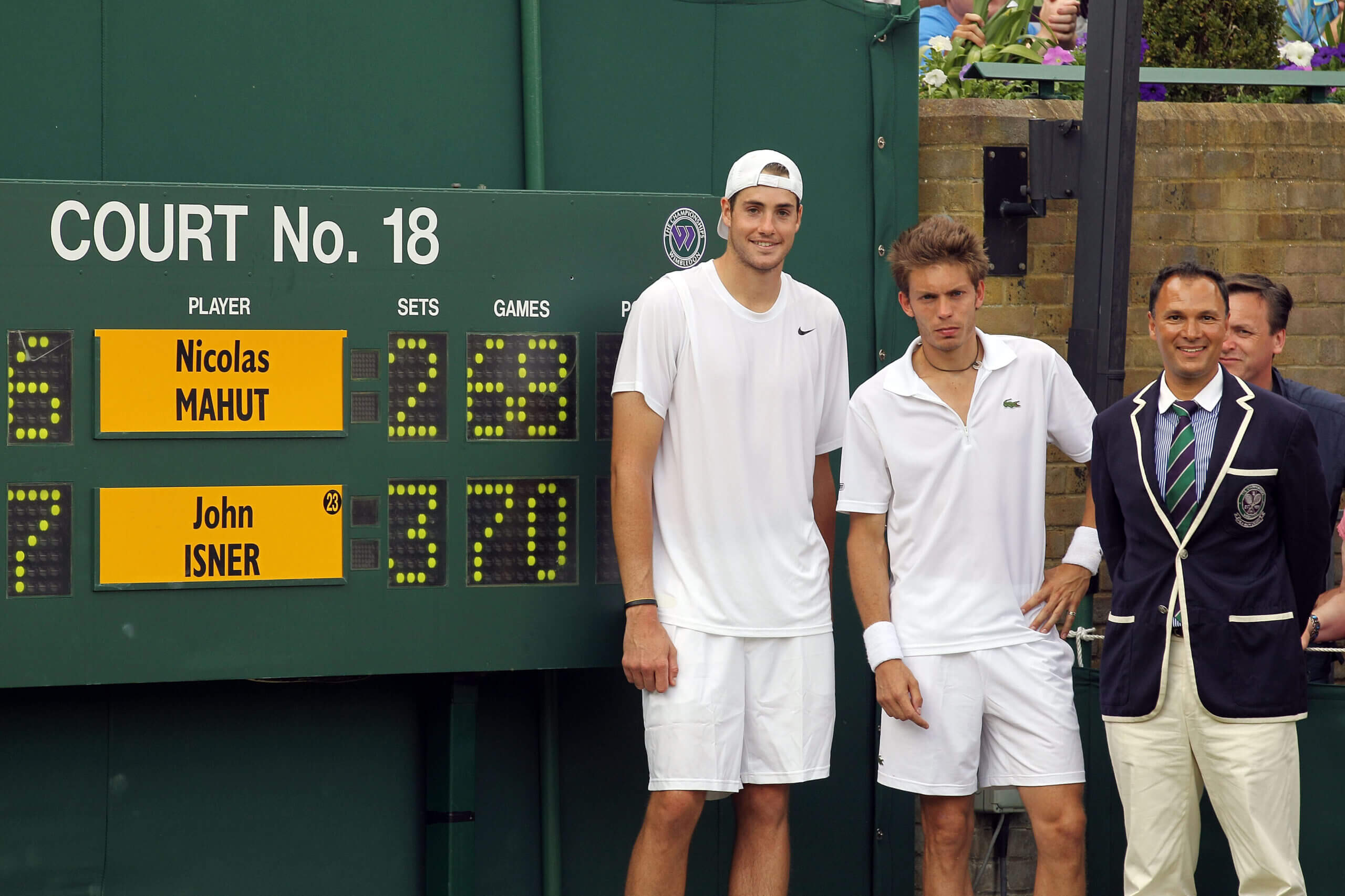
John Isner (L) and Nicolas Mahut’s epic Wimbledon match spanned three days. (Hamish Blair / Getty Images)
The Wimbledon match that lasted three days
Date: June 22-24, 2010
Sport: Men’s tennis
Length: 11 hours, 5 minutes
Outcome: John Isner 6-4, 3-6, 6-7(7), 7-6(3), 70-68 Nicolas Mahut
Carlos Alcaraz and Jannik Sinner’s five hours and 29 minutes of spellbinding tennis in this year’s French Open final ended with a final-set tiebreak. When they got to 6-6 in the fifth set, they knew it was nearly over.
Fifteen years ago, no such thing — and no such comfort — existed at Wimbledon. When John Isner, a big-serving American, and Nicolas Mahut, a skillful Frenchman, got to 6-6 in the fifth set of their first-round match in 2010, there was no telling how, or when, it would end.
The set ultimately lasted eight hours and 11 minutes, the entire match 11 hours and five minutes. It took three days, twice being suspended for darkness, with the players tied at 59-59 before the second suspension. The final set alone was longer than every tennis match in the record books, except the one that contained it. The scoreboard broke at 47-47.
The entire affair was more strange than spectacular. Mahut won more games in a match than anyone in tennis history (except for Isner) and lost. Because Isner served first in the final set, Mahut had to serve for his tournament life 65 times, and held 64 of them.
At 68-69, 15-15, Isner stumbled deep behind the baseline and dropped his racket. Mahut, who had a drop shot he could have launched into space and still won the point, plopped it into the net instead to leave Isner two points from victory in a match that spanned 980 of them.
Then, he had two chances for victory. Mahut stopped one, but on the next, he could only bunt a fast return straight back to the giant American, who struck a backhand down the line to end it all.
It took Wimbledon nine more years and one more Isner epic (a 2018 semifinal defeat to Kevin Anderson that went 26-24 in the fifth set) to introduce a fifth-set tiebreak.
An NHL game so long that it upended a long overtime tradition
Date: May 4, 2000
Sport: Hockey
Length: Five overtimes; seven hours
Outcome: Philadelphia Flyers 2, Pittsburgh Penguins 1
It’s not the longest game in NHL history; you’d have to go back to 1936 for that, a 1-0 game that went almost six full overtimes. And it’s not the most recent mega-marathon; that was five years ago, during the 2020 bubble playoffs, when Brayden Point gave the Lightning a 3-2 win over the Blue Jackets midway through the fifth overtime.
We’ll go with the Penguins and Flyers, because it was pretty much the prototype of a way-too-long NHL game.
Let’s start with the goalies. In an era with guys like Patrick Roy, Dominik Hasek and Martin Brodeur — the latter two had their own marathon duel in 1994 — we wound up watching Brian Boucher and Ron Tugnutt go save-for-save. Yes, the guy with the weird shutout record and every seven-year-old’s favorite hockey name decided to go full Terry Sawchuk for several hours. Boucher actually gave up a goal two minutes in and then was perfect for roughly 150 minutes. Why not? Goaltending makes no sense. Have it at, boys.
Then there’s the winner. In a game featuring Hall of Famers like Jaromir Jagr and Mark Recchi, the goal finally came from Keith Primeau, who was … fine? Good? He was a perfectly cromulent player, one who scored plenty over the course of his career. Did he score many of those going end-to-end and sniping bar down? No, because his whole thing was that he was a gigantic plodder who ran people over. But when a game is seven hours old, you do what you have to do.
Hockey is weird. Overtime is even weirder. Quintuple overtime, between two rivals? It’s like watching the world burn, only with slightly more Darius Kasparaitis.
A Texas Longhorns pitcher threw 169 pitches over 13 innings for a no-decision
Date: May 30, 2009
Sport: College baseball
Length: 25 innings; 7 hours, 3 minutes
Outcome: Texas 3, Boston College 2
The Longhorns prevailed in this NCAA tournament regional game 3-2 when Travis Tucker hit a single through the Eagles’ drawn-in infield.
However, the most impressive performance was that of Texas pitcher Austin Wood. In 13 innings, Wood threw 169 pitches and tossed 12 1/3 innings of no-hit ball. Wood exited the game in the 20th, so when Texas eventually won, Wood didn’t even get a decision for his effort.
Two years after the Texas-Boston College game came a 22-inning game (7 hours, 12 minutes) between Fresno State — featuring Aaron Judge — and the University of San Diego — featuring Kris Bryant.
Fresno State’s Danny Muno led off the 22nd inning with a single, stole second and scored on Garrett Weber’s two-out single to left field, giving the Bulldogs a 3-2 victory.
Judge and Bryant, who were both freshmen, played the entire game and each reached base four times. Bryant went 3 for 8 with an RBI, run scored, walk and struck out three times. Judge was 2 for 8 with two walks but struck out five times.
Fifty runners were left on base, an NCAA Division I record at the time, and there were 39 hits in the game.
Jenson Button’s 2011 four-hour Canadian Grand Prix comeback
Date: June 12, 2011
Sport: F1
Length: 70 laps; 4 hours, 4 minutes, 39 seconds
Outcome: Jenson Button edges out Sebastian Vettel
At the 2011 Canadian Grand Prix, rain turned Montreal’s Circuit Gilles-Villeneuve into a waterlogged lottery, with six safety-car appearances and a two-hour red-flag delay.
Driving for McLaren, Jenson Button turned it into the greatest comeback win of his career. The race started behind the safety car in a downpour, barely got going before devolving into yellow-flag chaos and was finally red-flagged on lap 25, suspending the race for over two hours.
Button had wasted no time making life difficult for himself. Starting seventh, he collided with teammate Lewis Hamilton early on and served a drive-through penalty. Once racing resumed, Button made contact with Fernando Alonso on Lap 37, sending him to the back of the field — 21st place with 30 laps to go. Only 17 of the 24 starters would see the checkered flag.
Meanwhile, Sebastian Vettel looked untouchable out front. The reigning world champion had dominated all season, and this was supposed to be his sixth victory. But as the rain eased and the track dried, Button found a rhythm nobody else could match. He made five regular pit stops that day, called his tire changes perfectly to match the drying track and sliced through the field lap by lap.
By the final lap, Button was within striking distance of the leader. Then Vettel, flawless all day, caught a damp patch and slid wide. Button surged through.
“In a 70-lap race, I led half a lap,” Button said afterward, still in disbelief.
It was enough. Four hours, four minutes, and 39 seconds to produce one of motorsport’s strangest wins. It remains the longest race in F1 history.