
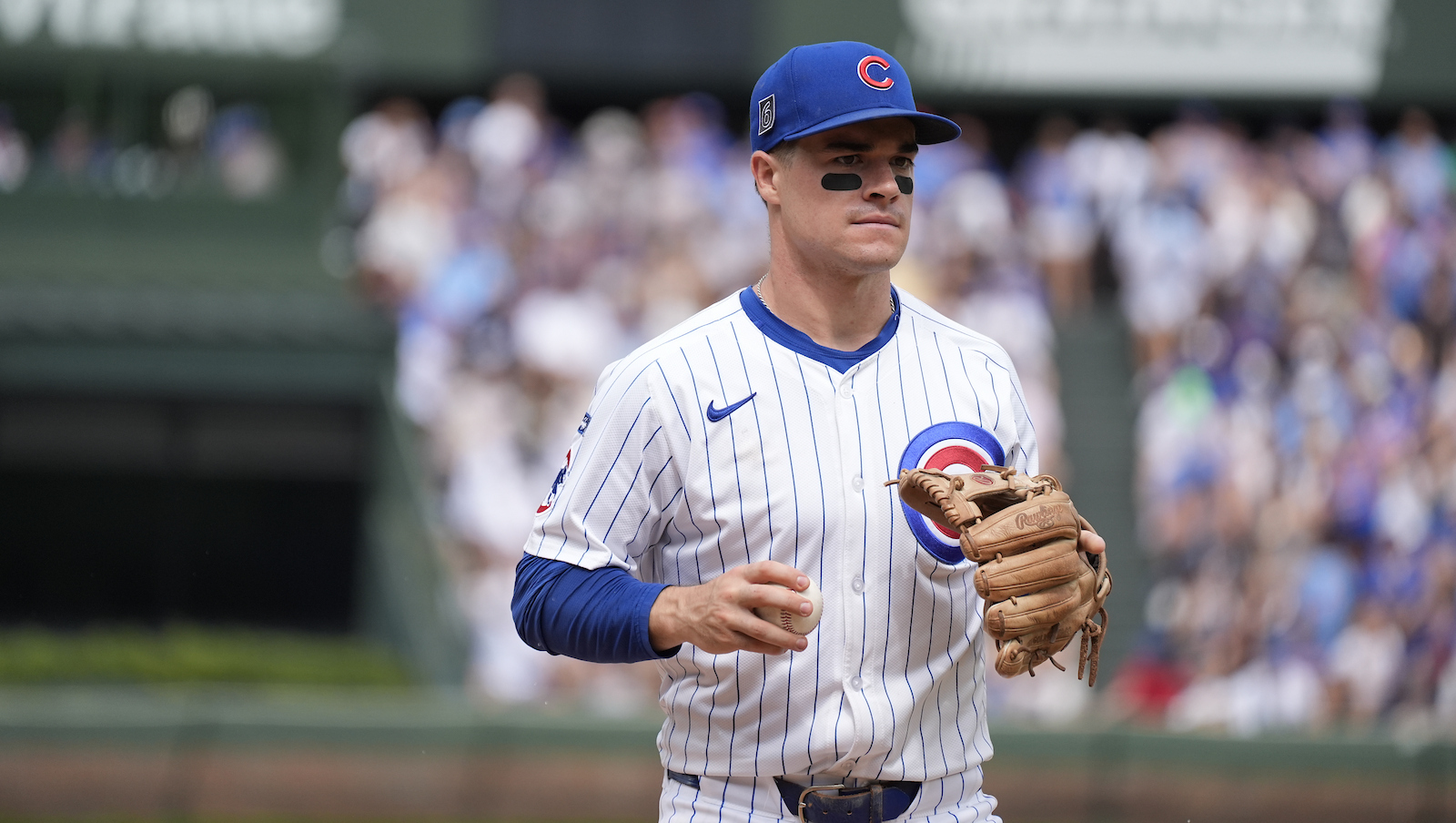
CHICAGO — The Cubs may very well have their third baseman of the future.
Watch Jed Hoyer’s full end-of-season press conference only on the Marquee Sports Network app.
In 2023, Jed Hoyer’s front office used the No. 13 overall pick in the MLB draft on a University of Maryland standout whose primary position was shortstop.
That standout was Matt Shaw.
Shaw, who hit .357 with a 1.018 OPS across three levels in his first taste of minor league baseball, cruised through the Cubs’ farm system as the organization’s top prospect before making his debut in The Show less than two years later.
Shaw’s debut was instantly a tall task. The Cubs hadn’t truly had a reliable, everyday third baseman since Kris Bryant was traded in 2021. Even then, Bryant hadn’t primarily played third since the 2019 season. Bygone players like Christopher Morel, Nick Madrigal and Patrick Wisdom each had their shot, but none were ever able to produce much higher than replacement-level at the position.
And in the 2024 offseason, the Cubs traded away Cam Smith, another top prospect drafted as a third baseman in 2024, to the Houston Astros for Kyle Tucker. That meant Shaw stood alone in the line of succession.
As the Cubs kicked off a highly anticipated 2025 season, Shaw made his MLB debut on the world stage in Tokyo, playing third base and hitting fifth against the reigning World Series champion Los Angeles Dodgers.
But what ensued in the following weeks wasn’t exactly a dream start for Shaw. In his first 18 MLB games, the 23-year-old slashed .172/.294/.241 (.535 OPS) with just three RBI and 18 strikeouts. He made three errors at the hot corner. Suddenly, he was headed back down to Triple-A Iowa with a lot still to prove. Hoyer at the time insisted it was “part of the process” in becoming a great major-leaguer.
Six months later, the Cubs’ president of baseball operations praised Shaw for seeing that process through.
“Overall, he had a really good season,” Hoyer said in his end-of-season press conference on Oct. 15. “He played well early on and then obviously struggled. We sent him down and brought him back up. When you look at what he did in the second half, it was really impressive.”
After Shaw’s demotion, the platoon of Jon Berti, Gage Workman (who was designated for assignment late April), Nicky Lopez and Vidal Bruján wasn’t exactly working despite the rest of the team surging. The third base position was becoming the team’s black hole on both sides of the ball, and, needless to say, they needed Shaw back quickly.
Shaw had an instant impact at the plate when his second stint with the Cubs began on May 19. In his next 18 games, he slashed .323/.362/.477 (.839 OPS) with seven doubles, seven stolen bases and 11 runs scored. His first career walk-off hit lifted the Cubs over the Colorado Rockies on May 27.
The weeks leading into the All-Star break were far tougher for Shaw at the plate. He endured a 1-for-32 (.037) slump and was slashing just .198/.276/.280 (.556 OPS) with two home runs on the season after 63 career games. Those struggles, coupled with the July 31 trade deadline nearing, called Shaw’s role down the stretch into question as the Cubs made a playoff push.
Offensive struggles aside, something was keeping Shaw afloat that the Cubs perhaps didn’t foresee at the beginning of the season: His stellar defense.
“Defensively, he really, candidly, surprised us,” Hoyer said. “That was an area where we didn’t know how it was going to go for him. He was playing largely a new position and doing it in the big leagues, and he was exceptional.”
Those three errors Shaw made in his first MLB stint quickly faded into the background as the rookie began to put on a nightly show at third base. At the end of the regular season, his 12 defensive runs saved were the third-most in MLB at his position. His .977 fielding percentage was fifth-best among all third basemen in baseball.
It was no surprise by the end of the season that Shaw became a Gold Glove Award finalist in his first year.
All the while, Shaw fought off the outside noise that trade deadline chatter brought and began the second half as one of the hottest hitters on the team. He hit 11 of his 13 total home runs, hit .258 and posted an .839 OPS in the season’s final two months. And after all, the Cubs didn’t make a move for a rental third baseman — meaning it was up to Shaw to finish the season strong.
Matt Shaw leads the Cubs in the following categories since the All-Star break:
• Runs
• Triples
• Home Runs
• RBI
• Extra-Base Hits
• SLG
• OPS pic.twitter.com/Jdv3hEgSPw
— Marquee Sports Network (@WatchMarquee) August 20, 2025
Shaw’s struggles came back to haunt him in the playoffs — he went 2-for-17 across the Cubs’ eight games.
Still, Hoyer didn’t seem alarmed by the rookie’s lack of production as the Cubs took on their first postseason run in five years.
“I think focusing on those eight games and knowing that the kind of stuff and velocity he was facing every single night — their guys are locked in,” Hoyer said of Shaw facing two of MLB’s top pitching staffs in the San Diego Padres and the Milwaukee Brewers. “If you’re struggling with anything, and then you’re facing the kind of stuff that he was facing … it was a challenge for him.”
Shaw’s roller coaster of a 2025 season doesn’t change the fact that he turned in the most valuable season for a Cubs third baseman (3.1 bWAR) since Bryant in 2019 (4.4 bWAR). And while it remains to be seen what the Cubs will do in the offseason to improve an already highly productive roster, Hoyer made it clear that the team is in it for the long run with Shaw.
“I thought he had a really good season to build on,” Hoyer said. “He’s going to be a really good Cub for a long time.”