
Tomorrow, and tomorrow, and tomorrow,
Creeps in this petty pace from day to day,
To the last syllable of recorded time;
And all our yesterdays have lighted fools
The way to dusty death. Out, out, brief candle!
Life’s but a walking shadow, a poor player,
That struts and frets his hour upon the stage,
And then is heard no more. It is a tale
Told by an idiot, full of sound and fury,
Signifying nothing.
– Macbeth, from Macbeth
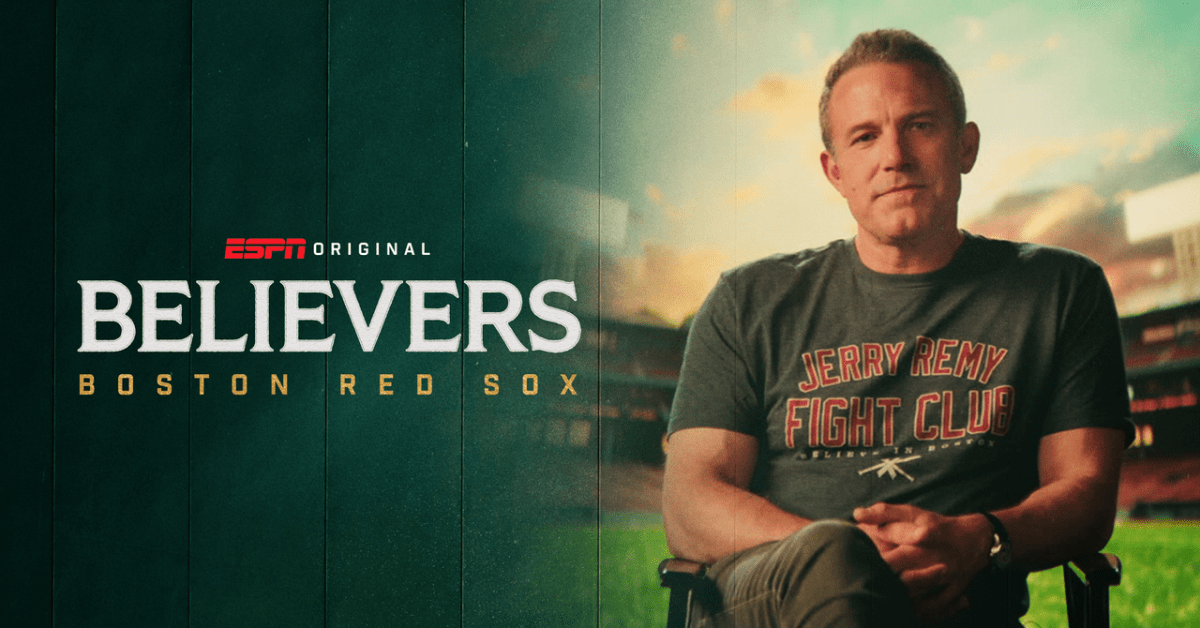
At least year’s home opener, the Red Sox honored the late Tim and Stacy Wakefield while celebrating the 20th anniversary of the team’s legendary comeback against the Yankees and “curse”-breaking World Series win against the St. Louis Cardinals. Most of the surviving members of the team were there, though Curt Schilling had to skip the event due to his perpetually worsening foot-in-mouth disease. If there was a good time to firmly, finally place 2004 in the past, that was it, but if it wasn’t, the release of Netflix’s The Comeback last October certainly was. The story has been told and retold and retold and retold to the point it’s at risk of losing its meaning, not unlike a word repeated over and over until its meaning starts to disintegrate – and now ESPN’s in on the action with Believers: Boston Red Sox.
I was there for 2003 and 2004, the events of which were so pristinely timed with the prime of my life as to present as farcical. The same is true of the Patriots’ success. The events of the early aughts were special to me because they happened to me, and I can recall where I was for each memorable moment. The Aaron Boone game? I was in the last row of Yankee Stadium’s Bleacher Creatures section, wearing a Pedro Martinez shirsey. The night the Sox won it all? In the streets outside Manhattan’s Riviera, at the time *the* Boston bar, dancing while grim-faced NYPD officers watched, and then at a bar across the street until the wee hours as corks were popped and demons were exorcised. I felt the champagne on my skin, and no one else could feel it for me.
Like anyone else, I’m fan of nostalgia, often against my better judgment. It has never been lost on me why the 2004 team remains popular in the regional and national imagination, but at this point I feel like this particular chicken has been fucked dry. It’s not just the TV networks or the Bill Simmonsness, but the idea of the team itself. In the years following the ghastly Mookie Betts trade that *weren’t* 2021, Sam Kennedy’s rebuttal to criticism of the Chaim Bloom Red Sox would be to point to the past, and ask what other Red Sox administration could claim such success. Forget tomorrow: It was yesterday, and yesterday, and yesterday that mattered, until that self-important notion began to dissolve under its own ultimate meaninglessness.
There is an analog for the 2004 Red Sox, and it’s the 1986 Mets. Like that team, the 2004 Red Sox have infiltrated nearly every level of their franchise’s consciousnesses, be it through announcers, pundits, executives, you name it. Like that team, its success hangs over the present day because the organizations have understandably insisted it be made so. Both teams have been so scared of the memories of those cash-cow teams floating away that they’ve rigged them to their existence, never letting the fans forget, for a second, to the Platonic ideals of a baseball season. Which from some angles, yeah. From others, it’s like the 2007, 2013 and 2018 Red Sox World Series wins don’t exist, or matter; history stopped on October 27, 2004, but its long tail thrashed for another 15 years before coming to rest.
Which begs an obvious, overdue question: What can we look forward to next? What else is there? The answer is, boringly, that I don’t know. Part of the reason I don’t know is that we’re all stuck in George W. Bush’s first term, with those of you who weren’t around for it getting treated to a warped, heightened version of those times. We can’t think honestly about the future because everyone is lying about everything, all the time; the idealized past, also being lied about, is much safer ground. Having finally won a title, the Red Sox have become a team that wins titles, and the logic spirals from there about a given season’s goals fast enough that this very site had people furious that the team didn’t go bigger at this year’s trade deadline, a notion I continue to find preposterous. I’ve seen title teams, and this wasn’t a title team… and that was okay. It remains so. It’s the goal, but it’s not the reason we exist.
It’s probably too existential to ask what the Red Sox should be any more, but that doesn’t stop me from wondering. When I watched this year’s Mariners/Tigers series, I got Red Sox nostalgia from the M’s, not from the 2003/2004 stuff but 1999, when the Red Sox won a similarly fraught division series only to fall in the ALCS. Having never made a World Series, the Mariners are starting to write their own national underdog story. How will it end? We don’t know, and that’s what makes it exciting. It’s also why Mariners fans were far more proud of the team than they were devastated in the wake of George Springer’s Game 7 homer: You can’t mourn what you haven’t lost. In the same way the eventual Mariners World Series win won’t make the 2025 team’s 15-inning Game 5 ALDS over Detroit win any less thrilling, the 2004 season doesn’t obliterate my joy about Pedro Martinez shutting down Cleveland in 1999 or my despair at Boone’s homer in 2003, except on television… where, again, it’s forever 2004, albeit only if you want it. Clearly, many of us do.
But to me, that all was a long time ago, in years and miles. Baseball’s power center has moved west, where the Dodgers are playing the role of the late-90s Yankees to a T and the Padres and Mariners are doing their best pre-John Henry Red Sox impressions. This place – these places (Fenway Park, Yankee Stadium, Citi Field) – don’t have the juice anymore. Outside of the Philadelphia, East Coast baseball remains largely fossilized, so we dig the same ground over and over, looking for any stray bones we might have missed, rather than look to the horizon and a sport’s manifest destiny which has long passed us by. We are loud and furious about it, because we still believe we belong at the top of the world – but as any mountaineer knows, even with gravity on your side, descending is the hardest. If it’s a lesson we’re determined to learn for ourselves, we’d have been better off doing the reading.