
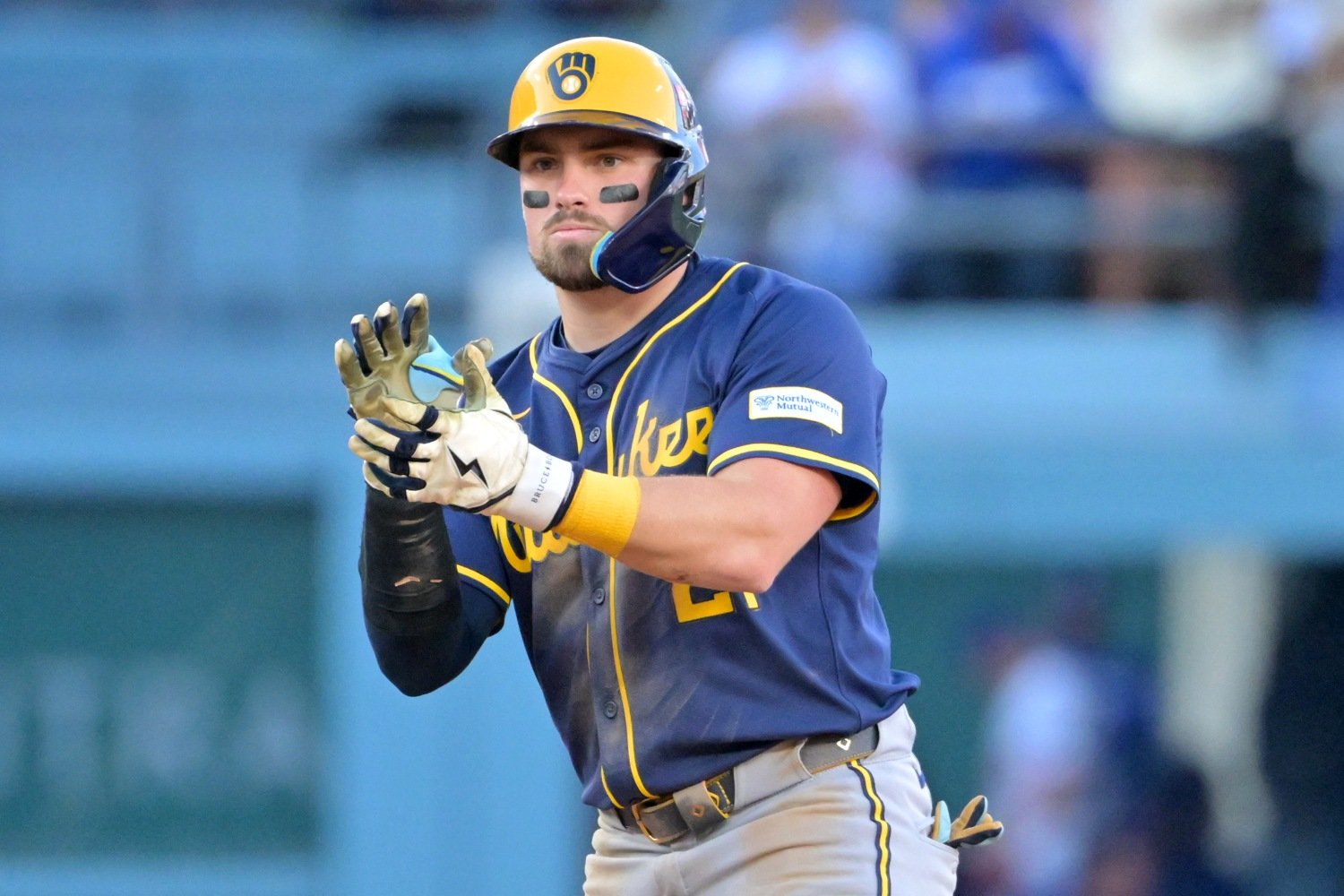
The modest but meaningful power Caleb Durbin demonstrated during the summer faded in September and October. His bat speed fell to the lowest marks of his rookie campaign in those months, at 66.9 miles per hour—about 1.5 miles per hour slower than had been his norm until then. Durbin was a good hitter in his first year in the majors, achieving more than most expected by being surprisingly deft at going the opposite way in addition to consistently lifting the ball to the pull field. His contact rate was elite; his willingness to take a base via being hit by pitches was very valuable. Going forward, though, the team needs to have insurance against regression, fatigue and/or injury for Durbin.
For one thing, while he did put up adequate numbers in September (.253/.359/.367) and good ones in October (.276/.364/.414), those stats were less well-supported by his process at the plate than in previous, better months. The bat speed was down, and that led to just eight extra-base hits—just two of them homers, the last of them on Sept. 14—in 125 plate appearances after the end of August. In the postseason, he also struck out much more (eight times in 33 trips to the plate) than at any previous juncture of the year.
For another thing, we saw a few more mistakes from Durbin in other facets of the game down the stretch. He had two key misplays in the field and two poor moments on the bases during the playoffs. For a player who thrives on being excellent at the small things of the game, that was a jarring change, and an unwelcome one. It’s clear that, to stay as sharp as he needs to be to remain at his best, Durbin needs to play a bit less often.
The good news is that, as a tactical roster piece, Durbin is pretty easy to fit into a just-under-full-time role. Despite starting the 2025 season at Triple-A Nashville, he played 136 games (and started 122) for the Brewers after being promoted in mid-April. (He’d also played 13 full games with the Sounds.) If the goal is to reduce that workload to roughly 120 starts over the full season in 2026, the Crew can do it in a pretty straightforward way:
15 starts at second base against left-handed opposing starters, spelling and partially platooning with Brice Turang
105 starts at third base, 90 of them against righties and 15 of them against lefties
Based on the usual breakdown of opposing starting pitcher handedness, this would give Durbin 90 starts against righties and 30 against lefties, leaving him on the bench for roughly 25 games against righties and roughly 15 against lefties. Why not maximize his exposure to left-handed pitchers and hide him a bit more from righties? Because Durbin is (if anything) better against righties; that’s why.
vs. RHP: 373 plate appearances, .255/.337/.385, 6.2% walk rate, 5.1% HBP rate, 11.5% strikeout rate, 7.5% extra-base hit rate
vs. LHP: 133 PA, .258/.326/.392, 5.3% walk rate, 3.8% HBP rate, 5.3% strikeout rate, 6.0% XBH rate
One wrinkle, with hitters who get hit by pitches often, is that they tend to have small or reverse platoon splits—because most pitchers are much more likely to hit a same-handed batter with a pitch than to hit an opposite-handed batter with one. Durbin gets hit so often by righties that it inflates his overall production against them. Most of his over-the-fence power comes against lefties, but he’s just as good against righties because of the extra times he reaches base by being plunked.
Thus, you can play Durbin against righties more and against lefties less than you might play a typical righty batter in need of this kind of workload management. He can fill in just a bit for Turang, to keep the latter fresher in his own right, by playing against southpaws at second. That leaves us to fill (theoretically) just 57 starts at third base: something like 30 against lefties and 27 against righties.
To do that, the Brewers could engage any of several impending free agents. Switch-hitters like Willi Castro and Yoán Moncada hold some appeal, but each is coming off a tough season as they hit the market. Enrique Hernández and Isiah Kiner-Falefa, each of whom can be seen this week playing in the World Series, would be excellent fits for this role, particularly because each could also move around the diamond and fill some other needs likely to arise for the team over the course of the year.
Bo Bichette is an enticing potential fit on multiple levels for Milwaukee this winter. Though radically unlikely to be a long-term fit at shortstop for his new team, the impending free agent might prefer a landing spot where he can stay at his most familiar position in the short term. Bringing in Bichette to displace Joey Ortiz and stop the gap while the team waits for the matriculation of Cooper Pratt and/or Jesus Made from the farm system would be a landmark move for the Crew, and he could begin his gradual transition to third base by sliding over to spell Durbin on this part-time basis, with Ortiz rotating in at short.
The most intriguing pair of potential targets, however, have to be the two star sluggers likely to be posted by their Nippon Professional Baseball (NPB) teams this winter, Munetaka Murakami and Kazuma Okamoto. Murakami, who will turn 26 in February, is a lefty power bat with 265 career homers in Japan. Okamoto, a righty hitter who will turn 30 next summer, is a bit more balanced in his approach and makes more contact, but he, too, has tapped into huge power: He has 91 doubles and 83 home runs since the start of the 2023 season, despite missing roughly half of the 2025 campaign.
Both players have spent the majority of their careers at third base, but have also played some first base. Both are expected to play more at the cold corner than at the hot one as they come to the States. However, each profiles as a solid complement to both Durbin and Andrew Vaughn, the incumbent Brewers first baseman for 2026. Murakami could start most of the time against righties at first, but slide over to third against most lefties. Okamoto, who will be less expensive and is therefore much more likely to slide into the Brewers’ price range, is an imperfect platoon partner to Vaughn but could find some playing time by spelling Christian Yelich against lefties at designated hitter.
Bichette, Murakami and Okamoto sound like pie-in-the-sky possibilities, but the Brewers will have money to spend this winter. Even if they ultimately allocate those resources elsewhere, though, they should select a lower-wattage target and bolster their infield mix by bringing in someone who fits alongside Durbin at third base. Doing so would make Durbin himself more effective, in addition to deepening the talent pool around the horn for the World Series aspirants in the third year of the Pat Murphy era.