
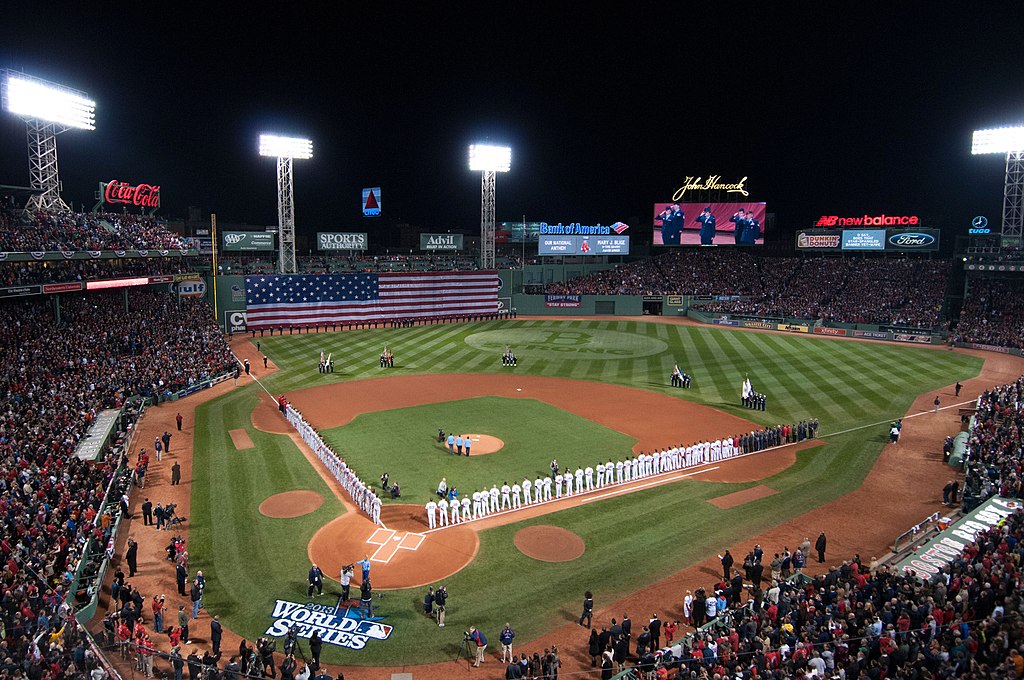
AS OCTOBER DRAWS to a close, baseball fans are being treated to a riveting World Series featuring some of the sport’s biggest stars. Unfortunately, none of these games are taking place at Fenway Park.
But that doesn’t mean there’s nothing to cheer about in Boston as the 2025 baseball season nears its climax. This year marks an important anniversary for the oldest stadium in Major League Baseball, one well worth celebrating in a region that puts a premium on preserving its past.
It was 25 years ago that Fenway Park was saved from the wrecking ball whose time, we were told, had come. It’s easy to forget important milestones when they mark something significant that didn’t happen, but it’s a moment worth recalling – and toasting.
Like most Bostonians, I distinctly remember my first game at Fenway Park. I was seven years old in 1979 when my father and I emerged from the darkened concourse to the bright lights and green glow from the field of what John Updike indelibly termed our “lyric little bandbox of a ballpark.”
Almost every Bostonian has a memory like that: A father, a mother, a grandparent, an uncle, a neighbor who took them to their first game, introducing them to a civic ritual that is as storied as any in this city of rituals.
What many have forgotten now is just how close Boston came to losing its beloved ballpark. At that first game, I could never imagine that some 20 years later, I – as a first-term city councilor — would have a front-row seat for the battle to save Fenway Park, and how it would overwhelm everything else in my nascent political career.
The plan to tear down Fenway Park was first announced by Red Sox president and CEO John Harrington on May 16, 1999. For the 14 seasons that Harrington led the team, while he would be responsible for onboarding some of the players who would go on to win the 2004 World Series, the team never once played in the championship series.
This must have haunted him, for despite the Red Sox consistently being among the highest paying teams in baseball, he couldn’t make it to the main event. To become a championship team would require something more. To win, he believed, the team needed a new ballpark.
“In the long run it’s just not feasible to compete in Fenway,” Harrington would explain in a business forum in 2000.
The plan he unveiled for a new stadium would expand the current ballpark’s footprint to over 15 acres, nearly twice its current size, and increase the seating capacity by over 10,000. It was estimated at the time to cost $545 million and would require the absorption of approximately two dozen privately owned parcels, as well as the intervening streets and sidewalks.
What wasn’t mentioned at the time was that more than half the cost of the new park was to be covered by public funds from the city and state.
At the time, I was a candidate for the Boston city council, crisscrossing my way through a district that extended from the Boston Common to the edge of the Longwood Medical Center at the border of Brookline.
As a long-shot to win, and with limited funding, my strategy was to knock on the doors of each and every voter in a district with 70,000 residents — not once, but three times.
I was young — only 27 at the time. But I had learned from the best, having previously worked in the administration of the man who would go on to become Boston’s longest serving mayor, Tom Menino. I learned that voters wanted someone to roll up their sleeves and get the job done. Little did I know that Boston’s defining issue as it entered the new millennium would be the future of Fenway Park, which sat squarely in the middle of the district I sought to represent.
When I was first asked about the proposal for the new ballpark, I was at a candidate’s forum. Maybe it was because I got the question before the others, or that I just hadn’t prepared a clever political answer with room to pivot. Maybe it was because I ran a campaign in all the ways you weren’t supposed to. Or maybe it was a quick flashback to that first game with my father. But my answer helped me earn a streak of independence that was important to many of the voters within the district. And so, I said something like:
“That’s ridiculous. Who would want to tear down Fenway Park? It’s a national treasure and one of the defining landmarks of our city.”
It felt good that day, and all the times that I was thanked for my stance by active residents of the neighborhood, including those from the group Save Fenway Park! and the Fenway Community Development Corporation, who had been organizing around the ballpark issue for months.
But the list of “who would want to tear down Fenway Park” was long and powerful. It started with my former boss, Tom Menino.
The majority of the city was behind the new stadium plan. The sports world was convinced that only with a new park could Boston recover from the drought that had left it without a World Series championship since 1918. The business community loved the idea of new jobs, corporate boxes, and renewed attention for their city. And the political community saw a legacy-making decision for the ages. This holy trinity came together in a whirlwind campaign to build Boston a world-class stadium, and woe to those who stood in its way.
On November 8, 1999, I won my election in a close race. I was now the city councilor for District Eight, which included an extremely prominent property located at 4 Yawkey Way.
The plan to rebuild Fenway Park was moving quickly. In this summer of 2000, the state Legislature overwhelmingly passed a bill allowing $312 million in public funds, not including another $140 million coming from the city for the development of a parking garage, a deal that was hatched in a multiple-hours meeting just days before the end of the legislative session.
Momentum was on the side of the new park, and I was part of a fledgling group of underdogs that was trying to stop it.
I remember during this period trying to get basic city services completed within my district. Calls from department heads suddenly were not returned, and in more than one exchange I was told by the person on the other end of the phone that they were not allowed to talk to me. Going against the grain had its costs, and I was paying for it.
It was around this time that I visited Fenway Park, not to see a game, but to inspect the structure. John Harrington himself met me to provide the tour. Harrington was a bit of a showman. My visit came on the heels of the successful 1999 All-Star Game at Fenway, which hadn’t hosted the midsummer classic since 1961.
Some have argued that the All-Star Game itself saved the park from demolition – spotlighting for a national audience the beauty and splendor of what was soon to no longer be. An appearance by an aging Ted Williams, enthralling every player who was there that day, was one of the greatest moments in the history of sports.
The team’s messaging, however, was schizophrenic at best: On one hand, they were showcasing to the world a place of true majesty, while on the other, saying that it was obsolete and time for it go.
The Boston City Council is not best described as a powerful body, but in this instance, the future of the new ballpark rested with just a handful of its members. For the city to take private land, as well as to issue bonds to pay for the parking garage, it required a two-thirds vote of the council — meaning just five votes in opposition on the 13-member body would jettison the entire plan. As the district councilor who represented the Fenway neighborhood, it fell to me to round up those votes.
With the combination of the council’s rare moment of consequential power under the city’s strong-mayor charter, and the grassroot opposition to a new stadium within the community, there finally seemed to be some momentum for the underdogs. When it came time for the highly anticipated public hearings at the city council, there was a sense of possibility in the air, if not a festival-like atmosphere.
I distinctly remember a man dressed in a giant hot dog costume walking into the city council chambers, with the president of the body, Jimmy Kelly, an old-school politician with no tolerance for such public antics, smashing his gavel on the rostrum, screaming “Order! Order!”
It was around this time that I decided to take my colleagues on a tour of the Fenway neighborhood, a place that many of the councilors didn’t know beyond the area around the ballpark. We boarded a borrowed Old Town Trolley and toured the neighborhood. The visit was a high-profile media stunt and put more pressure on the impending plan by localizing the story and focusing on actual voters in front of their elected representatives.
But before the council could deliver the death-knell to the plan, Harrington himself would reveal a bombshell of his own.
The Red Sox were for sale.
Just weeks after hundreds of millions of public dollars were committed by local and state government to this private sports team, Harrington announced it was “the right time” to sell.
The sound of jaws dropping could be heard from City Hall to the State House.
“It would be irresponsible and reckless to turn around and commit public financing to a new stadium today only to find out tomorrow the team’s being purchased by an internet multibillionaire,” said city councilor Michael Flaherty at the time.
As various groups began to assemble their bids to become the next owners of the team, a feat that would have to clear both Major League Baseball and the Massachusetts attorney general’s office on account of the non-profit status of the team’s majority owners, the future of the park was still very much in doubt.
What would happen next was as much a matter of faith as it was league politics — faith because the ownership team led by John Henry was the most preservationist-friendly of all the potential purchasers; politics because they had the backing of baseball commissioner Bud Selig.
Much has been written about how the Henry group, equipped with Janet Marie Smith, a brilliant preservationist architect, did what was needed in order to restore, and ultimately “save” Fenway Park.
This included adding the Green Monster seats, expanding the upper decks for premium seating, and using the surrounding streets for game-day operations. In a bold move that signaled a philosophic shift from the old to the new, Yawkey Way was restored to its original name of Jersey Street, an action that brought immediate rebuke from the Yawkey Foundation as well as many of its well-connected supporters.
I have no doubt that Fenway Park would not be standing if it were not for Henry and his associates. I also have no doubt that a pivotal role in this saga was played by a lesser known group of rag-tag dreamers who had the audacity to take on a long list of power brokers to protect a treasure worth saving.
In 2005, in commemoration of the 10th anniversary of the New England Holocaust Memorial, my father, a survivor of the Holocaust and the memorial’s founder, was invited to Fenway Park to throw out the first ceremonial pitch. Catching the ball would be Kevin Youkilis, a Jewish member of the Red Sox team, who had distinguished himself among his co-religionists by refusing to play on Yom Kippur, the holiest day of the Jewish calendar, the previous year.
Watching my father stand on the pitching mound of Fenway Park and throw out the first pitch was a vision I will never forget. Behind him you could see the newly installed Green Monster seats, a concept originally pitched by Save Fenway Park! and dismissed by the Harrington group as impossible.
A lot had changed since that first game he and I attended some 27 years prior to that moment. For one thing, the Red Sox were world champions again – finally (and thrice more since). For another, the new Red Sox ownership had decided that Fenway Park was worth saving and invested an extraordinary amount of talent and resources in doing so.
At that moment, I felt pride. I had found my place in Boston. Standing there basking in the verdant glow of Fenway Park’s ethereal field, nothing else seemed to matter.
Mike Ross is an attorney at the Boston law firm Prince Lobel. He served on the Boston City Council from 2000 to 2013.
This <a target=”_blank” href=”https://commonwealthbeacon.org/opinion/for-the-fenway-faithful-something-to-cheer-about/”>article</a> first appeared on <a target=”_blank” href=”https://commonwealthbeacon.org”>CommonWealth Beacon</a> and is republished here under a <a target=”_blank” href=”https://creativecommons.org/licenses/by-nd/4.0/”>Creative Commons Attribution-NoDerivatives 4.0 International License</a>.<img src=”https://i0.wp.com/commonwealthbeacon.org/wp-content/uploads/2023/08/cropped-Icon_Red-1.png?resize=150%2C150&ssl=1″ style=”width:1em;height:1em;margin-left:10px;”>
<img id=”republication-tracker-tool-source” src=”https://commonwealthbeacon.org/?republication-pixel=true&post=305128&ga4=G-1X7ZBDTLR0″ style=”width:1px;height:1px;”><script> PARSELY = { autotrack: false, onload: function() { PARSELY.beacon.trackPageView({ url: “https://commonwealthbeacon.org/opinion/for-the-fenway-faithful-something-to-cheer-about/”, urlref: window.location.href }); } } </script> <script id=”parsely-cfg” src=”//cdn.parsely.com/keys/commonwealthbeacon.org/p.js”></script>
Canonical Tag:
Copy Tag
Article Content:
For the Fenway faithful, something to cheer about
Mike Ross, CommonWealth Beacon
October 29, 2025
AS OCTOBER DRAWS to a close, baseball fans are being treated to a riveting World Series featuring some of the sport’s biggest stars. Unfortunately, none of these games are taking place at Fenway Park.
But that doesn’t mean there’s nothing to cheer about in Boston as the 2025 baseball season nears its climax. This year marks an important anniversary for the oldest stadium in Major League Baseball, one well worth celebrating in a region that puts a premium on preserving its past.
It was 25 years ago that Fenway Park was saved from the wrecking ball whose time, we were told, had come. It’s easy to forget important milestones when they mark something significant that didn’t happen, but it’s a moment worth recalling – and toasting.
Like most Bostonians, I distinctly remember my first game at Fenway Park. I was seven years old in 1979 when my father and I emerged from the darkened concourse to the bright lights and green glow from the field of what John Updike indelibly termed our “lyric little bandbox of a ballpark.”
Almost every Bostonian has a memory like that: A father, a mother, a grandparent, an uncle, a neighbor who took them to their first game, introducing them to a civic ritual that is as storied as any in this city of rituals.
What many have forgotten now is just how close Boston came to losing its beloved ballpark. At that first game, I could never imagine that some 20 years later, I – as a first-term city councilor — would have a front-row seat for the battle to save Fenway Park, and how it would overwhelm everything else in my nascent political career.
The plan to tear down Fenway Park was first announced by Red Sox president and CEO John Harrington on May 16, 1999. For the 14 seasons that Harrington led the team, while he would be responsible for onboarding some of the players who would go on to win the 2004 World Series, the team never once played in the championship series.
This must have haunted him, for despite the Red Sox consistently being among the highest paying teams in baseball, he couldn’t make it to the main event. To become a championship team would require something more. To win, he believed, the team needed a new ballpark.
“In the long run it’s just not feasible to compete in Fenway,” Harrington would explain in a business forum in 2000.
The plan he unveiled for a new stadium would expand the current ballpark’s footprint to over 15 acres, nearly twice its current size, and increase the seating capacity by over 10,000. It was estimated at the time to cost $545 million and would require the absorption of approximately two dozen privately owned parcels, as well as the intervening streets and sidewalks.
What wasn’t mentioned at the time was that more than half the cost of the new park was to be covered by public funds from the city and state.
At the time, I was a candidate for the Boston city council, crisscrossing my way through a district that extended from the Boston Common to the edge of the Longwood Medical Center at the border of Brookline.
As a long-shot to win, and with limited funding, my strategy was to knock on the doors of each and every voter in a district with 70,000 residents — not once, but three times.
I was young — only 27 at the time. But I had learned from the best, having previously worked in the administration of the man who would go on to become Boston’s longest serving mayor, Tom Menino. I learned that voters wanted someone to roll up their sleeves and get the job done. Little did I know that Boston’s defining issue as it entered the new millennium would be the future of Fenway Park, which sat squarely in the middle of the district I sought to represent.
When I was first asked about the proposal for the new ballpark, I was at a candidate’s forum. Maybe it was because I got the question before the others, or that I just hadn’t prepared a clever political answer with room to pivot. Maybe it was because I ran a campaign in all the ways you weren’t supposed to. Or maybe it was a quick flashback to that first game with my father. But my answer helped me earn a streak of independence that was important to many of the voters within the district. And so, I said something like:
“That’s ridiculous. Who would want to tear down Fenway Park? It’s a national treasure and one of the defining landmarks of our city.”
It felt good that day, and all the times that I was thanked for my stance by active residents of the neighborhood, including those from the group Save Fenway Park! and the Fenway Community Development Corporation, who had been organizing around the ballpark issue for months.
But the list of “who would want to tear down Fenway Park” was long and powerful. It started with my former boss, Tom Menino.
The majority of the city was behind the new stadium plan. The sports world was convinced that only with a new park could Boston recover from the drought that had left it without a World Series championship since 1918. The business community loved the idea of new jobs, corporate boxes, and renewed attention for their city. And the political community saw a legacy-making decision for the ages. This holy trinity came together in a whirlwind campaign to build Boston a world-class stadium, and woe to those who stood in its way.
On November 8, 1999, I won my election in a close race. I was now the city councilor for District Eight, which included an extremely prominent property located at 4 Yawkey Way.
The plan to rebuild Fenway Park was moving quickly. In this summer of 2000, the state Legislature overwhelmingly passed a bill allowing $312 million in public funds, not including another $140 million coming from the city for the development of a parking garage, a deal that was hatched in a multiple-hours meeting just days before the end of the legislative session.
Momentum was on the side of the new park, and I was part of a fledgling group of underdogs that was trying to stop it.
I remember during this period trying to get basic city services completed within my district. Calls from department heads suddenly were not returned, and in more than one exchange I was told by the person on the other end of the phone that they were not allowed to talk to me. Going against the grain had its costs, and I was paying for it.
It was around this time that I visited Fenway Park, not to see a game, but to inspect the structure. John Harrington himself met me to provide the tour. Harrington was a bit of a showman. My visit came on the heels of the successful 1999 All-Star Game at Fenway, which hadn’t hosted the midsummer classic since 1961.
Some have argued that the All-Star Game itself saved the park from demolition – spotlighting for a national audience the beauty and splendor of what was soon to no longer be. An appearance by an aging Ted Williams, enthralling every player who was there that day, was one of the greatest moments in the history of sports.
The team’s messaging, however, was schizophrenic at best: On one hand, they were showcasing to the world a place of true majesty, while on the other, saying that it was obsolete and time for it go.
The Boston City Council is not best described as a powerful body, but in this instance, the future of the new ballpark rested with just a handful of its members. For the city to take private land, as well as to issue bonds to pay for the parking garage, it required a two-thirds vote of the council — meaning just five votes in opposition on the 13-member body would jettison the entire plan. As the district councilor who represented the Fenway neighborhood, it fell to me to round up those votes.
With the combination of the council’s rare moment of consequential power under the city’s strong-mayor charter, and the grassroot opposition to a new stadium within the community, there finally seemed to be some momentum for the underdogs. When it came time for the highly anticipated public hearings at the city council, there was a sense of possibility in the air, if not a festival-like atmosphere.
I distinctly remember a man dressed in a giant hot dog costume walking into the city council chambers, with the president of the body, Jimmy Kelly, an old-school politician with no tolerance for such public antics, smashing his gavel on the rostrum, screaming “Order! Order!”
It was around this time that I decided to take my colleagues on a tour of the Fenway neighborhood, a place that many of the councilors didn’t know beyond the area around the ballpark. We boarded a borrowed Old Town Trolley and toured the neighborhood. The visit was a high-profile media stunt and put more pressure on the impending plan by localizing the story and focusing on actual voters in front of their elected representatives.
But before the council could deliver the death-knell to the plan, Harrington himself would reveal a bombshell of his own.
The Red Sox were for sale.
Just weeks after hundreds of millions of public dollars were committed by local and state government to this private sports team, Harrington announced it was “the right time” to sell.
The sound of jaws dropping could be heard from City Hall to the State House.
“It would be irresponsible and reckless to turn around and commit public financing to a new stadium today only to find out tomorrow the team’s being purchased by an internet multibillionaire,” said city councilor Michael Flaherty at the time.
As various groups began to assemble their bids to become the next owners of the team, a feat that would have to clear both Major League Baseball and the Massachusetts attorney general’s office on account of the non-profit status of the team’s majority owners, the future of the park was still very much in doubt.
What would happen next was as much a matter of faith as it was league politics — faith because the ownership team led by John Henry was the most preservationist-friendly of all the potential purchasers; politics because they had the backing of baseball commissioner Bud Selig.
Much has been written about how the Henry group, equipped with Janet Marie Smith, a brilliant preservationist architect, did what was needed in order to restore, and ultimately “save” Fenway Park.
This included adding the Green Monster seats, expanding the upper decks for premium seating, and using the surrounding streets for game-day operations. In a bold move that signaled a philosophic shift from the old to the new, Yawkey Way was restored to its original name of Jersey Street, an action that brought immediate rebuke from the Yawkey Foundation as well as many of its well-connected supporters.
I have no doubt that Fenway Park would not be standing if it were not for Henry and his associates. I also have no doubt that a pivotal role in this saga was played by a lesser known group of rag-tag dreamers who had the audacity to take on a long list of power brokers to protect a treasure worth saving.
In 2005, in commemoration of the 10th anniversary of the New England Holocaust Memorial, my father, a survivor of the Holocaust and the memorial’s founder, was invited to Fenway Park to throw out the first ceremonial pitch. Catching the ball would be Kevin Youkilis, a Jewish member of the Red Sox team, who had distinguished himself among his co-religionists by refusing to play on Yom Kippur, the holiest day of the Jewish calendar, the previous year.
Watching my father stand on the pitching mound of Fenway Park and throw out the first pitch was a vision I will never forget. Behind him you could see the newly installed Green Monster seats, a concept originally pitched by Save Fenway Park! and dismissed by the Harrington group as impossible.
A lot had changed since that first game he and I attended some 27 years prior to that moment. For one thing, the Red Sox were world champions again – finally (and thrice more since). For another, the new Red Sox ownership had decided that Fenway Park was worth saving and invested an extraordinary amount of talent and resources in doing so.
At that moment, I felt pride. I had found my place in Boston. Standing there basking in the verdant glow of Fenway Park’s ethereal field, nothing else seemed to matter.
Mike Ross is an attorney at the Boston law firm Prince Lobel. He served on the Boston City Council from 2000 to 2013.
This article first appeared on CommonWealth Beacon and is republished here under a Creative Commons Attribution-NoDerivatives 4.0 International License.
Copy Content
Tracking snippet:
Copy Snippet