
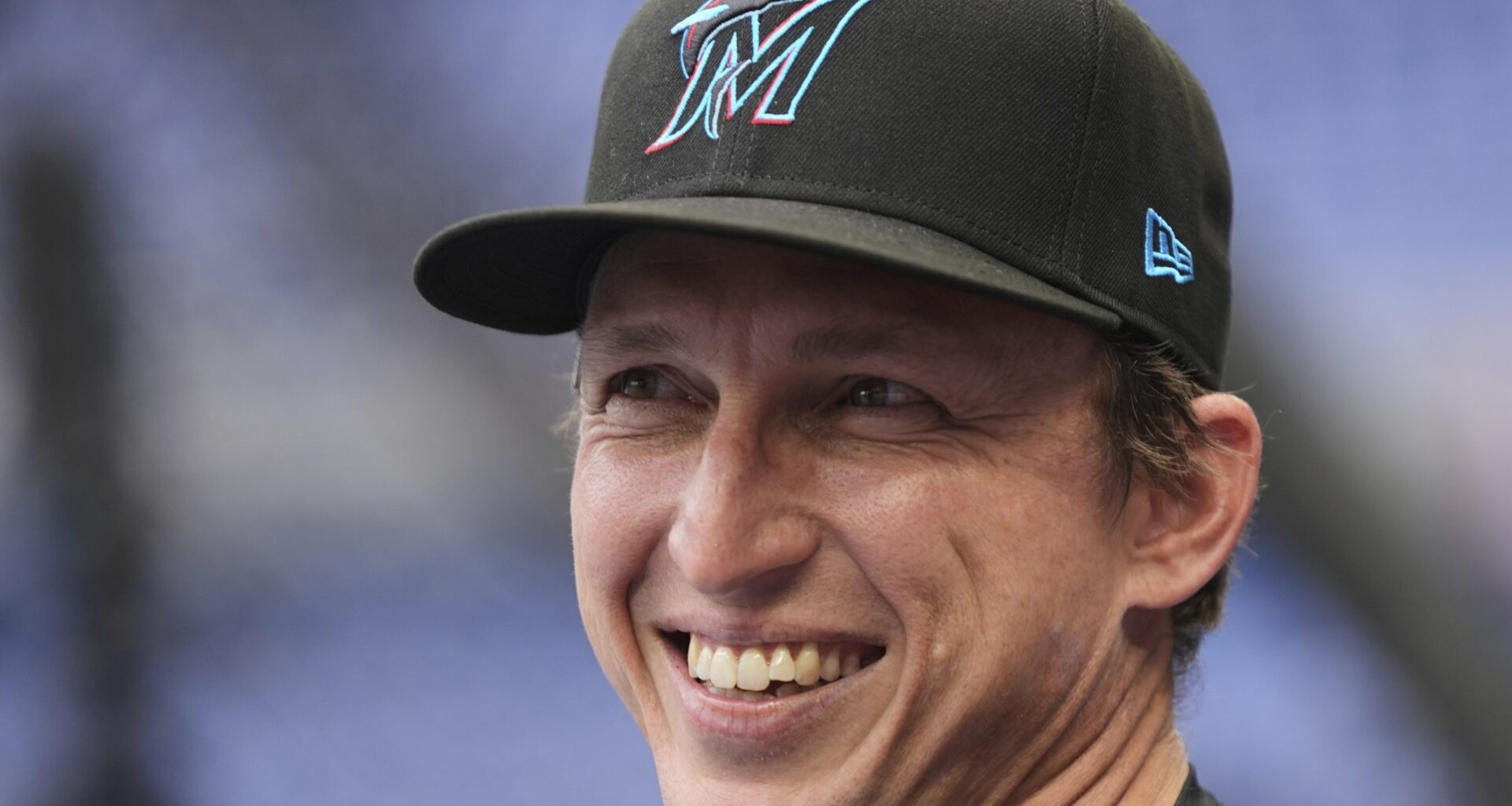
MESA – Seven months after the New York Yankees turned heads using Aaron Leanhardt’s “torpedo” bat, a bowling-pin-shaped instrument he invented to maximize contact, his focus has shifted from revolutionizing hitting to managing lineups.
Leanhardt’s substantial brain is now fixed on the Mesa Solar Sox clubhouse, where innovation meets the daily grind of the Arizona Fall League.
In the dugout, Leanhardt, Mesa’s manager, is part educator, part tactician, part motivator. He values tone as much as technique, believing that mindset is inseparable from mechanics. The bat may have put his name on the map after years as a minor league hitting coach with the Yankees before joining the Miami Marlins’ staff in the offseason, but the Mesa dugout is where his influence takes root, in subtle adjustments, open dialogue and team-wide curiosity.
That approach stems from his academic past. Before baseball, Leanhardt earned a bachelor’s degree in electrical engineering and a doctorate in physics from MIT, later spending seven years teaching at the University of Michigan.
While in Ann Arbor, he learned how to help students from vastly different backgrounds collaborate and absorb complex concepts, skills that now anchor his leadership style.
“Whether it’s about coaching or teaching… I try to lean into all the various experiences that your students have,” Leanhardt said. “At the same time, I try to offer that external experience that I might have to them, so when they go their separate ways, they get that little piece they might not have had otherwise.”
That blend of science, empathy and communication defines his coaching philosophy. His focus on development stretches far beyond numbers. He studies how a hitter adjusts mid-game, how a pitcher manages pressure, and how a player carries himself in the dugout. To Leanhardt, data supports instinct, not the other way around.
The same curiosity that guides his coaching first made headlines with the torpedo bat.
“I normally used to walk around behind (the media), not being in front of (the media),” Leanhardt said. “It was a surreal experience… I’m just really happy and lucky that I got to be part of something positive.”
A year to remember barely captures his journey. Leanhardt’s coaching career began in 2017 as an assistant in New Jersey’s Atlantic Collegiate Baseball League and at Dawson Community College, followed by a volunteer stint with the Duluth Huskies of the Northwoods League in 2018.
That spring, he joined the Yankees organization as a minor league hitting coach.
From 2018 to 2023, he worked closely with players in the Yankees’ system, developing the torpedo bat around 2022–2023 with the help of feedback from players in the organization.
The torpedo wasn’t just about harder contact; it was about how players could adapt tools to their own rhythms. Leanhardt saw the Yankees’ use of his technology as an extension of his own broader mission: to connect the dots between science, data and hands-on coaching to create smarter players, and not simply better players who get good numbers in the box score.
In 2024, after completing a short stint as an analyst with the Yankees, he began working as a field coordinator for the Marlins. Meanwhile, the legacy of Leanhardt’s impact was still being felt in New York, when the Yankees took to the field in 2025 with five of their hitters using his invention. By the third game of the season, they had hit 15 home runs (tying a league record), bringing Leanhardt’s new-age technology and himself into the national spotlight.
Now, roughly a third of the Solar Sox players are using the torpedo bat, and Leanhardt expects that number to rise as more players use their time in the Arizona Fall League to experiment with it.
In the AFL, Leanhardt’s philosophy is facing a new test. The Solar Sox roster blends players from five MLB organizations, each with distinct routines and philosophies. For Leanhardt, the challenge isn’t just introducing new ideas, it’s learning how to communicate them effectively.
“This is like walking into a classroom with close to 40 students whose names you don’t know,” Leanhardt said. “Literally, I walk in and I’ve got 40 new players. Don’t know any of them. So really, it’s just that — trying to get up to speed with 40 guys that aren’t even your guys.”
That teaching mindset reflects how he sees the game. The AFL, long recognized as a hub for baseball innovation, provides the perfect laboratory for someone like Leanhardt. From early testing of the automated ball-strike system (ABS) to new ideas like the check-swing challenge system, the league’s culture of experimentation aligns seamlessly with his own.
For players such as Max Muncy, an A’s young star and Solar Sox third baseman who appeared in 63 MLB games this year and came to the AFL seeking extra reps after an injury, that approach shows in every drill.
“It’s cool – I know he’s a really smart guy,” Muncy said. “Definitely brings a different side of baseball. More than just being the guy who played.”
Muncy’s comment illustrates a larger theme throughout Leanhardt’s coaching: a focus on learning as a constant pursuit. Even for seasoned players, he is trying to create a sense of curiosity, asking them to wonder why things are done in a particular manner, on the field and in practice.
For Muncy, who joked about his own level of scholarship, it’s an opportunity to continue to build a knowledge of the game and learn concepts that he might apply after his playing days.
“I’m a high school guy, so I didn’t go to MIT,” Muncy said with a chuckle. “Talking to someone like that is great… there’s always a learning experience, especially down the road if I end up coaching.”
Leanhardt’s Solar Sox staff buys into the same mindset. Hitting coach Brett Schneider might not have crafted a bat that changed the game, but his sharp eye for hitting keeps him in sync with Leanhardt, and open to picking up new insights from his manager.
“He’s been awesome,” Schneider said. “It’s great having that kind of chemistry on staff. He loves to talk hitting, baseball, even life. Obviously, everyone’s been asking him about the torpedo bat, but beyond that, he’s been great to collaborate with on keeping guys engaged.”
For Leanhardt, that collaborative energy defines what makes head coaching special.
“What I really enjoy about head coaching opportunities is a chance to kind of broaden what I’ve had the opportunity to do (in my career),” Leanhardt said. “It’s a chance to touch every aspect of the game and make sure we’re doing the things that don’t show up in the box score, but actually contribute to winning.”
Leanhardt’s own career mirrors the players he mentors. He moved from MIT physics labs to college baseball, then to minor-league coaching and MLB analytics. His mix of rigor and adaptability now defines how he leads, combining experiment with experience.
In practice, he’s deeply hands-on. Video review and swing data are tools, but his real focus is on habits and how players respond in real time. That blend of science and empathy makes him approachable, even as he pushes boundaries.
“Every day, you mess something up, and you roll with the punches,” Leanhardt said. “…Not everything I do on the field or in the cages is going to be perfect, but as time goes on, it’s going to get better.”
For Leanhardt, the torpedo bat was the opening act; operating the Solar Sox is the main event. In the clubhouse, on the field and quietly, he merges science and experience and instruction into a comprehensive philosophy, teaching players to not just improve their swing, but to learn more about the game.
“Whether it’s about coaching or teaching… I try to lean into all the various experiences that your students have, so I try to do that with the players as well,” Leanhardt said. “At the same time, try to offer that external experience that I might have to them, so when they go their separate ways, they get that little piece that they might not have had otherwise.”
This <a target=”_blank” href=”https://cronkitenews.azpbs.org/2025/10/29/leanhardt-fall-league-torpedo-bats/”>article</a> first appeared on <a target=”_blank” href=”https://cronkitenews.azpbs.org”>Cronkite News</a> and is republished here under a <a target=”_blank” href=”https://creativecommons.org/licenses/by-nd/4.0/”>Creative Commons Attribution-NoDerivatives 4.0 International License</a>.
<img id=”republication-tracker-tool-source” src=”https://cronkitenews.azpbs.org/?republication-pixel=true&post=97404″ style=”width:1px;height:1px;”><script> PARSELY = { autotrack: false, onload: function() { PARSELY.beacon.trackPageView({ url: “https://cronkitenews.azpbs.org/2025/10/29/leanhardt-fall-league-torpedo-bats/”, urlref: window.location.href }); } } </script> <script id=”parsely-cfg” src=”//cdn.parsely.com/keys/cronkitenews.azpbs.org/p.js”></script>
Canonical Tag:
Copy Tag
Article Content:
Big bat, bigger brain: Aaron Leanhardt goes from designing torpedo bat to managing Mesa Solar Sox in AFL
George Lund, Cronkite News
October 29, 2025
MESA – Seven months after the New York Yankees turned heads using Aaron Leanhardt’s “torpedo” bat, a bowling-pin-shaped instrument he invented to maximize contact, his focus has shifted from revolutionizing hitting to managing lineups.
Leanhardt’s substantial brain is now fixed on the Mesa Solar Sox clubhouse, where innovation meets the daily grind of the Arizona Fall League.
In the dugout, Leanhardt, Mesa’s manager, is part educator, part tactician, part motivator. He values tone as much as technique, believing that mindset is inseparable from mechanics. The bat may have put his name on the map after years as a minor league hitting coach with the Yankees before joining the Miami Marlins’ staff in the offseason, but the Mesa dugout is where his influence takes root, in subtle adjustments, open dialogue and team-wide curiosity.
That approach stems from his academic past. Before baseball, Leanhardt earned a bachelor’s degree in electrical engineering and a doctorate in physics from MIT, later spending seven years teaching at the University of Michigan.
While in Ann Arbor, he learned how to help students from vastly different backgrounds collaborate and absorb complex concepts, skills that now anchor his leadership style.
“Whether it’s about coaching or teaching… I try to lean into all the various experiences that your students have,” Leanhardt said. “At the same time, I try to offer that external experience that I might have to them, so when they go their separate ways, they get that little piece they might not have had otherwise.”
That blend of science, empathy and communication defines his coaching philosophy. His focus on development stretches far beyond numbers. He studies how a hitter adjusts mid-game, how a pitcher manages pressure, and how a player carries himself in the dugout. To Leanhardt, data supports instinct, not the other way around.
The same curiosity that guides his coaching first made headlines with the torpedo bat.
“I normally used to walk around behind (the media), not being in front of (the media),” Leanhardt said. “It was a surreal experience… I’m just really happy and lucky that I got to be part of something positive.”
A year to remember barely captures his journey. Leanhardt’s coaching career began in 2017 as an assistant in New Jersey’s Atlantic Collegiate Baseball League and at Dawson Community College, followed by a volunteer stint with the Duluth Huskies of the Northwoods League in 2018.
That spring, he joined the Yankees organization as a minor league hitting coach.
From 2018 to 2023, he worked closely with players in the Yankees’ system, developing the torpedo bat around 2022–2023 with the help of feedback from players in the organization.
The torpedo wasn’t just about harder contact; it was about how players could adapt tools to their own rhythms. Leanhardt saw the Yankees’ use of his technology as an extension of his own broader mission: to connect the dots between science, data and hands-on coaching to create smarter players, and not simply better players who get good numbers in the box score.
In 2024, after completing a short stint as an analyst with the Yankees, he began working as a field coordinator for the Marlins. Meanwhile, the legacy of Leanhardt’s impact was still being felt in New York, when the Yankees took to the field in 2025 with five of their hitters using his invention. By the third game of the season, they had hit 15 home runs (tying a league record), bringing Leanhardt’s new-age technology and himself into the national spotlight.
Now, roughly a third of the Solar Sox players are using the torpedo bat, and Leanhardt expects that number to rise as more players use their time in the Arizona Fall League to experiment with it.
In the AFL, Leanhardt’s philosophy is facing a new test. The Solar Sox roster blends players from five MLB organizations, each with distinct routines and philosophies. For Leanhardt, the challenge isn’t just introducing new ideas, it’s learning how to communicate them effectively.
“This is like walking into a classroom with close to 40 students whose names you don’t know,” Leanhardt said. “Literally, I walk in and I’ve got 40 new players. Don’t know any of them. So really, it’s just that — trying to get up to speed with 40 guys that aren’t even your guys.”
That teaching mindset reflects how he sees the game. The AFL, long recognized as a hub for baseball innovation, provides the perfect laboratory for someone like Leanhardt. From early testing of the automated ball-strike system (ABS) to new ideas like the check-swing challenge system, the league’s culture of experimentation aligns seamlessly with his own.
For players such as Max Muncy, an A’s young star and Solar Sox third baseman who appeared in 63 MLB games this year and came to the AFL seeking extra reps after an injury, that approach shows in every drill.
“It’s cool – I know he’s a really smart guy,” Muncy said. “Definitely brings a different side of baseball. More than just being the guy who played.”
Muncy’s comment illustrates a larger theme throughout Leanhardt’s coaching: a focus on learning as a constant pursuit. Even for seasoned players, he is trying to create a sense of curiosity, asking them to wonder why things are done in a particular manner, on the field and in practice.
For Muncy, who joked about his own level of scholarship, it’s an opportunity to continue to build a knowledge of the game and learn concepts that he might apply after his playing days.
“I’m a high school guy, so I didn’t go to MIT,” Muncy said with a chuckle. “Talking to someone like that is great… there’s always a learning experience, especially down the road if I end up coaching.”
Leanhardt’s Solar Sox staff buys into the same mindset. Hitting coach Brett Schneider might not have crafted a bat that changed the game, but his sharp eye for hitting keeps him in sync with Leanhardt, and open to picking up new insights from his manager.
“He’s been awesome,” Schneider said. “It’s great having that kind of chemistry on staff. He loves to talk hitting, baseball, even life. Obviously, everyone’s been asking him about the torpedo bat, but beyond that, he’s been great to collaborate with on keeping guys engaged.”
For Leanhardt, that collaborative energy defines what makes head coaching special.
“What I really enjoy about head coaching opportunities is a chance to kind of broaden what I’ve had the opportunity to do (in my career),” Leanhardt said. “It’s a chance to touch every aspect of the game and make sure we’re doing the things that don’t show up in the box score, but actually contribute to winning.”
Leanhardt’s own career mirrors the players he mentors. He moved from MIT physics labs to college baseball, then to minor-league coaching and MLB analytics. His mix of rigor and adaptability now defines how he leads, combining experiment with experience.
In practice, he’s deeply hands-on. Video review and swing data are tools, but his real focus is on habits and how players respond in real time. That blend of science and empathy makes him approachable, even as he pushes boundaries.
“Every day, you mess something up, and you roll with the punches,” Leanhardt said. “…Not everything I do on the field or in the cages is going to be perfect, but as time goes on, it’s going to get better.”
For Leanhardt, the torpedo bat was the opening act; operating the Solar Sox is the main event. In the clubhouse, on the field and quietly, he merges science and experience and instruction into a comprehensive philosophy, teaching players to not just improve their swing, but to learn more about the game.
“Whether it’s about coaching or teaching… I try to lean into all the various experiences that your students have, so I try to do that with the players as well,” Leanhardt said. “At the same time, try to offer that external experience that I might have to them, so when they go their separate ways, they get that little piece that they might not have had otherwise.”
This article first appeared on Cronkite News and is republished here under a Creative Commons Attribution-NoDerivatives 4.0 International License.
Copy Content
Tracking snippet:
Copy Snippet