
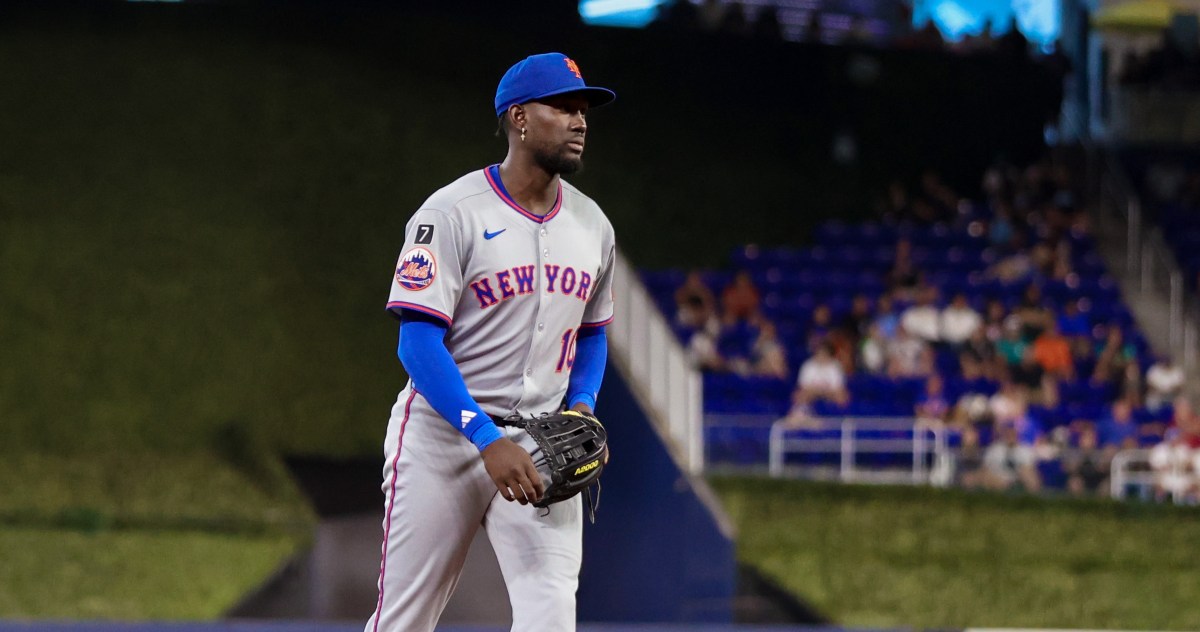
We’ve talked for years about how Ronny Mauricio is a flawed player. Blessed with impressive bat speed and passable contact ability, his lack of approach and injury-driven tumble down the defensive spectrum left him on the fringes of true prospectdom. Despite these flaws, we still ranked Mauricio as the 10th best prospect in the system this past offseason even though he missed all of 2024 while recovering from a torn ACL. There was even some optimism that the Mets could squeeze more out of this profile given their success with Mark Vientos (who had very distinct flaws, to be clear) in 2024.
Needless to say, that was not how things played out. Mauricio returned to minor league action in late April and was quite good for a month, running a 137 wRC+ over 73 PA. The damage numbers were excellent, but under the hood the same problems persisted; Mauricio chased a ton (6th percentile chase rate) and saw his in-zone contact numbers decline from good to merely average. His Triple-A SEAGER was a ghastly 5.3, ranking in the 11th percentile among Triple-A hitters.
Despite those red flags, Mark Vientos’ hamstring strain forced the Mets’ hand, and Mauricio returned to the major league club in early June. He crushed his first home run of the season four days later in Colorado, a true bomb out to right field in the thin Denver air. That moment did not serve as a springboard for Mauricio, however. His continued inability to recognize spin resulted in 6th percentile chase (identical to his minor league mark) and a 19th percentile SEAGER. Mauricio also completely flopped as a right handed batter, posting a paltry .083 /.132/.083 line against lefties.
Now, too his credit, Mauricio was quite good as a left-handed batter, with a line more than 20% better than league average. He also rated surprisingly well on defense per Statcast with a +5 OAA (in a relatively limited sample) at third base. Nevertheless, Mauricio ended the season with an 88 wRC+ that was reasonably well supported by his .294 xwOBA. His redundancy with Brett Baty as a left-hand-hitting, non-SS infielder resulted in a stark reduction in playing time down the stretch, and that’s indicative of how the Mets value their options at those spots at this point.
Mauricio is a square peg in a round hole for this roster. While his left handed bat is theoretically useful – and he should honestly consider giving up switch hitting entirely – the approach flaws remain catastrophic and likely will drive significant regression in that line over a longer sample. It is of course easy to dream on the lightning quick bat and gargantuan home runs he pops off every once in a while, but we’ve been talking for a half-decade about the same problems here with little improvement.
What that means for 2026 is at this point unclear. The sort of consolidation trade that might’ve contained Mauricio never materialized last offseason, but I imagine he’s a name that’s being dangled in trade discussions over the next couple months. Maybe he functions as a secondary piece in a trade for a top of the rotation starter, or perhaps it’s a smaller deal for a shutdown reliever, who knows. Or maybe he’ll still be on the roster and we’ll spend yet another offseason wondering if 2026 will finally be the year he puts it all together.