
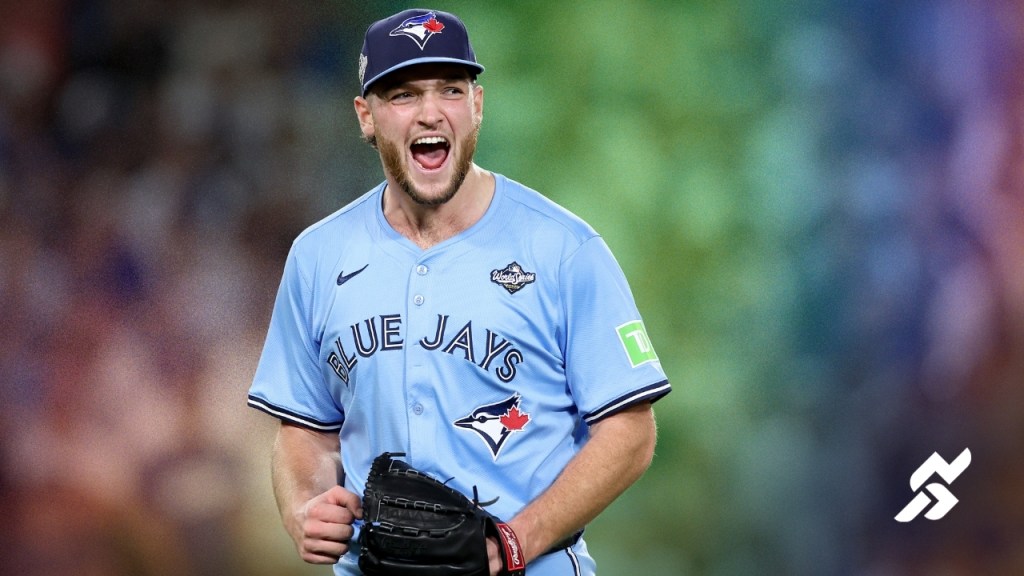
LOS ANGELES — For all the big names and big-money players on both World Series rosters, it was a 22-year-old rookie right-hander making chump change who pitched the Toronto Blue Jays one win away from winning this Fall Classic.
Trey Yesavage pitched at every level of the minor leagues this season before being called up for the Blue Jays in September. His seven innings pitched—he allowed one run on three hits with 12 strikeouts and no walks—helped beat the Dodgers, 6-1, in Game 5 Wednesday at Dodger Stadium.
Max Scherzer, Kevin Gausman, Blake Snell, Shohei Ohtani or Yoshinobu Yamamoto, he is not—they are all making millions this season. Yesavage took home a team-low salary of $57,204, per Spotrac—a prorated portion of Major League Baseball’s $760,000 minimum salary to cover his three starts (his first was on Sept. 15) over two regular-season weeks.
“This playoff paycheck is going to be nice when it hits,” Yesavage said after the game.
The Blue Jays are leading the best-of-seven series 3-2, and the team now has two chances to win it all for the first time in 32 years at home at Rogers Centre.
Win or lose, Yesavage’s postseasoncheck will be a big one. Last fall, Dodgers players each took home $477,441 after they beat the Yankees in five games, while New York players each earned $354,572. This year’s pool could be higher.
When Yesavage was signed out of college as the 20th overall pick in the 2024 draft, he was given a $4.175 million signing bonus. So, he’s hardly a pauper—he’s just a kid trapped in MLB’s arcane pay system where you have to earn your way up through service time. For example, Paul Skenes, who is the favorite for the National League Cy Young Award this season, was paid $820,000 as a second-year player.
Comparatively, Ohtani, who started at $540,000 in his 2018 rookie season with the Los Angeles Angels, is now making $70 million a year with the Dodgers through 2033, $68 million of it deferred each season until then.
Yet, it was the young Yesavage who outpitched Snell, a Cy Young Award-winning pitcher with a five-year, $182 million free agent deal, on Wednesday night.
“I don’t have to know anything about [Yesavage], I just know he’s an athlete,” Dodgers manager Dave Roberts said. “He fields the position well. He’s got a good baseball IQ. He holds base runners. He has a lot of poise. You have to tip your cap to him.”
Game 5 was basically over before it even started. Davis Schneider and Vladimir Guerrero Jr. hit homers on Snell’s first three pitches, giving Yesavage and the Blue Jays a quick, 2-0 lead.
Yesavage then took over and mowed the Dodgers down retiring the first seven hitters before Kiké Hernández hit a homer of his own to make it 2-1. The Dodgers never threatened after that. They had only one base runner as far as second base against Yesavage, who whiffed 10 through the first five innings.
“His slider and splitter were electric,” Blue Jays manager John Schneider said. “He’s a different pitcher when he has his stuff.”
The Dodgers couldn’t touch Yesavage, but the team with a $416.8 million payroll for tax purposes, the higest in MLB, is mired in a massive team-wide slump at absolutely the wrong time. Including the last 11 innings of Monday’s 6-5 Dodgers win in 18 innings, the Dodgers have scored four runs in their last 29 innings.
Roberts tried re-arranging his lineup, inserting Will Smith in the second spot behind Ohtani, while moving Mookie Betts to the third slot ahead of Freddie Freeman. No matter, the top four hitters went 1-for-15 on the evening, the lone hit a ninth-inning base hit by Smith.
It was an opportune evening for Yesavage, who earlier in the season pitched in front of small minor league crowds in places such as Single-A Dunedin. On Wednesday night, he said he tried to take it all in as he took the mound to open the game in front of 52,175 at Dodger Stadium.
“It’s a wild world, just a crazy world,” he said. “Hollywood couldn’t have written a better script.”
Yesavage will eventually be able to take that to the bank.