
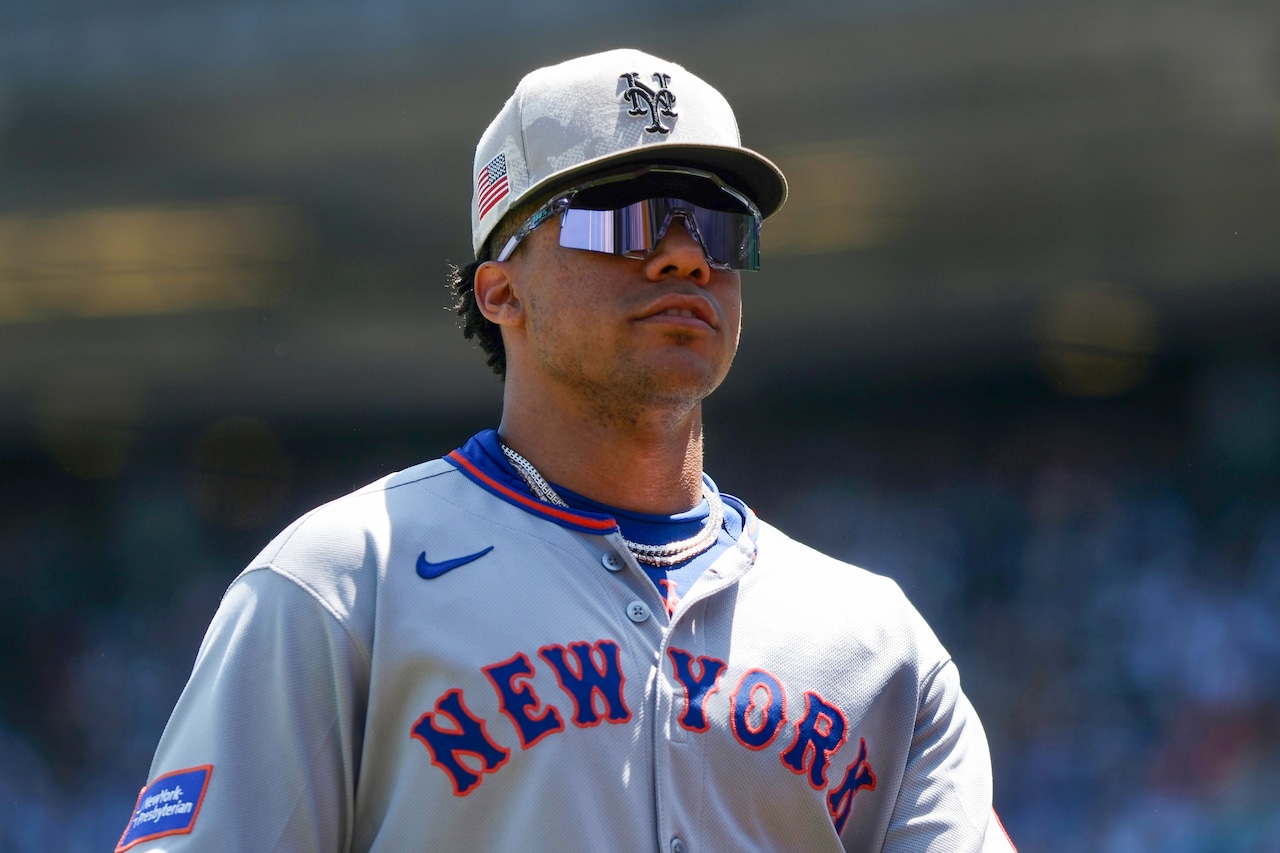
BOSTON — Unsurprisingly, Juan Soto was a marked man at Yankee Stadium over the weekend.
Every time he stepped onto the field or into the batter’s box, he was roundly booed. The Bleacher Creatures, assembled in right field, literally turned their backs on him as he took his position Friday night.
The Yankees had given up a handful of players to San Diego for Soto the previous year and after helping lead them to the AL pennant, he switched boroughs, with the $765 million offer from the crosstown Mets proving too good to turn down.
Still, the weekend was a three-day-long How dare he? fest.
The Red Sox, too, were suitors for Soto last December, even if the pursuit of the free agent outfielder was portrayed elsewhere as an exclusively New York contest.
Even the crowd — which featured a fair number of Mets fans — couldn’t get too exorcised about Soto’s presence. When Soto was announced — both during pregame introductions and in his first plate appearance in the top of the first — his appearance barely called a ripple.
(In a humorous turn of events, Soto thought he had homered leading off the sixth, only to realize that his opposite-field flyball would only land two-thirds of the way up The Wall, forcing him to settle for a long single. He then stole second base, as if to make up for his presumptuousness.)
The few Red Sox fans who bothered to boo probably did so out of some sense of obligation; others might have been reacting to the fact that he was recently a Yankee.
Mostly, most Red Sox fans never considered Soto a realistic target. They either considered the chase to windup as a battle between the Steinbrenner family and Steve Cohen. Belief in the Red Sox had sunk so low that many considered the Sox’ offer of $700 million or so to be mere window-dressing, an empty gesture.
The Red Sox, so went the thinking, only submitted a healthy bid because Soto was always going to chose between the two New York behemoths, and their involvement was never genuine.
(It was only with the winning bid for Alex Bregman, two months later and the subsequent extension to Garrett Crochet that the fan base began to take the Red Sox’ efforts to spend again seriously).
As it is, the Red Sox’ forays into free agency, sans Soto, have worked out fine to date. Bregman has inarguably been the team’s best player; Aroldis Chapman, despite a few rocky outings, has been solid in the closing role; and Walker Buehler was trending in the right direction when he experienced shoulder soreness earlier this month.
Meanwhile, Soto has begun slowly for the Mets. He’s belted eight homers, but his slugging percentage if down sharply from the past two seasons and he was hitting just .246. Imagine the reception he’d been getting in Boston with those same numbers.
The Sox’ offer was for 15 years, so it’s nonsensical to evaluate him on his first two months. Like the Mets and Yankees, the Red Sox were committing for the long-term.
Still, it’s unclear how much of an early boost Soto would have provided the Red Sox this season. His signing might have led to the team dealing away Wilyer Abreu, who is a vastly superior defender in right field, and thus far at least, more productive at the plate, too.
Soto’s mere presence would have enhanced the entire lineup; he’s good enough to have that effect on others. And his meticulous plate discipline would likely have impacted others.
But would he have made the Red Sox better on May 19? Doubtful.
If the Red Sox had to lose out on Soto, it’s best that he went to the National League, where he can only torment them for one three-game series a season. His otherwise unremarkable start has been camouflaged by the Mets’ 29-18 record, tied for the best record in the NL.
Meanwhile, the Red Sox have more pressing issues: a rotation that has been inconsistent other than Crochet; a shaky infield defense; a worrisome bullpen; and, for now, no one established enough to handle first base in the wake of Trison Casas’s season-ending injury.
Soto would have solved none of those current challenges, though again, one can’t presume much about the first year of a presumed long-term engagement.
Over time, the guess here is that Soto becomes more of forgotten figure in Red Sox history, and instead, the pursuit of him, though ultimately unsuccessful, signaled the beginning of a re-engagement on the part of club ownership.