
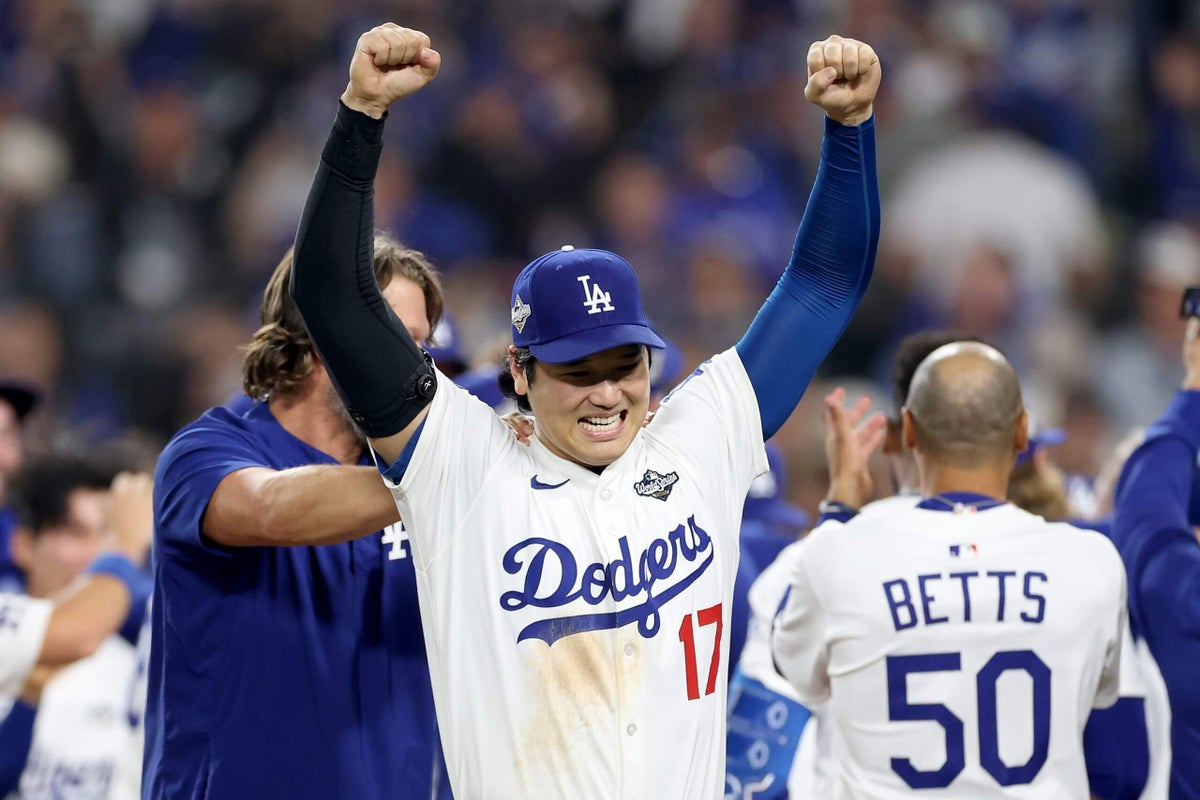
This was a World Series for the ages, and it was a postseason for the stars.
Shohei Ohtani and Vladimir Guerrero Jr. hit the most home runs. Aaron Judge had the second-highest OPS. Blake Snell, Tarik Skubal and the wunderkind Trey Yesavage had the most strikeouts. Clayton Kershaw used his last major-league pitch to escape a 12th-inning, bases-loaded jam. Not only did the stars come out — they shined bright.
Accordingly, our All-Playoff Team includes three leading candidates for league MVP, a pitcher who’s almost certainly going to win his second consecutive Cy Young award, another pitcher who already has two Cy Youngs, a first baseman who’s been to five straight All-Star Games and three acclaimed rookies who have been dominant on the mound.
Our team also includes four multi-positional players who aren’t necessarily household names but played significant roles in getting their teams to the World Series.
These were the best of the best this October.
Position playersC Cal Raleigh, Mariners (14-for-46, 2 2B, 5 HR, 1.081 OPS)
Raleigh hit a home run every 2.65 games in the regular season, a historic pace for a catcher, but his pace was even better in the playoffs (a home run every 2.4 games). His batting average, on-base percentage and OPS were also higher than in the regular season. Raleigh might be the AL MVP, and he had even more in the tank for the playoffs. Blue Jays catcher Alejandro Kirk was also excellent this postseason, Phillies catcher J.T. Realmuto had four extra-base hits in four games and Padres catcher Freddy Fermin had a .909 OPS in his lone series.
A Cal Raleigh dinger ties up the ALCS 🔥
🎥 @MLBpic.twitter.com/IfUcxBMGbk
— The Athletic MLB (@TheAthleticMLB) October 13, 2025
1B Vladimir Guerrero Jr., Blue Jays (29-for-73, 18 R, 8 HR, 15 RBIs, 14 BB, 1.289 OPS)
The postseason leader in RBI might have been the most consistently productive player in the entire playoffs. Guerrero had twice as many walks as strikeouts and delivered multiple home runs in each round. He had nine multi-hit games and went hitless only twice. In addition to RBIs, Guerrero led the postseason in OPS and runs and finished second in hits and walks. Mariners first baseman Josh Naylor and Cubs first baseman Michael Busch were also excellent, and Dodgers first baseman Freddie Freeman had his usual moments of unmistakable impact, but Guerrero might have been the overall postseason MVP.
2B Nico Hoerner, Cubs (13-for-31, .419 BA, .972 OPS)
Hoerner did commit a rare error in Game 1 of the NLCS, but he also homered in that game and got seven hits in his next three games. He played eight games total and had a hit in all of them. The only players with more postseason hits were Raleigh, Naylor and some guys who went to the World Series, playing twice as many games as Hoerner.
Mariners second baseman Jorge Polanco gets an honorable mention for delivering in some big moments, and Red Sox utility man Nick Sogard gets a shoutout for being a surprise starter in two games and getting two hits in the lone Red Sox win. Bo Bichette returned from injury to play some second base — an unfamiliar position — just when the Blue Jays needed him in the World Series. He finished with a .922 OPS. And, of course, Miguel Rojas came up huge for the Dodgers in Game 7.
3B Ernie Clement, Blue Jays (30-for-73, 13 R, 6 2B, .978 OPS)
Clement was a menace, leading the postseason in hits and doubles while striking out only twice. He had one homer and one walk, but his real impact came from his relentless consistency. He went hitless only twice in 18 games and had multiple hits 10 times, including three hits in World Series Game 7. His versatility was also important as the Blue Jays were able to use him at second base early in the postseason.
Dodgers third baseman Max Muncy was on base a lot (11 walks) but didn’t hit a ton until going 3-for-4 with a home run in Game 7. Guardians third baseman José Ramírez had a .500 on-base percentage but played only three games. Mariners third baseman Eugenio Suárez’s game-winning grand slam was one of the highlights of the ALCS, and Brewers third baseman Caleb Durbin was pretty much his team’s only reliable bat in the NLCS.
SS Andrés Giménez, Blue Jays (14-for-65, 10 R, 12 RBI, SB)
This wasn’t a great postseason for shortstops. Elly De La Cruz was hitless in two games for the Reds. Dansby Swanson played strong defense for the Cubs but hit just .154. Trevor Story was productive but played just three games for the Red Sox. Trea Turner didn’t have an extra-base hit for the Phillies. Mookie Betts was in such a slump the Dodgers moved him out of the No. 2 hole in the lineup.
Giménez, though, made every hit count for the Blue Jays. Tigers’ shortstop Javier Báez had a much higher OPS (.802), but Giménez was the only shortstop to score more than three runs, and only Betts had even half of his RBIs. Giménez got all but two of his hits in Blue Jays wins, and they won only once when he didn’t get on base at all.
LF Kiké Hernández, Dodgers (16-for-64, 4 2B, 9 R, 7 RBI)
Only one everyday left fielder had an OPS higher than .700 in the postseason, and that was Max Kepler, who played just four games for the Phillies. The Blue Jays got production out of their platoon of Nathan Lukes and Davis Schneider, and Randy Arozarena scored 10 runs and stole five bases for the Mariners (while hitting just .188).
But we’ll give this All-Playoff spot to Hernández, who started just four games in left field during the regular season but became the Dodgers’ left field regular in the playoffs. He seems always to have a productive October, and he did it again with nine runs, seven RBIs and his second career World Series homer. He also made the catch and throw that ended World Series Game 6 (all of which helped make up for his 24 postseason strikeouts).
CF Julio Rodriguez, Mariners (10-for-48, 4 HR, 9 RBI, 7 BB, .809 OPS)
Rodriguez had an OPS almost 100 points higher than Blue Jays center fielder Daulton Varsho, but honestly, it’s a toss-up between those two. Rodriguez had a huge ALCS Game 7 to do what he could to get the Mariners into the World Series, but Varsho had a two-homer game in the division series, drove in an early run in Game 7 of the ALCS and homered off Blake Snell in Game 1 of the World Series. If Varsho is your All-Playoff center fielder, that’s fine by us. Jackson Merrill was also very good for the Padres, but played in only three games.
RF Aaron Judge, Yankees (13-for-26, 2 2B, HR, 1.273 OPS)
Judge came into this postseason with a career .768 OPS in the playoffs and a .648 OPS in playoff games since 2020. He’d had his moments, but the consistency wasn’t there. This postseason, Judge was steady, delivering multiple hits in six of seven games and leading the Yankees in hits, runs, walks and RBIs. Only Guerrero had a higher OPS among qualified postseason hitters. Dodgers right fielder Teoscar Hernández also had a productive postseason — he hit five homers and was among the playoff leaders in RBIs — while Jackson Chourio (Brewers), Kerry Carpenter (Tigers) and Seiya Suzuki (Cubs) also had their moments.
DH Shohei Ohtani, Dodgers (18-for-68, 8 HR, 14 RBIs, 16 BB, 1.096 OPS)
At times, Ohtani seemed truly unstoppable. His Game 4 of the NLCS — hitting three home runs while pitching six scoreless innings — was one of the great playoff performances of all time, and as an encore he homered twice and reached base nine times in Game 3 of the World Series. He had 28 strikeouts as a pitcher, but he was better as a hitter, and his biggest moments were at the plate.
Blue Jays DH George Springer was also one of the great playoff DHs, and he played through an injury to deliver five hits in the final two games of the World Series. Kyle Schwarber (Phillies), Masataka Yoshida (Red Sox) and Gavin Lux (Reds) also performed well but lasted just one round.
UT Addison Barger, Blue Jays (22-for-60, 4 2B, 3 HR, 1.024 OPS)
His Game 6 base-running blunder not withstanding, Barger was one of the most productive hitters in this postseason, including six multi-hit games in the World Series. Beyond that, his ability to play third base gave the Blue Jays options while Bichette was hurt in the early rounds, and he played an excellent right field after Anthony Santander went down with an injury in the ALCS (including a diving catch in World Series Game 5 and throwing a runner out at the plate in Game 3). Reds rookie Sal Stewart also played a few different roles — he came off the bench, started at first base, and played third base — and delivered four RBIs in four at-bats.
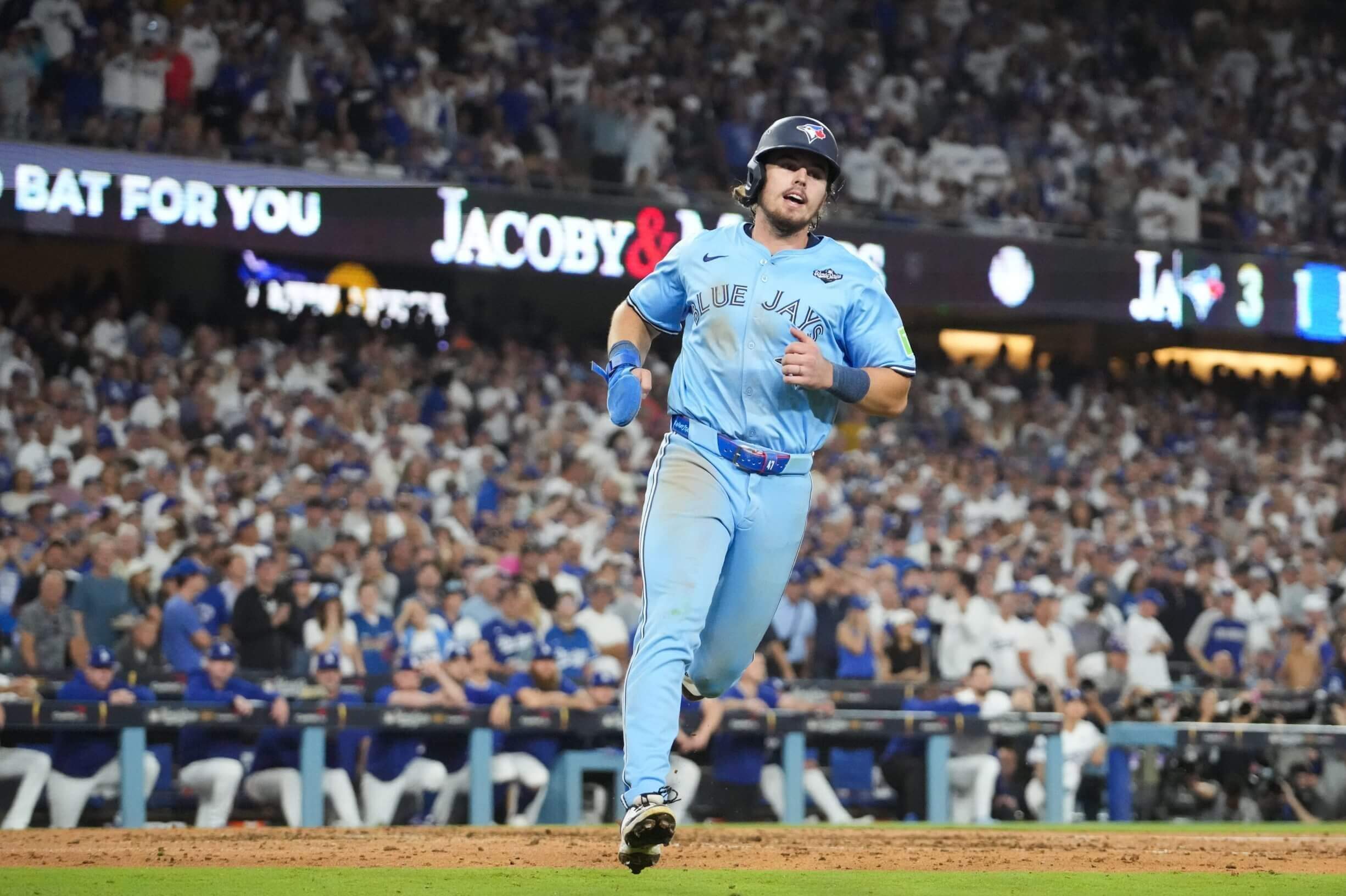
Addison Barger’s play stood out for the Blue Jays all postseason. (Kirby Lee / Imagn Images)
PitchersSP Yoshinobu Yamamoto, Dodgers (6 G 5 GS, 37 1/3 IP, 33 K, 1.45 ERA, 0.78 WHIP)
Especially in the early rounds, this was a postseason full of elite starting pitching. All told, there were 23 pitchers who made at least two starts, and 14 of those had an ERA of 3.60 or better (it was 16 before Saturday’s Game 7). So, there were a lot of starters to choose from, but even so, it wasn’t hard to pick the guy who pitched back-to-back complete games, including one in the World Series, and then pitched out of the bullpen on zero days rest to help clinch the championship. Yamamoto led the postseason in innings and did it while allowing less than one baserunner per inning. He walked only five batters, and didn’t walk anyone in the World Series until his next-to-last batter in his final start.
SP Trey Yesavage, Blue Jays (6 G, 5 GS, 27 1/3 IP, 39 K, 3.58 ERA, 1.05 WHIP)
The ERA isn’t as good as some of the other candidates, but there’s just no way to leave Yesavage off an All-Postseason roster after what he did in his first and last starts. His high points were among the best in the playoffs, and his 12-strikeout masterpiece in Game 5 was one of the great all-time World Series performances by any pitcher, especially a rookie, and he pitched out of the bullpen in Game 7. Yesavage gets a spot on our team ahead of Yankees rookie Cam Schlittler, who had a 1.26 ERA in two starts including an outrageous winner-take-all performance in the wild-card round.
SP Tarik Skubal, Tigers, 3 G, 20 2/3 IP, 1.74 ERA, 0.68 WHIP)
Skubal was eliminated in the division series and still finished with the fifth-most innings and third-most strikeouts in the playoffs. He struck out 14 in his first start, then struck out 13 in his last start. He allowed a total of four runs, yet the Tigers still managed to lose two of his three starts. There is a compelling case that Skubal is the best pitcher in baseball, and he showed it in October.
SP Blake Snell, Dodgers (6 G, 5 GS, 34 IP, 41 K, 3.18 ERA, 1.00 WHIP)
Even after his stumbles in the World Series, Snell was still among the postseason leaders in Win Probability Added. That’s how good he was in the first three rounds (21 innings, two earned runs, 28 strikeouts). He also pitched well out of the pen in World Series Game 7. Snell gets our final rotation spot ahead of Red Sox ace Garrett Crochet (7 2/3 innings, 11 strikeouts in his only start), Phillies lefty Cristopher Sánchez (12 innings, 2.25 ERA in two starts), Blue Jays veteran Kevin Gausman (2.93 ERA in six games, five starts) and Mariners ALCS Game 1 starter Bryce Miller (2.51 ERA in 14 1/3 innings).
SP/RP Tyler Glasnow, Dodgers (6 G, 3 GS, 21 1/3 IP, 25 K, 1.69 ERA, 1.22 WHIP)
Just consider some of the big names who pitched as both a starter and reliever this postseason: Gausman, Logan Gilbert and Luis Castillo of the Mariners, Jack Flaherty of the Tigers, Jesús Luzardo of the Phillies, Shota Imanaga of the Cubs, and half of our All-Playoff rotation. The versatility to do both has become a necessary skill set in October, and the Dodgers leaned on Glasnow in big spots, using him as a starter in half of his appearances and as a reliever in the other half. He started the division series clincher (after pitching out of the bullpen in Game 1), and he successfully escaped a two-on, none-out jam in the ninth inning of World Series Game 6.
LRP Jake Misiorowski, Brewers (3 G, 12 IP, 16 K, 1.50 ERA, 0.83 WHIP)
Pitching strictly out of the bullpen, Misiorowski threw as many innings as some guys who made multiple starts. The bulk relief role has become a go-to strategy in the postseason, and the Brewers rookie did it about as well as it can be done. He got the win in his first two appearances, and even when he took the loss in Game 3 of the NLCS, Misiorowski went five innings with one earned run, one walk and nine strikeouts. Honorable mention to Misiorowski’s teammate Chad Patrick, who struck out 11 in a similar role, Ranger Suárez, who got the only Phillies win, Blue Jays veteran Chris Bassitt, who allowed one run in 8 2/3 innings and Dodgers reliever Will Klein for his remarkable four-inning effort in Game 3 of the World Series.
RP Will Vest, Tigers (5 G, 8 IP, 9 K, SV, 0.00 ERA, 0.25 WHIP)
Vest is basically the Tigers’ closer, but he pitched in only one save opportunity while getting more than three outs four times. He pitched in all four of the Tigers’ postseason wins and he struck out four in two scoreless innings of the Game 5 division series marathon that ultimately ended the Tigers’ season. Vest was even better than last October (and he was awfully good last year, too). He makes our All-Postseason bullpen ahead of Blue Jays workhorse Louis Varland, Cubs stopper Daniel Palencia, Cubs opener Drew Pomeranz, Brewers lefty Jared Koenig and Yankees closer David Bednar.
RP Roki Sasaki, Dodgers (9 G, 10 2/3 IP, 3 SV, 6 K, 0.84 ERA, 1.03 WHIP)
We’ll save the closer role for someone else, but Sasaki’s emergence as a bullpen force helped get the Dodgers to the World Series, where he was an important part of their 18-inning, Game 3 win and got three big outs in the eighth inning of Game 6 (before nearly imploding in the ninth). Sasaki’s finest hour was Game 4 of the division series when he pitched three hitless innings to help eliminate the Phillies. Every time Sasaki pitched, the Dodgers won.
RP Andrés Muñoz, Mariners (7 G, 8 1/3 IP, 2 SV, 5 K, 0.00 ERA, 0.48 WHIP)
The idea is to not load an all-playoff team with closers, but closers really did most of the heavy lifting this postseason. Muñoz got only two save opportunities, but he didn’t allow a hit in his first six appearances (across 7 1/3 innings), then he got himself in and out of trouble in Game 7 of the ALCS (at least giving the Mariners a fighting chance before they were eliminated a half inning later). The Mariners won six games this postseason and used Muñoz in all but one of them.
RP Jeff Hoffman, Blue Jays (10 G, 12 1/3 IP, 2 SV, 18 K, 1.46 ERA, 0.81 WHIP)
Hoffman had been lights out in the playoffs. He struck out the side to finish off the ALCS and pitched two scoreless innings in Game 3 of the World Series. Even in Game 7, Hoffman got the final out in the eighth inning as the Blue Jays felt secure calling on him for a four-out save that would win them a championship. But he gave up the game-tying home run in the ninth. Even with that crushing blow, the totality of Hoffman’s postseason was excellent. There’s just one pitch he’d desperately like to take back.