
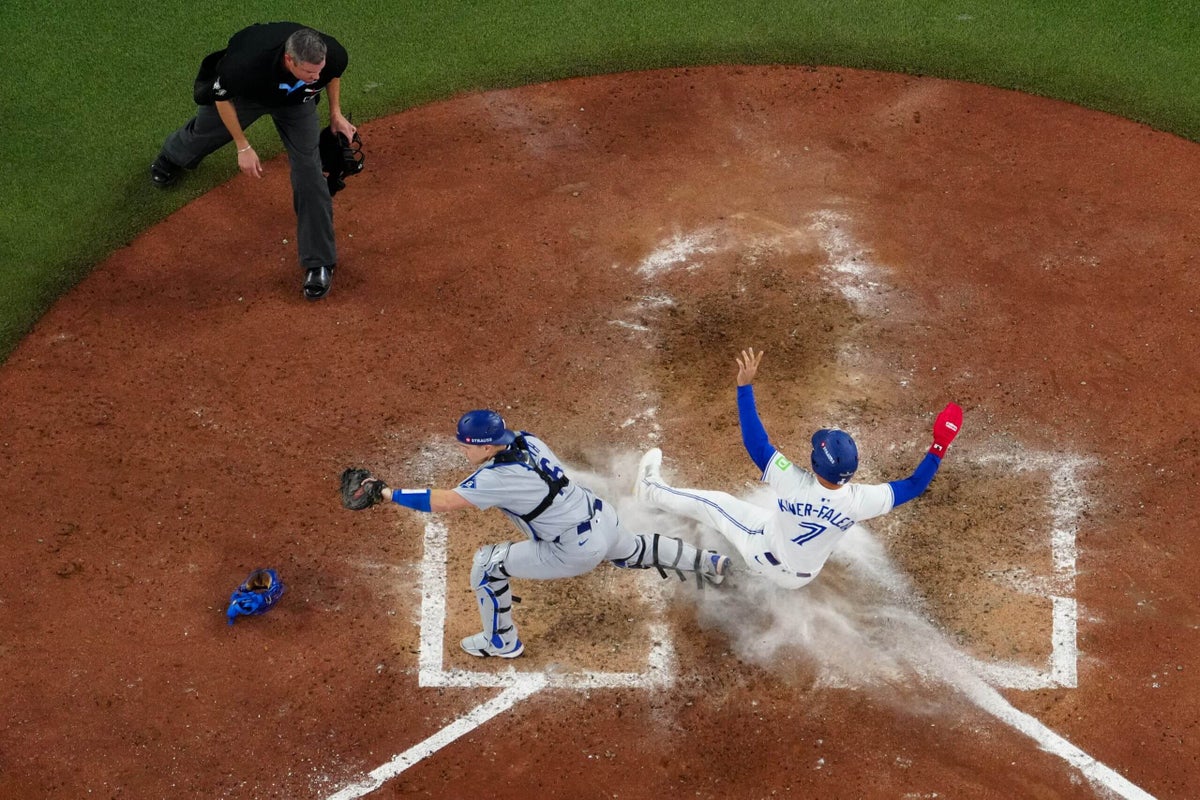
TORONTO — The Blue Jays had chances. For two games, they held opportunities to win their first championship since 1993. In Game 7 alone, Toronto held a lead for six innings. They left 10 runners on base and finished 3 for 14 with runners in scoring position. The Jays came to bat with three opportunities to walk off in one of the most dramatic World Series ever played.
No play was closer than Isiah Kiner-Falefa’s dash to the plate in the bottom of the ninth inning on Saturday night, two innings before the Los Angeles Dodgers sealed a 5-4 win on Will Smith’s 11th-inning homer.
Perhaps it would have played out differently if Kiner-Falefa had gotten a larger lead off third with one out, the bases loaded, and the Dodgers playing in. Here’s the video:
As the replay of Kiner-Falefa’s slide showed over the stadium’s giant video screen, fans cheered. They thought he was safe, driven in by Daulton Varsho’s grounder to second. They thought, upon review, the Jays were about to celebrate a title. An overturned call at home plate would have felt like a wild and fitting end to a tension-packed World Series.
Instead, the out call on the field was confirmed. The game — and the season — continued for a little while longer.
Kiner-Falefa needed just a few more inches to slide safely home. He might have been closer to that walk-off slide if he had taken a larger lead off third base. According to Statcast, his primary lead off the base, 7.8 feet, ranked 357 of 381 primary leads in the World Series. It was 3.8 feet shorter than Mookie Betts’ lead off third base in the following inning, when the Dodgers faced a similar bases-loaded opportunity.
Betts took an 11.6-foot lead off third on that play, although he also was forced out at home.
After receiving hateful messages following the game, Kiner-Falefa told reporters that his short lead was due to being instructed by coaches to stay close to the base in that situation. Other Blue Jays leads at third base throughout the World Series are consistent with that explanation. In the sixth inning of Game 1, Varsho’s primary lead at third base was 8.5 feet. Ernie Clement’s lead off third, in that same Game 1 inning, was just 5.7 feet.
The Jays, seemingly, tried to combat back-picks and line-drive double plays with those short leads, hoping to score on any ball that found a way out of the infield rather than beating grounders to the plate. For a team that led baseball in hits with runners in scoring position, it’s a trade-off that worked all year.
“They told us to stay close to the base,” Kiner-Falefa told Sportsnet. “They don’t want us to get doubled off in that situation with a hard line drive.”
Baseball hasn’t changed. Even with bigger bases and limits on throwing over, it remains a game of inches. That inch, between Kiner-Falefa’s foot and the plate, will live in the minds of Blue Jays fans.
Yet, so will so many other chances in the final innings of the 2025 World Series, from Addison Barger getting doubled off at second to end Game 6 to the back-breaking homers allowed in the eighth, ninth and 11th innings of Game 7. Miguel Rojas, who tied the game with one out in the ninth, had hit just one prior home run off a right-handed pitcher in 2025 before he launched a solo shot to left field to save the Dodgers’ season against closer Jeff Hoffman.
“I cost everybody in here a World Series ring,” Hoffman said after the game. “So it feels pretty s—-y.”
That’s the thing about losing the World Series in extra innings in Game 7 — every missed play or squandered chance will be dissected for decades. If the Jays capitalized on just one more moment, their magical season would’ve ended in a parade. They would be champions right now. Instead, the missed opportunities linger.
Said Kiner-Falefa: “It sucks that we didn’t get the job done.”
— With The Athletic’s Chris Kirschner