
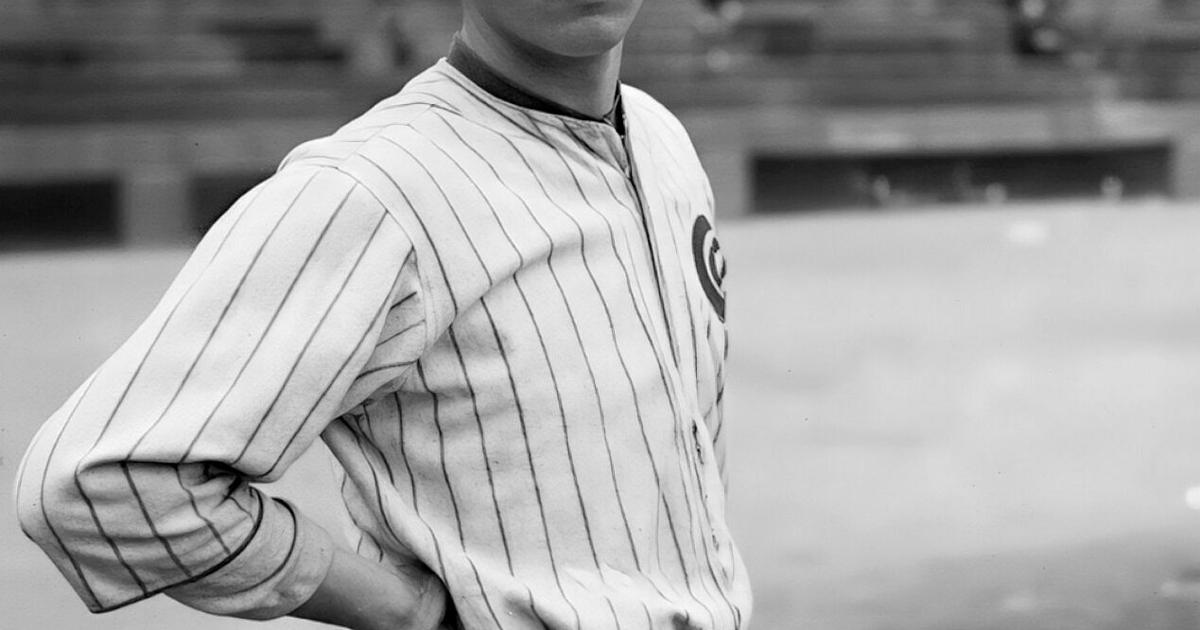
Perhaps the most dishonorable episode in Major League Baseball was the Black Sox scandal of 1919. It is the subject of hundreds of newspaper and magazine articles, books, television programs and movies. Eight Chicago White Sox ballplayers became infamous for conspiring to take money to throw the 1919 World Series against the Cincinnati Reds. They were banned for life by Commissioner Kenesaw M. Landis. Claude “Lefty” Williams, born in Aurora, Missouri, one of two pitchers in the group, derailed his promising pitching career. Without baseball, Williams had two decades of dead-end jobs, marital and alcohol problems before he reconciled with his wife and settled down to operate a garden nursery.
Claude “Lefty” Preston Williams was born March 9, 1893, to William and Mary Williams. His father was a farmer. After his father died in 1901, his mother married Robert Grimes, employed by the Frisco Railroad in Springfield, Missouri. Claude was the second of three sons.
He quit high school his freshman year to take a job as a grocery clerk. He was athletic and baseball held his heart. At 17, he joined the Springfield town team while working as a cigar maker for H.W. Geister. A Springfield News-Leader sports writer recalled, “Williams made cigars (sometimes) and pitched baseball (a lot more) while in Springfield.”
“Being a left-handed kid, it was only natural that he be a pitcher, so he started in that position. There was something about the way he curved a low one over the plate that had all the other kids fooled,” wrote the Chicago Tribune.
Minor league pro
Williams started with Springfield’s Elks team in 1910 at age 17. He was moved to teams in Muskogee, Oklahoma, Nashville and Morristown in Tennessee over the next three years. His pitching improved with each trade.
The Detroit Tigers signed him for the 1914 season. However, he was not ready, so they sent him to Salt Lake in the Pacific Coast League in 1915.
It was there he met Lyria Wilson, a waitress in a Salt Lake hotel frequented by Pacific Coast League players. Lefty settled “down to business” after meeting her, and his record improved, ending at 33-12 and 36 complete games that year.
Chicago White Sox
At 22, he was signed by the White Sox for 1916. He made the roster after spring training. Strikeouts were his strength.
In midsummer, he and Lyria were married in a quiet ceremony in Chicago. Sports writers commented on his renewed focus honing his skills. His record was 13-7 as a rookie. He was second in American League strikeouts to Hall of Famer Walter Johnson.
The 1917 season saw Chicago take the pennant, but Williams had stretches of wildness that kept him from starting any World Series games against the New York Giants. His only appearance was to relieve Eddie Cicotte in the seventh inning in Game 5, allowing one run and striking out three during his one inning.
World War I interrupted baseball as the government issued a “work or fight” rule. Players enlisted or worked in approved industries. Williams followed Shoeless Joe Jackson, a close friend, to the Harlan & Hollingsworth shipbuilding company in Wilmington, Delaware. Much like his cigar employment, Williams and Jackson played for the company team in an industrial league. They took the Atlantic Coast shipyards championship when he pitched a 4-0 shutout in Philadelphia.
At war’s end, he returned to the White Sox with a vengeance. With 40 starts, he made 27 complete games, five shutouts and 125 strikeouts. Two of the shutouts came in September as Chicago won its second pennant in three seasons.
World Series
Betting on major league games was common, and rumors of thrown games were not taken seriously by the league, press or fans. The owners had instituted a nine-game Series that year.
In September, first baseman Chick Gandil asked Williams to join other players planning to throw the Series to the Cincinnati Reds. Williams had been nursing a grudge against owner Charles Comiskey over salary and pay during the war hiatus. Promised a $10,000 payoff, he agreed to do it.
Williams started Game 2. He pitched three scoreless innings and then lost his control in the fourth. The Reds scored four runs, winning 4-2. Reporters and some players thought his wildness odd but passed it off. Meanwhile, no money arrived from Gandil. Dickey Kerr, not in on the fix, pitched a 3-0 victory for the Sox. When nothing showed after Game 3, Williams suspected a double-cross.
Game 4 was lost due to poor defensive plays by pitcher Eddie Cicotte, one of the rogues. Gandil delivered $10,000 to Williams with instructions to give half to Jackson. Williams gave it to Jackson in a dirty envelope.
When Williams’ wife found out about the deal and the cash, she was livid: “You have done it. What can I say now? Let it go and just get the best of it.”
Williams was ready for Game 5. He went five innings giving up but one run. Then in the sixth, wildness returned. The Reds earned four runs, winning 5-0. But he said later he was beginning to have second thoughts.
The Sox looked to stave off defeat, winning Game 6 and Game 7. No more payments appeared. Williams was up for Game 8. Suspecting a double-cross, he told Jackson he was planning on pitching to win. But it was not to be. He faced five batters in the first inning with the Reds smashing four hits for four runs. Manager Kid Gleason pulled him. The Reds won 10-5 to clinch the World Series. Williams still holds the record of three World Series losses.
Banned after trial
Though Comiskey learned of the fix, he did nothing. He brought back seven of the eight for the 1920 season, each with raises. Williams got $6,000. He played well, and the Sox were in pennant contention again.
Then in September, a Chicago grand jury was impaneled to investigate baseball gambling. Prosecutors went after White Sox players, urging them to confess. Cicotte confessed first, then Jackson. Next, Williams gave a sworn statement admitting the fix. Comiskey suspended them all. Chicago lost the pennant.
The players and several gamblers were indicted for conspiring to obtain money by false pretenses. Grand jury testimony given to reporters appeared in newspapers across the country. The trial took place in the summer of 1921. Players and gamblers had top-notch defenders. The jury appeared to be star-struck. After deliberating three hours, the verdict came back — not guilty for all the players. The players were celebrated in the courtroom, photographed on the courthouse steps with the jury and feted with them at an Italian restaurant that evening.
The other shoe fell when Landis announced all eight were permanently banned from Major League Baseball.
Life after baseball
Williams had no skills to fall back on. He took a variety of dead-end jobs and started drinking. He and Lyria Williams separated. Next, he played semipro ball in New Mexico for a couple of years. He returned to Chicago to reconcile with his wife in the 1930s.
In 1937, they moved to California, where he drove a truck. They eventually settled in Laguna, where he operated a garden nursery.
Williams suffered from Hodgkin lymphoma in the late 1950s. In 1959, the White Sox won the American League pennant, the team’s first since the scandal, but lost the series to the Dodgers. He died a month later on Nov. 4, 1959, at age 66.
Santa Ana Register reporter Eddie West described Williams’ career as an American tragedy. “The old-timers say he had everything, including pin-point control. If he sold himself and his career for a price, you’ll have to admit he hurt himself more than anyone. … Under normal circumstances this would have been a happy year for Williams. He would have been sounded out for stories of the old days, interviewed, maybe given a chance to throw out a first ball at the World Series. Instead he was tired and aging and ill and sick at heart. … I should say that if ever men paid for their sins, these did. Even after 40 years they were exposed to the white glare of disapproval, and in most cases, exile.”