
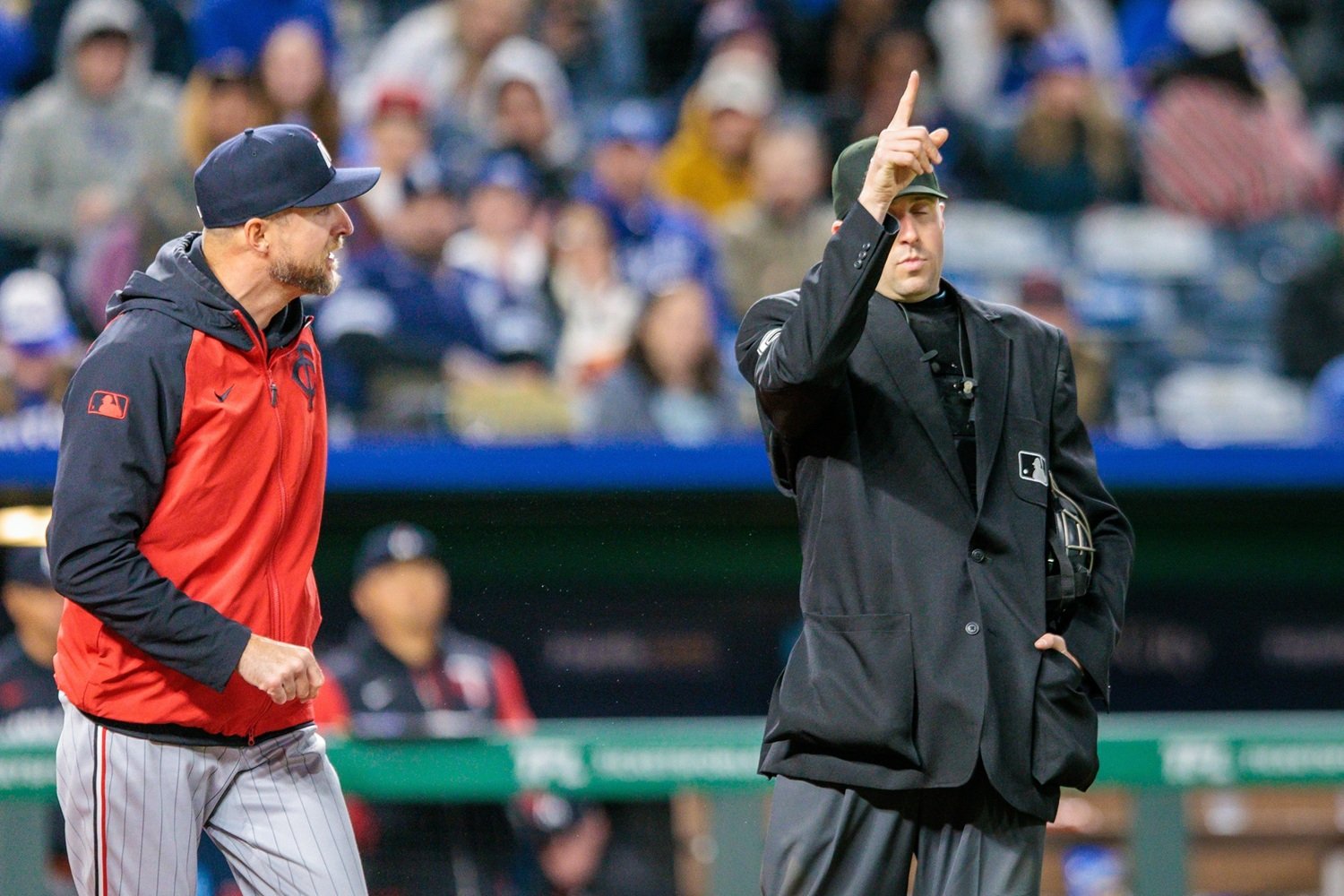
In baseball as in business, when an executive is feeling pressure to perform after a stretch of mediocrity, they will often take an action just so they can say they did something, anything, to try to move the needle. In many cases, these actions reek of desperation. Generally, even at the time these sorts of moves are made, they either look to be too little too late, or like the wrong move entirely. Sometimes there’s a blame game, a deflection of responsibility that can buy an executive a bit more time to right the ship.
Derek Falvey firing Rocco Baldelli is one such action, and this becomes increasingly clear with his hiring of Derek Shelton. I’ll give you three points in this argument, and further, I believe Shelton was similarly a fall guy for Ben Cherington in Pittsburgh.
The first clue that both were fall guys: Shelton got another manager position almost immediately. If he were the problem in Pittsburgh, surely the Twins would have sussed that out in the interview process. Similarly, Baldelli was publicly linked to the manager vacancies in Washington DC and Anaheim prior to both teams going with other candidates. Further, per Dan Hayes, from The Athletic, “As many as 10 teams called Baldelli in the aftermath of his Sept. 29 dismissal from the Twins to express interest in hiring the 2019 American League Manager of the Year for a variety of different roles, though Baldelli didn’t specify any job titles.” If Baldelli were the problem in Minnesota, that probably wouldn’t be the case — at least not immediately. So, based on this alone, teams seem to understand clearly that he was dealt a bad hand and couldn’t do much with it..
One can look at the statements the heads of baseball made about their respective managerial firings for the second clue that Baldelli was Falvey’s sacrificial lamb, and that the manager wasn’t the root of the problem. To wit, Falvey said at the time, “We’ve collectively arrived at this being the right time for a new voice in a new direction. It’s not about Rocco. This is a collective underperformance from our group, and it starts with me.”
Well now. If it’s not about Baldelli, then why was he fired? How does removing him fix the payroll problem? Or the young hitters not hitting? How does it fix the glut of soft tissue injuries key players have suffered? If it’s time for a new voice and direction, then why did Falvey replace Rocco with someone so similar, and why did he bring in someone already familiar with the organization and its leadership? It turns out I don’t have answers to any of these questions, other than…the manager probably wasn’t the problem.
Ok. So we know what Falvey said about Baldelli. How about the Pittsburgh situation? Ben Cherington said, of Shelton’s firing: “This certainly isn’t all on Shelty. We’re all responsible. It certainly starts with me. I’m more responsible than anyone. We need to perform better. That’s the bottom line. This wasn’t about any single player, even any single day. An accumulation over the last part of last year and early part of this year. It just became clear to me that in order to move forward and get the Pirates back moving in the direction we need to move that a change was necessary to give ourselves a chance to do that.”
Sounds almost identical, and it’s pretty clear that in both cases, one can look at these firings and glean a sense of “it was him or me”. In neither case are there specific examples of what the manager got wrong, or should have done differently. In both cases, there’s a sort of word salad that could be oversimplified as follows: “our team is broken right now, and we gotta do something.”
Further, if Falvey’s goal is to drive the sort of change that will usher in winning ways, this swap, when examined closely, doesn’t pass the sniff test. There are many similarities that suggest this is just shuffling deck chairs. Both are analytically oriented. Both have received the same sorts of criticism around team fundamentals, pulling pitchers early, and having their teams not be aggressive on the basepaths. Both have similar experience managing and have held a variety of other roles to build experience.
Both also are said to have fun, warm personalities with their players. When Falvey hired Baldelli, he said of him: “He connects exceptionally well to people. His humility, his open-mindedness, but also there’s a strong sense of opinion there. He has a lot of ideas as how to help players.” Just a few days ago, Falvey said of Shelton: “We’ve seen firsthand the trust and respect he earns from players and how he helps them reach their best.” Ok, these sorts of platitudes could probably by applied to most managerial candidates in 2025, but still, the verbiage is almost identical, just separated by eight years. What Falvey is looking for is…the same dynamic he had with Baldelli.
Really, what all of this says is that in some ways, the Twins’ 14th and 15th Managers are a bit interchangeable. Shelton is unlikely to produce fundamentally different results from Baldelli when the inputs (payroll and players) are the same. This is not to say that Shelton is a bad hire — even if his win/loss record isn’t markedly better than it was with the Pirates. Shelton seems widely respected across the league, has baseball bona fides, and is really not to blame for the Pirates’ ineptitude for the past, well, forever. This is also not to say that Rocco Baldelli was an amazing manager, or even that it wasn’t time for a change in the clubhouse and in the dugout.
However, if the Twins were truly interested in a fundamentally different voice, or even believed that the manager makes a significant impact on the team’s results, Falvey likely would have looked at a different group of candidates. The fact that he didn’t, and his own words, give up the game: Baldelli was a sacrifice.