
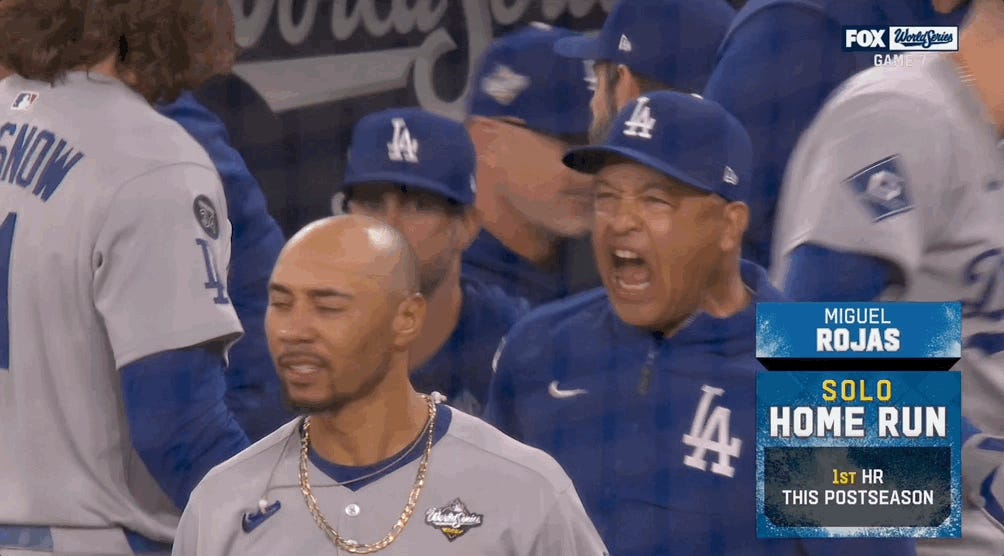
The last out, at some point, became too elusive to capture on its own. It had to be trapped, caught in a sneak attack, or else left behind entirely. The momentum of this World Series hurtled not toward a point, but toward more.
The 2025 World Series spanned 73 innings, the most ever contained in a seven-game Fall Classic. And that might be the only objective measure that even hints at the overwhelming torrent of happenings.
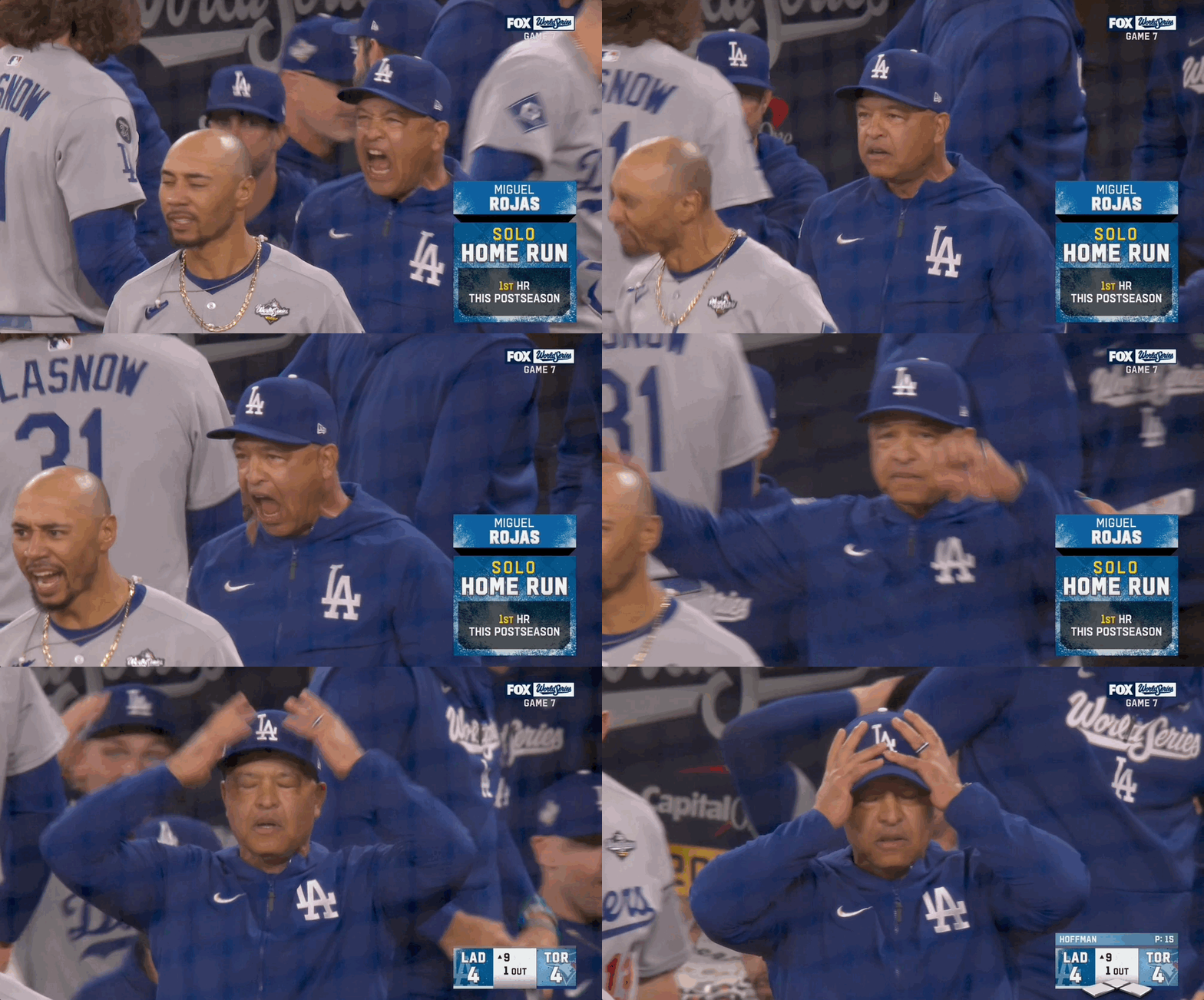
Maybe a series that produced the most baseball was destined to eventually reward the Los Angeles Dodgers’ stacked roster of tried and true talent. Really, though, the end was never clearly in sight until it arrived — with Yoshinobu Yamamoto inducing a ground ball and Mookie Betts dancing across second base to turn a double play. Vladimir Guerrero Jr. stood stranded on third, the Blue Jays 90 feet short of propelling the season even further into the unknown, the unbelievable.
It was a season that began with (overwrought) worries about a predetermined outcome and escalated with a postseason that ushered in (unserious) conversations framing the games as mere pawns in negotiations to set the rules of engagement. The plot, especially the finale, delivered both the winner that was so worrisome, and proof that hand-wringing about anything beyond the diamond was desperately misplaced.
The Dodgers’ game-ending double play now stands as the most momentous out-recording play in baseball history. It is there because so many other plays fought spectacularly against the pull toward resolution.
In a split-second force play at home, an NFL-style interception on the warning track, the float of a hanging slider, the unlikely might of a utility man’s swing, the series that will go down as the Dodgers’ dynasty-securing triumph was, on several occasions, fractions of a unit of measurement from becoming Toronto’s moment on top of the world. And that’s just from the ninth inning of Game 7 on.
We’ll remember the Shohei Ohtani of it all, the Hall of Famers, the stars who delivered as expected. We’ll remember the surprise heroism of Miguel Rojas and Will Klein and the valor of Guerrero Jr., Bo Bichette and Trey Yesavage. We’ll remember the Dodgers as great champions, the first back-to-back World Series winners of our era. And maybe most of all, we’ll remember that it was anything but inevitable.
– Zach Crizer
Here’s more of what we’re still thinking about.
⚾ Zach linked to this above, but for the second year in a row I wrote the day-after World Series wrap up story for The Guardian. I conceive of that prompt as essentially: something about how the World Series ending that is not just about how the World Series ended. The long narrative arc of the Dodgers lent itself well to this assignment.
In the (also linked above) issue from early April in which we engaged the already brewing debate about whether the Dodgers are “too good for baseball’s own good” I occupied the position of “yes.” I don’t think it’s hypocritical (although reasonable minds may differ!) that when it was all said and done, I came to the conclusion: “If this is what a broken sport feels like, don’t fix it.”
I just think the World Series was that good. To some extent, it changed my mind. But also, I think two things can be true — the payroll disparity in baseball is becoming a competitive balance problem, one that is exemplified and exacerbated by the Dodgers being so good both at spending money and everything else that goes into modern team construction; and also that if such a high concentration of the best players in the sport are going to be one single team, I want that team playing till the end.
In some ways, the Dodgers actually winning was the least interesting part of the 2025 World Series, because it meant the series was over. The Dodgers winning might be a problem if you only focus on the destination. But the whole point of sports is the journey.
Or, as I wrote in The Guardian piece:
The sense of awe would be the same if the Blue Jays had prevailed instead – they supplied half the drama and half the highlights. Ultimately, the series crowned a credible champ not just because the Dodgers were favored for months, but because, in the end, they had to scratch and claw their way to the top. Just because their victory was projected doesn’t mean it was easy or predictable. The many jaw-dropping moments when the entire series seemed to hinge on a single swing or a swipe of the glove or mere centimeters (both because it was so close and because it was in Canada): Don’t tell me you saw those coming.
–HK
⚾ Because of how Game 7 played out — so exhilarating! Suboptimal for getting a jumpstart on writing! — I was 600+ words into my “Jays win” story before I ultimately had to scrap that version. If I had finished it, I would have ended up repeating a lot of what we talked about in our live stream earlier in the World Series. Namely, that, in the past half decade, the Blue Jays have shown a rare degree of optimism, believing their talented core was not fundamentally flawed despite repeatedly being bounced in the first round of the postseason, and even persisting when they fell all the way to the AL East basement.
Here’s how that piece would have started:
On the day the Toronto Blue Jays toppled the mighty Dodgers to win their first championship in 32 years, the lineup looked almost identical to the one that finished last season in last place. Eight of the starting nine were all on the team in 2024, when the Blue Jays finished 74-88. The only addition was batting ninth. It was largely the same lineup as the 2023 team, which had snuck into the Wild Card with a third-place finish in the division before getting promptly swept out of October. That was their then-third-straight postseason appearance to not include a single win.
And, unlike too many teams in sports these days, the Blue Jays hadn’t been bad on purpose.
Coming up just short of a title doesn’t invalidate the moral of the Blue Jays’ season. Rather than retrench, they ran it back. And when they couldn’t persuade an elite free agent to cross the border, they pivoted to lavishing half a billion dollars on one of their own.
Front offices are tasked with balancing two priorities that are only sometimes aligned: building a winning roster and giving the fans what they want. When they’re at odds, the former overwhelmingly wins out. But Toronto realized it’s actually easier to control the latter. You can just pay Vladimir Guerrero Jr. to never leave the city that loves him. And they were almost rewarded with winning it all. –HK
⚾ One more from the annals of what could have been: There was a moment in Game 6, back when the Jays had a chance to clinch the championship before ever being pushed to the brink. Toronto was trailing, 3-1, in the bottom of the eighth, but George Spring and Guerrero both reached to bring up Bo Bichette with one out. If Bichette could come through in that moment — essentially ending the season and possibly his career in Toronto — the story of the series would have been whether the Blue Jays would bring him back, keeping he and Guerrero together indefinitely.
Here’s Vlad as Bo stepped to the plate:
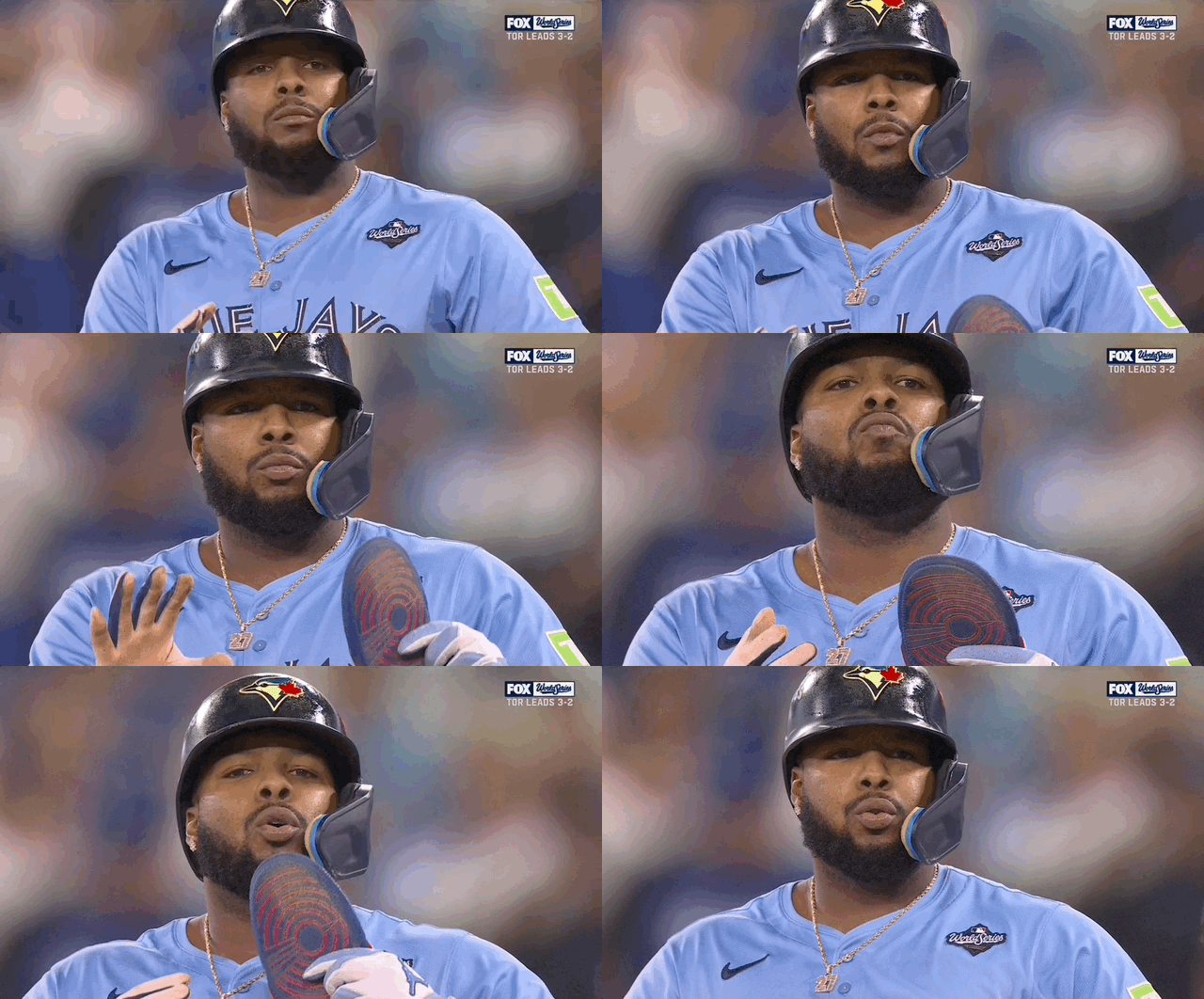
Oh man, I was so ready to opine on the intangibles — those that bond these two and those that make Guerrero worth $500 million. Instead, however, Bichette hit an easy pop up.
A little more than 24 hours later, he’d get his hero swing. But that one came too late in the series and too early in the night. Sometimes baseball isn’t about talent, it’s about sequencing. –HK
⚾ We might have lost track of this somewhere in the middle because of a certain slugging catcher, but was 2025: The Year of Yamamoto?
⚾️ To answer the question above: Yes! Unless 2026 is the Year of Yamamoto. Or unless we’re entering the Era of Yamamoto.
The most expensive pitcher in baseball fulfilled every ounce of hype with a ridiculous postseason. He threw 37 1/3 innings, the most since Madison Bumgarner threw 52 2/3 11 years ago (more on that in a moment), with a 1.45 ERA and two complete games. He got the win in Game 6 and Game 7 of a top-tier World Series.
I’m on the record with the prediction that this performance will justifiably inflate Yamamoto’s reputation. When we have waited by the window through the winter and spring has sprung, I think he will be discussed in the same breath as Tarik Skubal and Paul Skenes, as the clear-cut aces of the sport. I’d also bet on that becoming more true than it is right now, even though October lore doesn’t always translate to all-around achievement.
This was Yamamoto’s first 30-start season. He was excellent, mixing six pitches with diabolical unpredictability — a platonic ideal of a mid-2020s starter — and registering a 2.49 ERA. That worked out to a 167 ERA+ (an era- and park-adjusted number) that bests any full season Bumgarner, for instance, ever had. No, this may be something closer to 2001 Randy Johnson, but young.
At 27 years old, Yamamoto has a runway to become one of the signature pitchers of the generation. His finishing kick might just be the beginning. —ZC
⚾ On a lighter note: The Dodgers helpfully cut down on the copycat trope of every team trying to do what the most recent champion was known for, but I’ll be interested to see if Yamamoto’s unconventional training regimen returns to the spotlight in a more serious way.
If you don’t recall, the relatively diminutive Yamamoto eschews weight-lifting for yoga and javelin throwing to perfect his mechanics.
Over/under 0.5 new pitchers chucking Olympic-ish non-spherical objects as part of training next season? —ZC
⚾ Did you catch Dave Roberts shouting out the Dodgers wives mid-trophy presentation as the confetti rained down? It immediately struck me as such a second-time winner thing to say. I don’t mean that in a women be nagging kind of way, just that he was speaking from a place of truly having grappled with the collective effort required to emerge from what is really a nine-month ordeal victorious. Personally, I would have preferred to see the Blue Jays revel in their home ballpark in having accomplished something not seen since before some of them were born. But the one acknowledgement added some interesting specificity to what is often earnest but inarticulate. Also, full disclosure, I tried and failed to do a story this October about the behind-the-scenes efforts of wives, especially those with young children, in the postseason. Maybe next year. –HK
⚾ This, from Game 6, moved me to tears.

⚾️ If not for Andy Pages roaming into left-center and through Kiké Hernandez for that absurd catch in the bottom of the ninth, this whole newsletter might be about Blue Jays contact maestro Ernie Clement. The third baseman whose offense was once too bad for the Guardians to stomach broke the all-time postseason hits record, very nearly walked off Game 7, and had an imminently meme-able slide.
He also just seems like a very genuine hang. Before Game 7, he told reporters about how little he slept, and afterward he let everyone in on just how much this team meant to him.
We like honesty in baseball. Here’s hoping Clement has a lot more hits in that bat. —ZC
⚾ Loathe as I am to do free advertising, this — which aired immediately after the game ended — was pretty cool.