
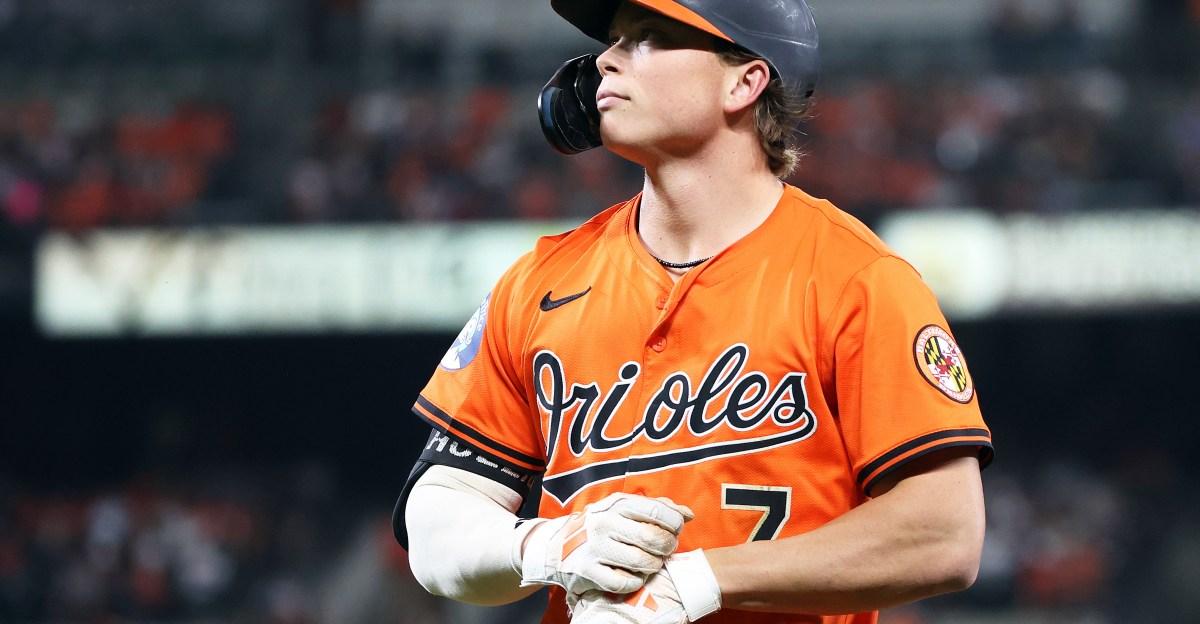
For Jackson Holliday, 2025 was supposed to be the year everything came together. The former No. 1 overall pick had captured imaginations with his stellar minor league track record and his memorable late-season debut in 2024, capped by that unforgettable grand slam onto Eutaw Street. But as anyone who’s watched baseball knows, the game has a funny way of humbling even the most talented players.
Holliday’s sophomore campaign turned into a grueling test of endurance and character. Playing in 149 games—second-most on the Orioles—the 21-year-old logged 586 at-bats and 649 plate appearances. To put that in perspective, only three players in Orioles history have gotten more plate appearances in their age-21 season or younger: Manny Machado, Eddie Murray, and Cal Ripken Jr. That’s some pretty elite company, but it also represents an enormous physical and mental burden for someone barely old enough to legally drink.
“What we’ve asked of this kid this year has been a lot, and I do feel like he’s answered in a lot of ways,” interim manager Tony Mansolino acknowledged as the season wound down. The expectations were sky-high, the spotlight was constant, and the team was struggling—a toxic combination that would challenge even veteran players, let alone a second-year player still learning his position.
So how did Holliday’s numbers actually shake out? His final line of .242/.314/.375 with 17 home runs and 55 RBIs isn’t going to win any awards, but it tells a more complex story than the raw numbers suggest. Those 17 homers were tied for the team lead, demonstrating that the power potential everyone drooled over in the minors (career MiLB .304 average and .928 OPS) is legitimate at the major league level. Add to that 21 doubles and three triples, and you can see that young master Holliday can drive the ball to all fields. His 17 stolen bases showcased his speed, although getting caught 11 times reveals he’s still, er, learning the finer nuances of baserunning at this level.
Holliday’s monthly splits help give context to these numbers. A blazing hot start in March—a .316 average with an .824 OPS—was followed by a downer of an April where he averaged .226 and OPS’d .637. The next month, he hit an impressive .287 and OPS’d .819, only to see those totals plunge to .239/.658 in June, where he struck out 32 times. He hit a season-low .184 in August, with just six extra-base hits all month, and September, where he was slowed down with a banged-up knee, wasn’t a lot better.
Look, ballplayers aren’t machines. But the inconsistency has a particular cause: Holliday was constantly tinkering with his mechanics throughout the season. He adjusted his hand positioning, modified his stance, and engaged in what he called a “cat-and-mouse game” with opposing pitchers who had extensive scouting reports on his weaknesses. “You’ve got guys with a bunch of computers on the other side, and they’re trying to get you out every single time,” Holliday explained. It’s the perpetual challenge of major league hitting—adapt or die.
To his credit, Holliday sought advice from everyone he could: Orioles hitting coaches, his father Matt (a seven-time All-Star in his own right), and even opposing players around the league. This willingness to be a student of the game bodes well for his future development, even if the results weren’t always pretty in 2025.
Defensively, the transition to second base, a position he didn’t even learn until Spring Training 2024, was a work in progress. The former shortstop’s defensive metrics (minus-0.5 dWAR) reflected that adjustment period. But there were bright spots. Holliday received some pointers on defense from legendary Orioles second baseman Brian Roberts, who faced similar growing pains early in his career. Interim manager and former infield coach Tony Mansolino praised Holliday’s ability to turn double plays, placing him among the top 10 second basemen in the majors in that specific skill. The backhanded plays remain an issue, but improvement has been visible.
Looking ahead, there’s still plenty of reason for optimism. Holliday’s raw tools remain elite. His power is legitimate. His speed is an asset. His mental makeup—the ability to handle pressure, accept coaching, and maintain perspective—seems strong. As Mansolino put it, “If there is a kid that has the makeup and the mental fortitude to handle it, it’s Jackson.”
Senior advisor John Mabry, who coached Holliday’s father in St. Louis, summed it up nicely: “People rail on him a little bit, but why? He’s 21 years old and he’s growing. He’s put up some really good numbers for a young second baseman. He’s learning a new position that he hadn’t played a whole lot of. He’s going to be a cornerstone for this franchise going forward.”
To Holliday’s credit, he knows where he fell short, and he’s already planning his offseason work. “I think I’ve learned a lot,” Holliday reflected as the season came to a close. “I’ve learned a lot of what I need to do in this offseason to improve, as far as going out there and getting better at defense and learning how to steal bases more efficiently and just getting stronger to be able to produce the whole year.”
The 2025 season wasn’t the breakout year Jackson Holliday fans had hoped for, but it was a necessary step in the youngster’s development. He took his lumps, learned his lessons, and emerged with a clearer understanding of what it takes to succeed at this level. The ceiling remains sky-high. Now it’s about putting in the work to reach it.