
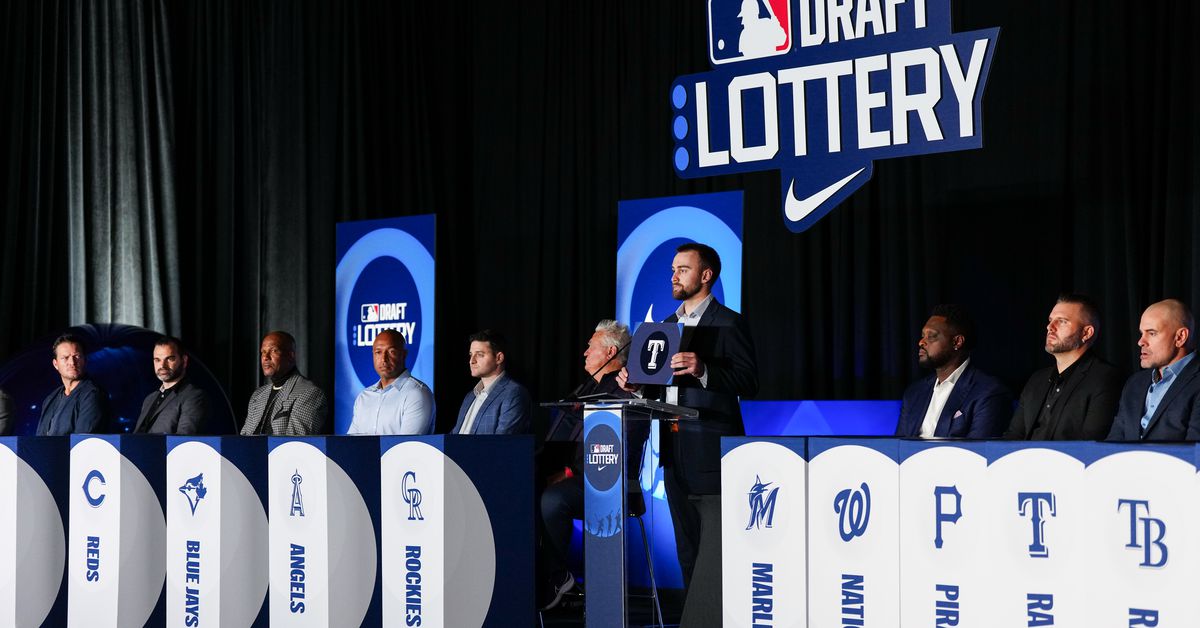
The 2025 MLB Draft will start on July 13, 2025, and the Texas Rangers will have the #12 overall pick in the draft. They will pick 9th in the second and third rounds, and will pick tenth in each round thereafter.
The draft isn’t exactly right around the corner yet, but it is less than two months away, so now is as good a time as any to start kind of thinking about the draft and the Texas Rangers. Today we’re going to look at what history tells us about the #12 overall pick, in the hopes that that can allow us to have reasonable expectations.
First of all, the Texas Rangers have had the #12 overall pick in the draft* three times. They took high school outfielder Billy Simpson in 1976, Arizona State outfielder Oddibe McDowell** in 1984, and prep pitcher Kasey Kiker in 2006.
* We are talking about the regular June draft here, not the January draft (back when they had a January draft) or the secondary phases of the January or June drafts (back when they had secondary phases). Beginning in 1987, there has just been one draft, in the summer.
** This was the sixth, and final, time that Oddibe McDowell was drafted. He was drafted in the 1981 January regular phase, the 1981 June secondary phase, the 1982 January secondary phase, the 1982 June secondary phase, the 1983 June secondary phase (when he went first overall!), and, finally, the 1984 June regular phase.
*** This is the draft where the Rangers mis-heard the player number the San Francisco Giants read out for their pick at #10 and started celebrating, because they thought it meant Tim Lincecum fell to them at #12. As it turned out, the Giants did pick Lincecum, and the Arizona Diamondbacks took Max Scherzer at #11, as everyone already knew they were planning to do. While Kiker was a bust, there were only five players taken after him in the first round who accumulated at least 5 bWAR — Jeremy Jeffress, Ian Kennedy, Daniel Bard, Adam Ottavino, and Joba Chamberlain.
McDowell is the only one of those three who made the majors, and he had an interesting, if short, major league career. His best two seasons were his first two seasons — he was called up in 1985 after just 31 minor league games and put up a 2.4 bWAR in 111 games, following that up with a 3.1 bWAR in 1986. He appeared destined for stardom at that point…alas, it was not to be. After two disappointing years in 1987-88, he was traded, along with Pete O’Brien and Jerry Browne, to Cleveland for Julio Franco. Cleveland traded him to Atlanta halfway through the 1989 season, and he had an excellent half-season for them, was bad the next year, and didn’t play in the majors again until 1994, when he appeared in 59 games for the Rangers. He played in 15 games at AAA for the Yankees in 1995 before retiring.
McDowell ended his career with 10.6 bWAR, good for 12th all time among players picked 12th overall, between Doug Glanville (1991, 10.9 bWAR) and Joe Saunders (2002, 8.4 bWAR) — both of whom, interestingly enough, are also former Rangers.
The top ten #12 overall picks in bWAR:
Nomar Garciaparra (1994, 44.3 bWAR)
Kirk Gibson (1978, 38.4 bWAR)
Jered Weaver (2004, 34.6 bWAR)
Billy Wagner (1993, 27.7 bWAR)
Delino DeShields the Elder (1987, 24.4 bWAR)
Matt Morris (1995, 20.4 bWAR)
Yasmani Grandal (2010, 20.2 bWAR)
Jay Bruce (2005, 19.7 bWAR)
Brett Myers (1999, 14.6 bWAR)
Adam Everett (1998, 12.6 bWAR)
Weaver, I will note, was considered the best player in the 2004 draft, but dropped (as did Stephen Drew) due to his bonus demands and insistence on a major league contract. He ended up being the second best player in that first round, behind Justin Verlander, and so his inclusion here should probably be accompanied by an asterisk, since he’s not necessarily indicative of the “true” level of talent one would expect to get at #12.
Since 2010, when Grandal was selected, the results have not been all that great for #12 selections. Of the players taken 2011-20, four players — D.J. Peterson, Kodi Medeiros, Jay Groome and Austin Hendrick — have not made the majors. Peterson and Medeiros are out of baseball, Groome is on the restricted list for betting on baseball, and Hendrick is a 24 year old corner outfielder repeating AA, putting up a 663 OPS, and not one of the top 30 Reds prospects (per BA).
Josh Naylor and Shane Baz appear to be the best of the six who have made the majors from that decade. Naylor, after a slow start to his career, has established himself as a more or less league average 1B/DH the past few years. Shane Baz has generally been good when healthy but hasn’t been healthy (and hasn’t been good so far in 2025, for what it is worth).
Brett Baty has been replacement-level in 199 career games as a bat-first third baseman who hasn’t hit, and who has been playing more second base of late. Gavin Cecchini appeared in 36 games in 2016-17 and is now out of baseball. Taylor Jungmann had a good year as a starter for the Brewers in 2015, otherwise did basically nothing in the majors, and has been out of baseball since the end of 2020. Jordan Groshans had 17 major league games in 2022, and now appears to be an organizational depth guy in the Royals’ system.
The #12 picks from the last four drafts are an interesting mix. The Mariners took catcher Harry Ford in 2021 as a prep catcher out of Georgia, and he was a fringe top 100 guy this offseason, a bat first catcher currently at AAA without a ton of power who may not stick behind the plate, but who could have value at another position if he has to move. Jace Jung, taken in 2022 by the Tigers, hasn’t hit in the majors yet and has questions about his long-term defensive home. Tommy Troy was the D-Backs’ 2023 pick as a shortstop out of Stanford, and after an awful 2024 season, has moved to second base and is hitting better at AA. Braden Montgomery dropped to the Red Sox at #12 last year due to a fractured ankle, but is performing well in A ball this year and is likely a top 100 guy right now.
Other #12 picks of note include Matt Dominguez, Joe Borchard, Duncanville’s own Todd Ritchie, Lastings Milledge, Jemile Weeks, Aaron Crow, and Bobby Seay, who was one of four players in the first round in 1996 who were declared free agents after not being tendered a contract in the time required (a loophole not previously exploited until Scott Boras took advantage of it that year).