
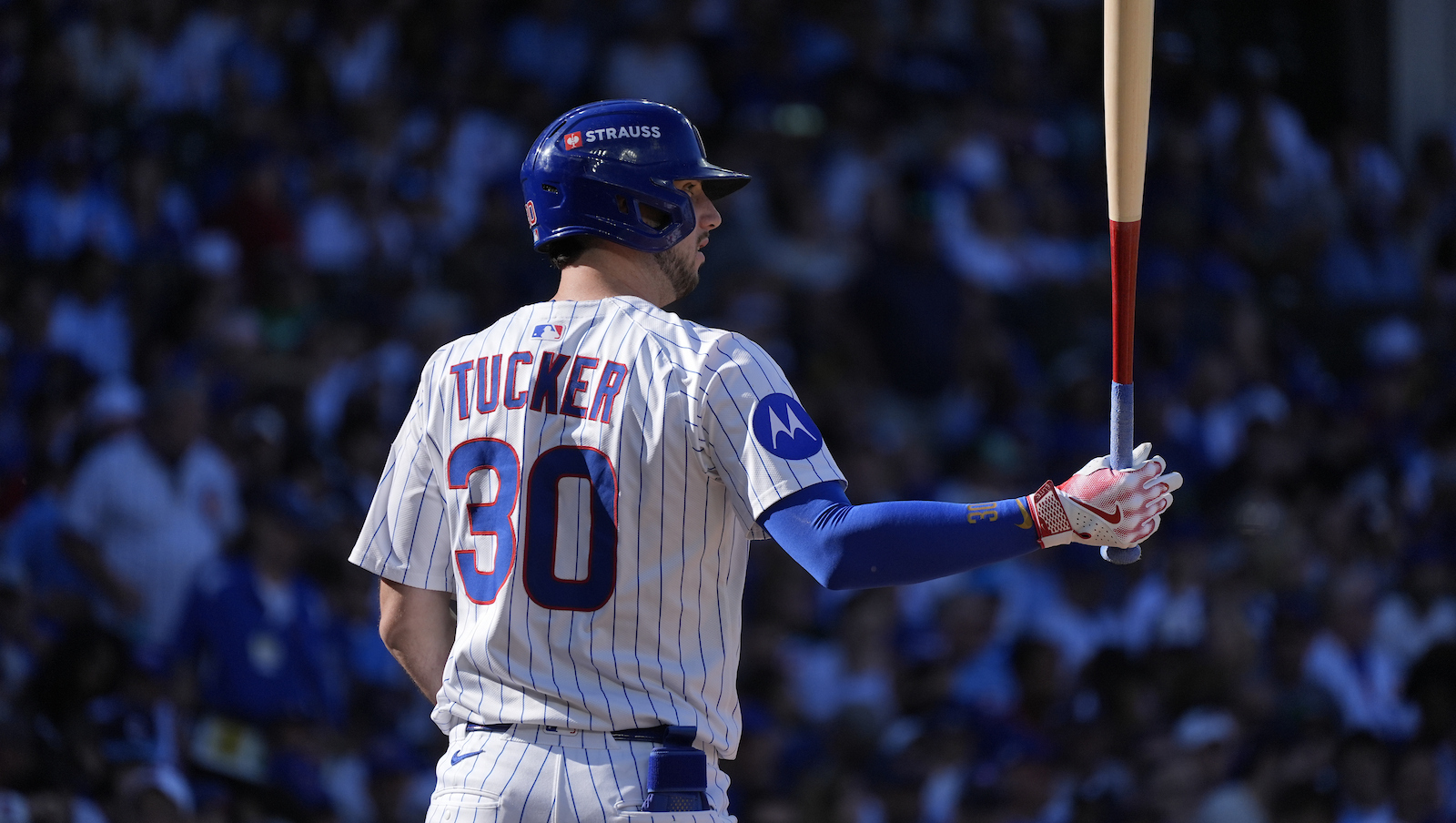
Kyle Tucker’s name will be the most prominent one to swirl in the Chicago Cubs’ rumor mill until he makes his decision in free agency.
And following Tuesday’s shocking news that Shota Imanaga is also hitting free agency and may not return to the team in 2026, it makes things perhaps a bit clearer.
Tucker, whom the Cubs acquired in a blockbuster trade with the Houston Astros last December, made an instant impact on the team’s lineup. There’s no question that he played a large role in the Cubs winning the most games they have in a single season since 2018 and clinching their first playoff berth since 2020. The Cubs inherited his salary for 2025, agreeing on a $16.5 million figure to avoid arbitration in January. His camp filed at $17.5 million while the Cubs filed at $15 million.
This will be Tucker’s first test with free agency in his career, and he’s projected to get a major payday: At least one MLB executive has said it will be in the ballpark of 10 years and $400 million.
What remains a question is whether the Cubs should fork over the money necessary to sign Tucker long-term. They’ve never handed a free agent a contract larger than $184 million — and that was the eight-year deal Jason Heyward signed in 2016.
Did Tucker’s highs outweigh his lows this year? Or is he no longer worth the hefty rumored price tag cast upon him by various MLB insiders?
Let’s break down whether Tucker will stay or go ahead of the 2026 season:
How Tucker’s 2025 season went down
Before Tucker ever dug into the box as a Cub, the team knew what they were getting out of a hitter of his caliber. In 2023, he won a Silver Slugger Award, led the American League in RBI (112) and finished fifth in AL MVP voting. He was an All-Star for a third straight year in 2024 despite missing significant time with a shin contusion. He was incredibly valuable in his shortened season: 23 home runs and a .993 OPS contributed to a 4.7 bWAR in just 78 games played.
When the 2025 season began, it took Tucker a few games to settle in. But it was no surprise when he did, and the rest of the lineup fed off of it.
Tucker slashed .276/.390/.484 (.874 OPS) through 51 games in April and May. The Cubs went 33-18 in those games and were firmly one of MLB’s most prolific offensive teams at that point in the season.
Tucker’s first injury scare came on June 1 when he exited the Cubs’ game against the Cincinnati Reds with a jammed right finger he sustained sliding headfirst into second base.
Despite the sprain, Tucker’s production didn’t drop off. June was his best month of the season, numbers-wise, slashing .311/.404/.578 (.982 OPS) in 25 games played. That led to the 28-year-old’s fourth straight All-Star Game selection and first as a starter when he was named to the NL team alongside Pete Crow-Armstrong on July 2.
But for Tucker, things went downhill when the calendar flipped to July and August. It was between July 1 and Aug. 18 that he managed just one home run and 10 RBI as part of a .189/.325/.235 (.560 OPS) slash line that reflected the worst slump of his career. The Cubs played just over .500 baseball during that stretch (20-18).
Tucker seemingly lost his ability to drive the ball amid that slump. He made a lot of weak contact. There was a point when boos would ring out at Wrigley Field when Tucker would roll over to first or second.
His year-over-year numbers showed that: In 2025, his hard hit percentage was down to 40.4% from 44.9% in 2024. His barrel percentage was down to 10.8% from 12.9%. He hit the ball on the ground more (33.9% vs. 27.1%) and hit fewer fly balls (66.1% vs. 72.9%).
On Aug. 20, it was revealed that Tucker had been playing with a hairline fracture in his hand that had been healing since the initial injury on June 1. At the time, Cubs manager Craig Counsell insinuated that playing through that small fracture may have affected Tucker’s performance. Still, Tucker was adamant about not missing any time.
“He wanted to play,” Counsell said.
Tucker couldn’t use that same strategy when he exited the Cubs’ game against the Atlanta Braves on Sept. 2. Not long after crushing a three-run home run — his first extra-base hit at Wrigley since July 19 — he left the game with left calf tightness. That led to an IL stint coupled with a return that didn’t come until the final three games of the season as the Cubs geared up for the playoffs.
That meant Tucker truly had just three meaningful games to get ready for the postseason. He went 7-for-27 (.259) with one home run and one RBI in the Cubs’ eight-game playoff run that ended in Milwaukee in Game 5 of the NLDS. He struck out and walked five times each.
That winner-take-all contest saw Tucker come up to bat in the top of the sixth with two men on and nobody out. The Cubs were down 2-1. In what may have been his penultimate at-bat as a Cub, Tucker struck out. The Brewers exited the inning unscathed, and the Cubs went on to lose the game 3-1.
Tucker finished the regular season with a slash line of .266/.377/.464 (.841 OPS) with 22 home runs and 73 RBI. His 91 runs scored paced the team along with Crow-Armstrong, as did his 87 walks with Ian Happ.
Where Tucker fits on the 2026 roster
If Tucker chooses to re-sign in Chicago, the right field position will still be reserved for him. Seiya Suzuki relinquished that post to Tucker when the latter arrived in Chicago, with Suzuki moving to a designated hitter role. The two did, however, end up splitting time in right when Tucker was hurt.
While they don’t jump off the page like Crow-Armstrong’s or Ian Happ’s, Tucker’s numbers as a defender are better than Suzuki’s overall, and it would be expected for him to take that starting spot.
Tucker’s hypothetical return would, in turn, bring question marks to the Cubs’ young hitting prospects and their potential playing time, namely Owen Caissie and Moisés Ballesteros. Both got the biggest chunks of their playing time this season out of necessity due to injuries to other players, Tucker included. But if Tucker wants to come back, the Cubs would likely take that trade-off if it meant retaining his bat for the future.
The verdict: Go
It’s been looming for a few months now, but we’re likely going to see Tucker depart.
As mentioned before, the projected value of the contract Tucker will get in free agency is around twice the amount the Cubs gave Heyward in 2016. That would be a staunch commitment for the Cubs to a player who, while elite, has had questions surrounding his durability the past two seasons.
Would Jed Hoyer and the Cubs’ front office want to take that pricey risk and lock Tucker down for a decade? Had Tucker been healthy and performed the way he did in the season’s early months all year, it may be a different story. But now that he’s dealt with three separate injuries in 2024 and 2025, at least some doubt has crept in.
There are also certainly teams like the Philadelphia Phillies, the Los Angeles Dodgers or the New York Yankees who likely will be willing to pay Tucker that steep figure regardless of his past. He’s a proven elite player, and he could benefit from playing in any one of those ballparks. That’s not to say that he’ll sign with one of those three, but it’s more of a testament to how those front offices operate compared to the Cubs.
All in all, it won’t be a shock decision to see Tucker walk in free agency.