

Image credit:
Edwin Diaz (Photo by Brandon Sloter/Getty Images)
Our coverage of MLB’s free agent season continues with a deep dive on the best starting pitchers available this year.
Below is a data-driven approach to ranking the available SP options, leveraging data from FanGraphs, Baseball Prospectus, Baseball Savant and Baseball Reference. Where applicable, we’ve left out players that are likely to have their club options picked up. Should that change, this list will be updated to reflect the new market reality.
1. Edwin Diaz, RHP
Projected Contract: 6 Years, $125M
How dominant has Diaz been? Let’s take a look at some numbers. Filtering for pitchers who have thrown 200 innings or more since 2021, here’s how Diaz ranks in a number of key categories:
Strikeout %: 40.3% — 1st (next closest are Josh Hader at 38.8% and Devin Williams at 38.1%)
ERA: 2.43 — 5th (Emmanuel Clase is first)
FIP: 2.14 — 1st (Clase is second)
xFIP: 2.39 — 1st (Jacob deGrom is second)
SIERA: 2.08 — 1st (next closer is Jhoan Duran at 2.41)
Diaz has been easily the most effective pitcher in baseball by ERA estimators. He’s also been the most dominant, with the highest strikeout rate of any pitcher. He’ll be highly sought by most contending teams, and it wouldn’t be a surprise if he benefits from another all-New York bidding war to land the richest contract a relief pitcher has ever signed.
2. Devin Williams, RHP
Projected Contract: 4 Years, $75M
One of the most reliable ways to measure pitcher performance is K%-BB%. Williams’ K%-BB% of 25.1% was right in line with his career numbers and 21st overall in baseball. If you only looked at his ERA of 4.79—or read all the headlines—you’d think that Williams was no longer an elite closer. Nothing could be further from the truth. Let’s put his season in context:
seasonERAFIPxFIPSIERADRA20212.502.822.922.903.3920221.932.012.362.432.9120231.532.662.792.933.5720241.252.062.442.313.3920254.792.682.952.673.37
StuffPro and Stuff+ did not observe any decline in pitch quality, with the changeup remaining an elite stuff pitch and the fastball maintaining its average-to-plus ratings. The only number that looks out of place is the 4.79 ERA. Every other data point suggests Williams is essentially the same pitcher he was from 2021 through 2024.
There may be a few teams that will shy away from him due to the optics of his 2025 season, but make no mistake—he’s a top shelf closer and will be paid like one.
3. Ryan Helsley, RHP
Projected Contract: 4 Years, $70M
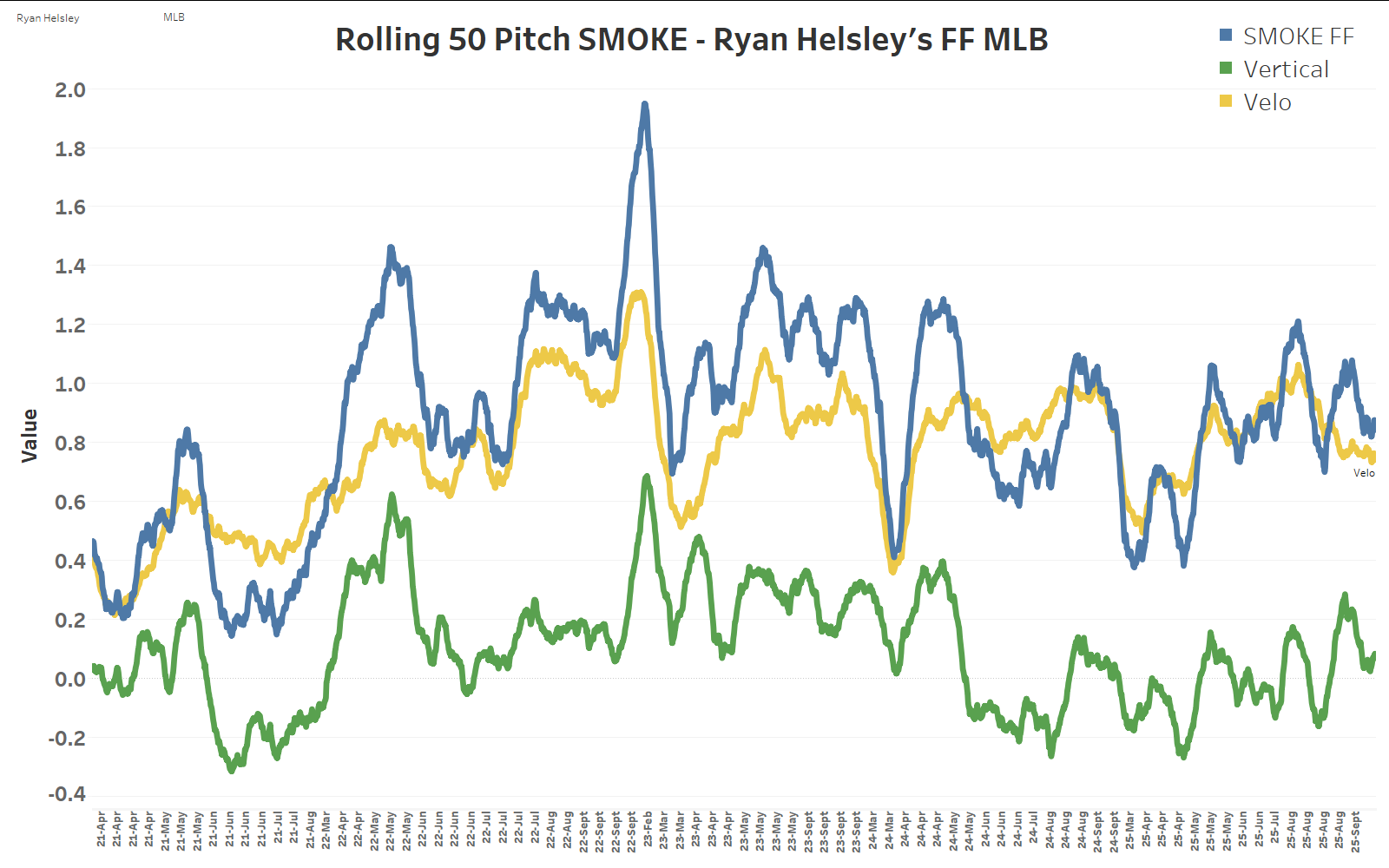
Fastball quality is relatively straightforward to measure. There are two primary components that determine fastball quality: velocity and how much ride the pitch gets compared to a pitcher’s arm slot. The green line indicates how much value Helsley has gotten on his fastball from the shape of the pitch. It was consistently above average from 2022 to early 2024, but he’s mostly been relying on velocity since then.
Pitching is a literal game of inches. Helsley’s 99 mph fastball has elite velocity, but it sits right below the expected vertical ride given his arm slot. If he upped the spin efficiency of the pitch from 89% to 95%, this suddenly becomes one of the deadliest fastballs in the game.
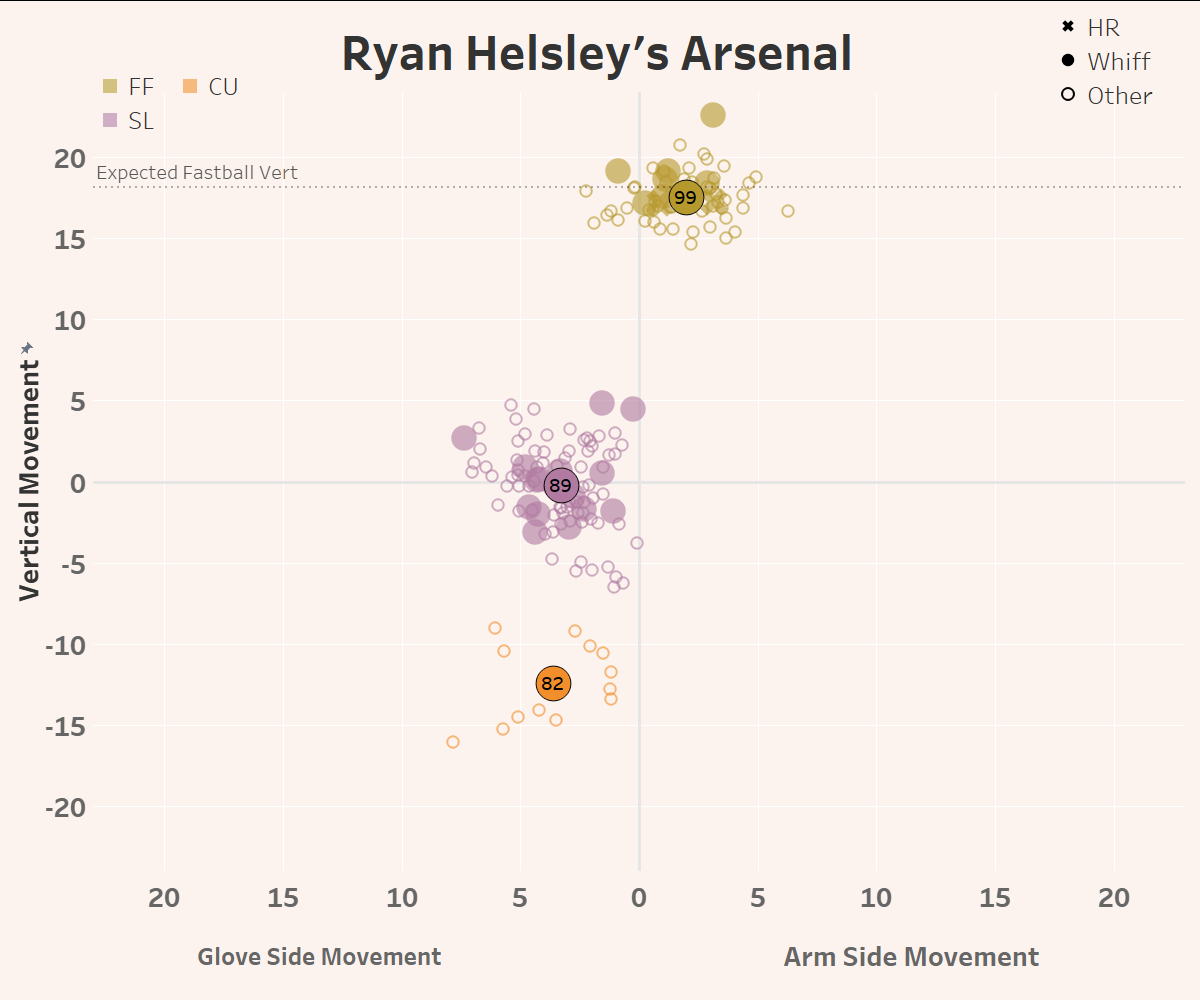
The slider is the money pitch for Helsley, as he gets enormous swing-and-miss with it. There’s a third pitch we’d love to see from Helsley—a Trey Yesavage splitter:
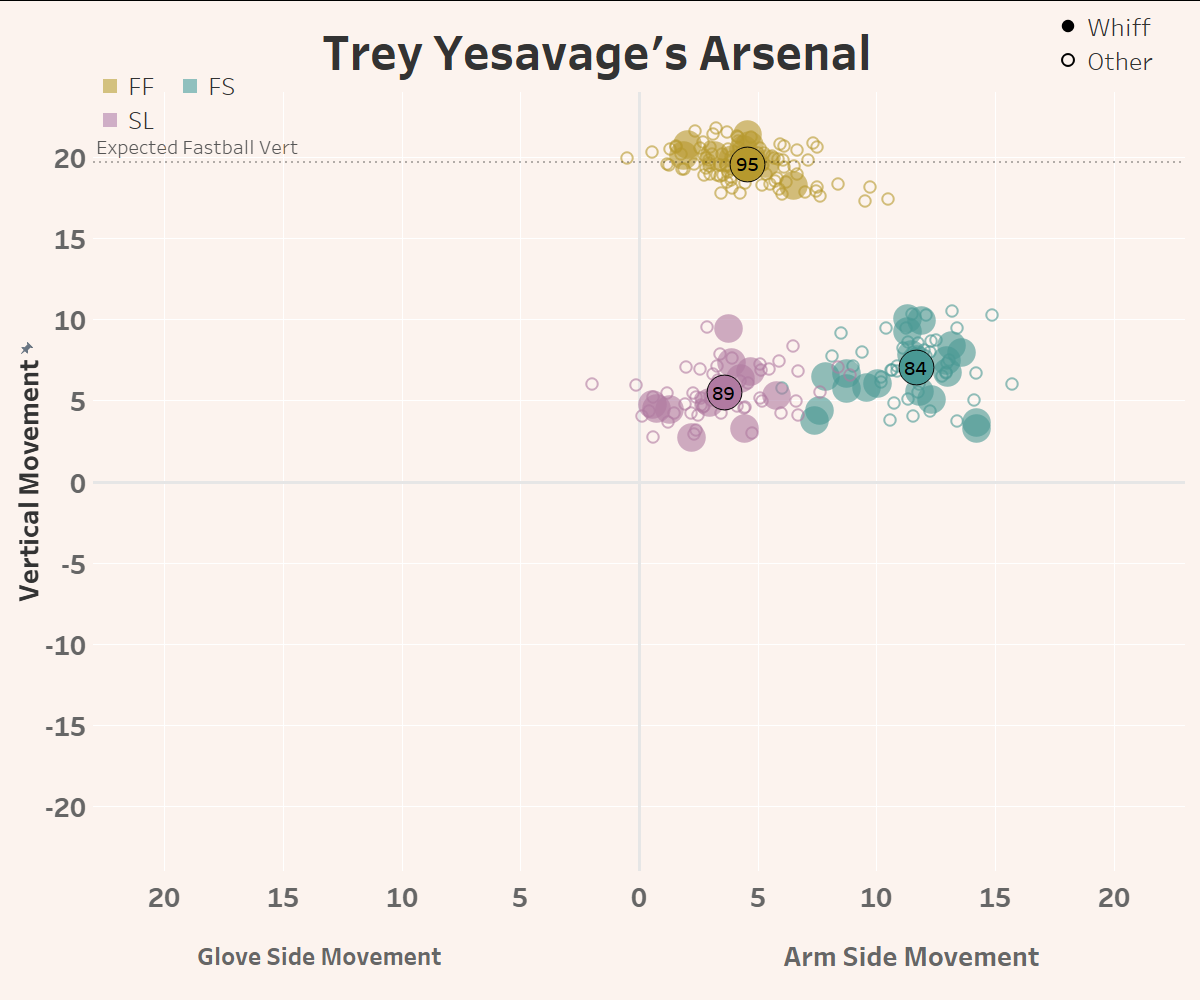
Yesavage has similar properties on his fastball, with similar expected IVB and shape that’s borderline average given their releases. Helsley’s curveball grades out well on stuff models but didn’t really do much for him. A good splitter might be another swing-and-miss weapon and might help the fastball play up.
It’s easy to create a pitch in theory and obviously much harder to do in practice. Ultimately, Helsley has an incredibly high floor given the velocity and dominant slider, but he also has an enormous ceiling if he makes some tweaks to his fastball and an improved third pitch.
4. Robert Suarez, RHP
Projected Contract: 3 Years, $54M
Suarez is quite predictable, in a good way. He throws a fastball or sinker almost 80% of the time, and he’s been consistently effective since coming over from Japan. Over 210 MLB innings, Suarez has struck out 219, pitched to a 2.91 ERA and recorded back-to-back seasons with 36 and 40 saves, showing he can handle the pressure of being the back-of-the-bullpen option.
Suarez would be a great fit for a contending team, either as a setup man or closer.
5. Raisel Iglesias, RHP
Projected Contract: 3 Years, $54M
Iglesias is the canonical example of the value of being a “proven closer”. While some scoff at the notion, there is tremendous value in proving you can handle the pressure of closing out games. Iglesias comfortably projects as a reliable closer with a 3.00 ERA and a solid strikeout rate.
6. Luke Weaver, RHP
Projected Contract: 3 Years, $45M
Weaver may follow in Clay Holmes’ footsteps and sign as a starting pitcher, depending on how the market for his services plays out. He wasn’t quite as dominant this year as he was in 2024, but he proved he could hold down a high-leverage role with strong strikeout rates.
7. Kenley Jansen, RHP
Projected Contract: 1 Year, $15M
Jansen just turned 38 and is coming off the first season in his career in which he failed to crack 10 K/9, falling below a batter an inning. His 24.4% K% was also a career low, and he mostly got by with a career low .195 BABIP.
That all sounds like a guy who might fall off the proverbial cliff. However, Jansen’s carry-cutter is still a unicorn pitch, and it will continue to be effective for the foreseeable future. Cutters are extremely effective at managing contact quality, so even with a reduced strikeout rate, he’ll continue to be a reliable option.
8. Tyler Rogers, RHP
Projected Contract: 3 Years, $44M
Rogers tweaked his sinker before the 2025 season, getting more depth and significantly more seam-shifted wake movement. He also added a tick of velo, averaging 83.8 mph. The result? A primary pitch that he could throw in the zone 64% of the time and give up a .338 slugging rate on contact. That’s an absurd combination, allowing him to limit walks but also not give up any hard contact. Over the last two seasons, Rogers has walked only 13 batters in 148 innings.
This wasn’t luck either. Rogers’ sinker generated an average launch angle of -8 degrees. It also was difficult for batters to hit hard, as evidenced by an average exit velocity of just 86.5 mph. His unique delivery enables him to be absolutely dominant with an 83-84 mph primary pitch and fill the zone without a worry in the world. He should be a target for every single team that has postseason aspirations. There’s a case to be made that he’s the second- or third-best reliever available this offseason.
9. Taylor Rogers, LHP
Projected Contract: 2 Years, $32M
Nature or nurture? The Rogers are identical twins, but they couldn’t be more different as major league pitchers. Whereas Tyler has a unique delivery, Taylor is more traditional. His performance track record is not far off from Iglesias, except that he hasn’t been used as a primary closer since the 2022 season. Such is the fickle nature of the position.
Going forward, he’s probably good enough to close, and is a reliable seventh-inning-or-later option.
10. Emilio Pagan, RHP
Projected Contract: 2 Years, $32M
Pagan emerged as the closer for the Reds, striking out 30% of the batters he faced for back-to-back seasons with a stellar K-BB% above 20%. His challenge mostly rests on preventing home runs, which he’s struggled to do throughout his career. Perpetually underrated, Pagan may have had the perfect contract year to cash in on.