
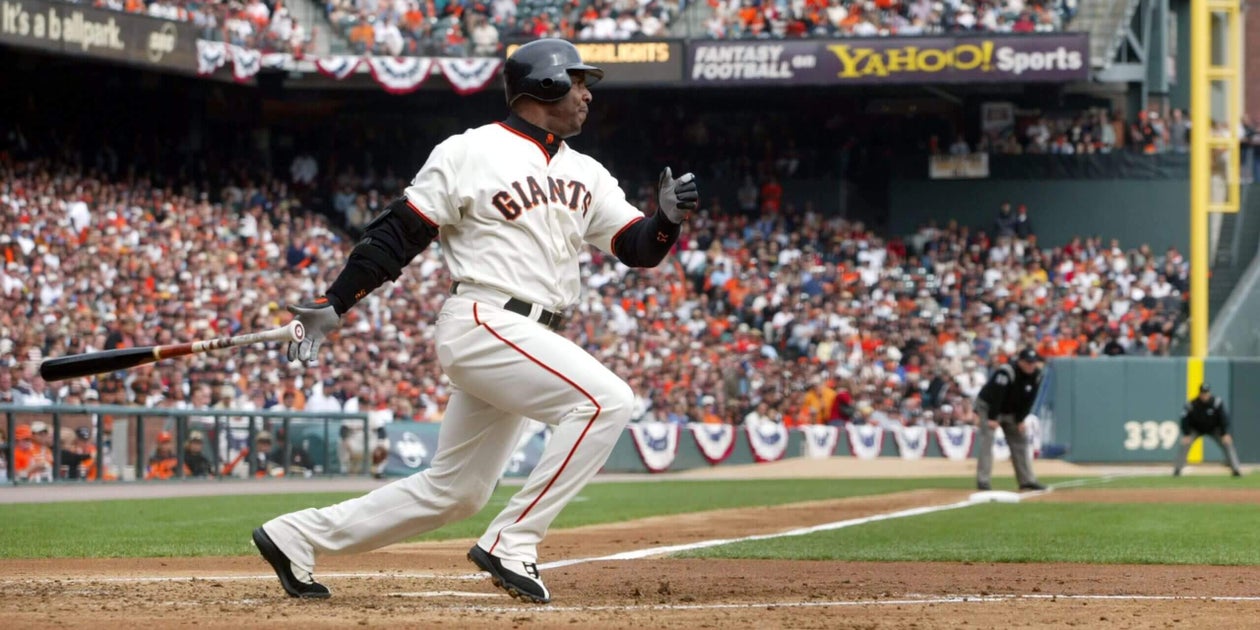
Barry Bonds and Roger Clemens should have been inducted into the Hall of Fame on July 30, 2017, which happens to be the same day former Major League Baseball commissioner Bud Selig received his Cooperstown wings. It would have been an appropriate way to clear the books, to acknowledge that the game enjoyed unprecedented success at the box office during Selig’s more than two decades as commissioner and that Bonds and Clemens did as much as anyone to pack those pews.
I’m using the 2017 induction ceremony as a jumping-off point to this week’s announcement that Bonds and Clemens, the prime representatives from an era in which many players were comically bulked-up and overstuffed thanks to performance-enhancing drugs, are among eight former players on the Hall of Fame’s Contemporary Baseball Era ballot. The others are Carlos Delgado, Jeff Kent, Don Mattingly, Dale Murphy, Gary Sheffield and Fernando Valenzuela. Results will be announced Dec. 7. To be elected, players must receive 75 percent of votes cast by a 16-person committee composed of Hall of Famers, executives and media members. Bonds and Clemens were on the BBWAA ballot for 10 years without coming close to election. They appeared on the 2023 Contemporary Baseball Era ballot, each player receiving fewer than four votes.
The Hall of Fame has released the Contemporary Era player ballot, featuring 8 players eligible to be inducted
-Barry Bonds
-Roger Clemens
-Carlos Delgado
-Jeff Kent
-Don Mattingly
-Dale Murphy
-Gary Sheffield
-Fernando Valenzuela
Who do you think gets inducted? pic.twitter.com/jREc8iFYCg
— Baseball Quotes (@BaseballQuotes1) November 3, 2025
And Selig? His election to the Hall of Fame, announced Dec. 4, 2016, was practically by acclamation. Just two years after stepping down as commissioner, Selig received votes from 15 of the 16 members on the Hall’s Today’s Game Era Committee. No lonely nights sitting by the phone for Bud!
Much was accomplished during Selig’s reign as commissioner, from bringing the wild-card format to the postseason to the league-wide retirement of uniform No. 42 to honor the memory of the trailblazing Jackie Robinson. In 2007, MLB set a single-season attendance record for the fourth straight year, drawing more than 79.5 million fans. Bonus points go to Selig for being a true lover of the game, a quality that’s a lost art in today’s lawyered-up professional sports hierarchy.
But there’s really no getting around this: MLB either didn’t know about all the performance-enhancing drugs that were circulating in baseball, which is laughable, or it did know and did nothing about it. We need to include the media in this discussion as well, right? It’s just that it was MLB raking in the money while Bonds was raking just about everything thrown to him. And as Clemens was striking out hitters, the owners were striking gold.
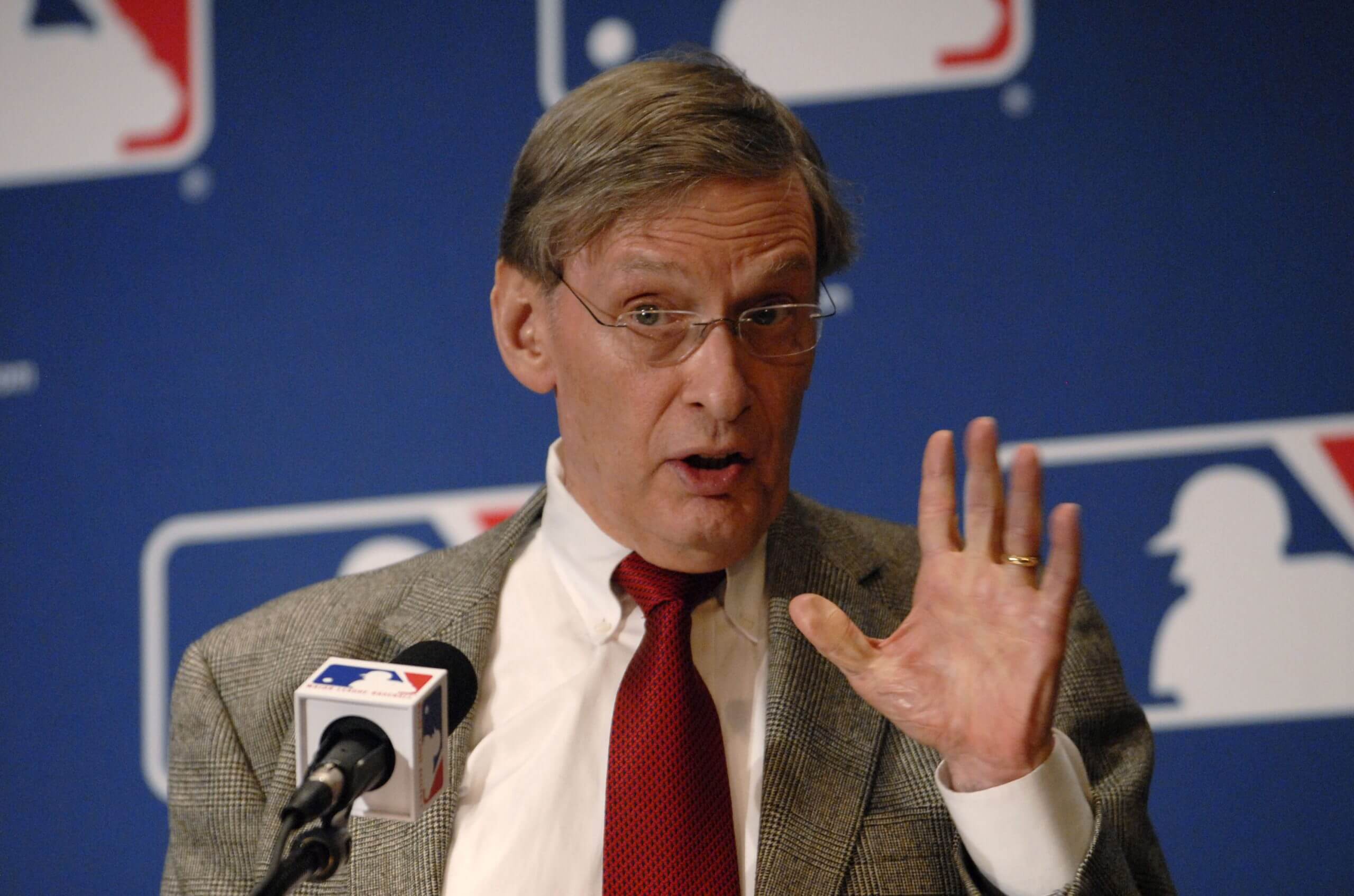
MLB commissioner Bud Selig speaks at a news conference Dec. 13, 2007, after the release of the Mitchell Report on steroid use in baseball. (Jonathan Fickies / Getty Images)
Baseball has always had its troubles, from players getting caught up in gambling scandals in the 19th century to, well, players getting caught up in gambling scandals in the 21st century. If you’ve read Joshua Prager’s “The Echoing Green,” you know that the success of the 1951 New York Giants was as much about illegal sign-stealing as Bobby Thomson’s “Shot Heard ‘Round the World.” And then there are the 2017 Houston Astros and their junior high-level (and yet quite effective, apparently) banging-on-trash-barrel antics to tell their batters what pitch was coming.
It would be simplistic, of course, to throw Bonds, Clemens and the rest of the performance-enhancing drugs guys in there with every other scandal maker in baseball history and then somehow rationalize it as boys being boys. But as an unintended nod to Selig and his introduction of the postseason wild card, there’s a wild card at play in this year’s Hall of Fame debate. The wild card is President Donald Trump.
It was Trump, remember, who earlier this year played a role in a decision by MLB commissioner Rob Manfred (Harvard Law School, Class of 1983) to remove the late Pete Rose from baseball’s “permanently ineligible list,” which could clear a path for Rose to be eligible for Hall of Fame consideration as soon as December 2027. And in August, after Clemens played golf with Trump, the president took to his Truth Social account to call for Clemens to immediately be inducted into the Hall of Fame.
“Put him in NOW,” the president wrote. “He and his great family should not be forced to endure this ‘stupidity’ any longer.”
Wonderful time yesterday at Trump National DC with @POTUS and my son Kacy. @KClemens21
I appreciate the love! DT knows more than anyone the fake news that’s out there. Everyone has their agendas… I played the game to change my family’s direction generationally and to WIN! pic.twitter.com/1GaAVaU6a3
— Roger Clemens (@rogerclemens) August 24, 2025
In that same post, Trump said he received a promise from Manfred to put Rose in the Hall of Fame, but that “it was essentially a promise not kept because he only ‘opened it up’ when Pete died and, even then, he said that Pete Rose only got into the mix because of DEATH. We are not going to let that happen in the case of Roger Clemens.”
Whatever was said, rest assured that any promise to put Rose in the Hall of Fame would be an empty promise because Manfred doesn’t have the power to do so.
Trump hasn’t weighed in on Bonds yet. But today is another day. Either way, Oval Office saber-rattling isn’t likely to enhance either player’s chances of being elected to the Hall of Fame. It might even hurt their cases.
But as most baseball fans know, the Hall of Fame, like life, isn’t always fair. It just isn’t. Consider that former Boston Red Sox right fielder Dwight Evans, with his 385 home runs, .370 OBP, eight Gold Gloves and 67.2 WAR, received next to no support in just three appearances on the BBWAA ballot, came up four votes shy on the 2020 Contemporary Baseball Era ballot and didn’t even make it to the field of eight on this year’s ballot. Evans’ numbers are vastly superior to those of Hall of Famer Harold Baines, who had 384 home runs, a .356 OBP, a meager 38.8 WAR and not only never won a Gold Glove but was enough of a defensive outfield liability as to spend more than half his career as a DH.
That the baseball community has never quite figured out Evans’ value is puzzling. It’s not complicated with Bonds and Clemens: They are two of the game’s all-time great players, but enough people have dismissed them as performance-enhancing drugs cheats, and that’s why they aren’t in the Hall of Fame. We could just as easily include Gary Sheffield in this discussion, except that Bonds and Clemens are inextricably linked as the headliners in this discussion. And they always will be — Cooperstown or no Cooperstown.
But the discussion would make more sense, and provide missing nuance, were it to take place in the Hall of Fame’s Plaque Gallery, where visitors could do one-stop shopping as they mull the careers of Bud Selig … and Barry Bonds and Roger Clemens.